




X Close

Ursula von der Leyen’s EU speech: an exercise in delusion

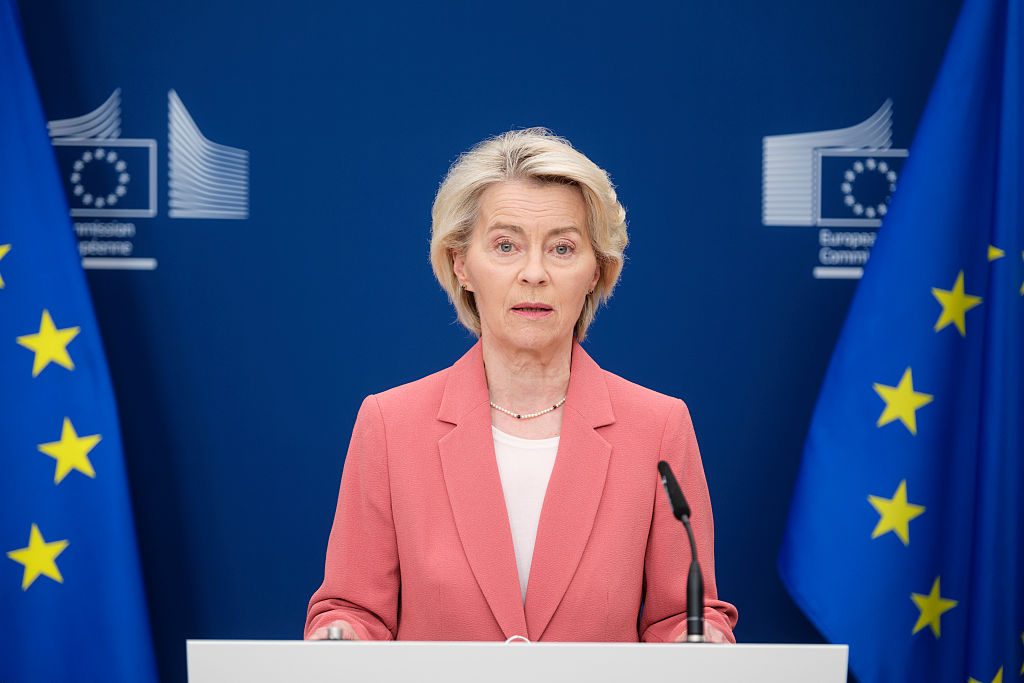
Von der Leyen today offered the same old jargon. Credit: Getty

Von der Leyen today offered the same old jargon. Credit: Getty

10 September 2025 - 1:00pm

Ursula von der Leyen’s 2025 State of the Union speech this morning was a case study in bureaucratic newspeak. It was the usual mixture of hollow promises, technocratic jargon, and moral posturing that the European Commission President has made her trademark.

The speech was filled with the Orwellian vocabulary of freedom, liberty, peace, prosperity and independence — even as the European Union continues to pursue policies which undermine all of these values. The bloc is pushing for militarisation, cracking down on free speech, sabotaging Europe’s economies with self-defeating energy and trade policies, and further subordinating the continent to Washington’s strategic agenda.

As expected, von der Leyen opened with Russia. “Europe is in a fight. A fight for a continent that is whole and at peace… a fight for our future,” she declared, announcing a new “European Defence Semester” and a “clear roadmap” for defence readiness by 2030. She was effectively stating that Europeans should prepare for a future marked by permanent militarisation, including a “drone wall” along the EU’s eastern flank and real-time space surveillance so “no movement of forces goes unseen.” She further pledged a “Qualitative Military Edge” programme for Ukraine and a “Drone Alliance” with Kyiv, partly financed by profits from frozen Russian assets.

Von der Leyen then turned to Israel, with whom the EU has not suspended any trade or cooperation treaties, let alone imposed sanctions. She announced that the Commission would “put our bilateral support to Israel on hold” and proposed sanctions on “extremist ministers and violent settlers”, along with a partial suspension of the Association Agreement. But by targeting only low-level actors and proposing measures requiring unanimous member state approval — a near-impossibility — this amounted to little more than a fig leaf to protect her proclaimed staunch alliance with Israel.

But it was on the economy where the speech truly descended into fantasy. Von der Leyen pledged a start-up fund with the aim of making the EU a leader in the field of tech and AI. Last year’s speech was full of similar promises — hardly any of which have materialised.

Addressing one of the main problems weighing on both European industry and households — high energy prices — she then made the astonishing claim that these were caused by “dependency on Russian fossil fuels”, rather than by Brussels’s decision to cut itself off from affordable Russian gas in favour of far more expensive American LNG. She compounded this distortion by insisting that “Europe is on the path of energy independence”, when in reality the continent has simply traded proximity for distance, becoming even more reliant on imports from far-flung suppliers exposed to volatile global markets.

Von der Leyen drew audible laughter when she proclaimed that “the future of cars, and the cars of the future, must be made in Europe” — a slogan that sounded absurd against the backdrop of stifling EU regulation of the continent’s auto industry. She even defended the recent EU-US trade deal — widely described as a capitulation — as “the best possible deal out there”.

But the most ominous part of the Commission President’s speech came when she spoke of “new tools” to enforce the rule of law and combat “information manipulation” and “disinformation”. To this end, she restated the need for a “European Democracy Shield” and “European Centre for Democratic Resilience” to counter supposed propaganda — foretelling more crackdowns on free speech and criminalisation of dissent, while announcing further EU-sponsored campaigns under the banner of “supporting independent journalism and media literacy”.

Ultimately, von der Leyen’s 2025 State of the Union was less a roadmap for Europe’s future than a catalogue of failures repackaged as triumphs. As usual, it blamed external enemies for Europe’s woes while ignoring the EU’s own supranational model, with its rigid political and economic constraints. By calling for even more centralisation, including an end to unanimity in key policy areas, von der Leyen signalled her intent to double down on the very policies that have weakened Europe. What she offered was not renewal, but more of the same: an ever more militarised, dependent and authoritarian Union.


Thomas Fazi is an UnHerd columnist and translator. His latest book is The Covid Consensus, co-authored with Toby Green.

battleforeurope

China is threatening America in the AI race

Reports sugget Zhipu AI  has released a new model that can rival leading US systems. Credit: Getty

Reports sugget Zhipu AI has released a new model that can rival leading US systems. Credit: Getty

1 July 2026 - 10:18am

China is trying to catch up with America on artificial intelligence. The Wall Street Journal has reported that Zhipu AI — one of China’s six “AI tiger” LLMs — has released a new model that can rival leading US systems, including Anthropic’s Mythos, in cybersecurity tasks such as pinpointing security bugs. While this marks a milestone in China’s drive to catch up with Western AI capabilities, strong performance on a single benchmark does not mean it has taken the lead. Chinese models still lag behind their Western counterparts in broader capabilities, such as autonomous operation. Skepticism is therefore warranted before resorting to hysterical conclusions, but complacency about the geopolitical implications of China’s AI advances would be an even greater mistake.

On the infrastructure side, Chinese AI is still constrained by access to advanced chips, with American labs way ahead in computing capacity as well as investment. Analysis from earlier this year suggests that Chinese models are likely to be at least a few months behind those in the US. But they are still continuing to make progress, or that the geopolitical importance of AI will be decided only by whose LLM has ventured deeper into the technological frontier. The practical applications of AI, countries’ to capture foreign markets, and the application of AI into the real economy will matter just as much.

Here, China may hold an advantage. As with its dominance across many critical supply chains, Beijing may not need to produce the most advanced AI systems — only those that are affordable and widely deployable. In doing so, it could consolidate global influence by supplying functional, low-cost AI at scale.

Beijing seems to be pursuing exactly that path, developing an AI “open-source” strategy that offers affordable, widely available AI models for companies and individuals to use and modify as they wish. The production of the DeepSeek AI model, which matched the performance of Silicon Valley tools such as ChatGPT at a fraction of the cost for users, created goodwill among Chinese models with developers.

The four most popular models on OpenRouter, an AI hardware platform for developers, are now all Chinese. The goal for China is not only to win the frontier-model race, but to make its systems the default layer of AI adoption across industries and global markets. For most economies, the choice is increasingly between an affordable tool they can deploy now and a more robust one that may be out of reach.

And while the countries adopting Chinese models may be exposed to political pressure and cyber threats from Beijing, safer and more capable alternatives matter little if they are unaffordable. American AI companies are already under pressure to monetize products whose operating costs are rising. If Chinese open-source models become the cheap default for startups, universities, governments and businesses across the developing world, then America’s AI lead will be eroded from below.

Perhaps more concerning for America in the long run is how AI can give Chinese manufacturing even more strength, through the ongoing integration of AI as a general-purpose technology. China’s new Five-Year Plan mentioned AI more than 50 times and includes an “AI+” action plan aimed at spreading AI across the economy.

Beijing has been pioneering automation of its critical infrastructure for years, with promising recent results in increasing warplane production capacity. In that regard, China’s open-model strategy and manufacturing dominance will reinforce each other. Cheap, adaptable models accelerate deployment across the real economy while those deployments generate real-world data and use cases that can feed back into further model improvement.

The United States should not dismiss the importance of its lead in the AI race. That lead worries Beijing, not least because a more automated Chinese economy would also become more vulnerable to AI-generated cyber threats. But nor should Washington assume that China cannot catch up with American capabilities over time.

This AI competition represents part of a broader struggle over tech supply chains and geopolitical influence. Decisions over whether to adopt US or Chinese models could produce a more fragmented global reality, with different regions relying on different cloud providers, chips and security structures. The result will likely be a global economy which is divided into competing spheres, rather than one which produces a single winner.


Miquel Vila is a political and geopolitical risk consultant focusing on industrial strategy, critical infrastructure and global supply chains.

miquelvilam