








July 28 2025 - 10:00am
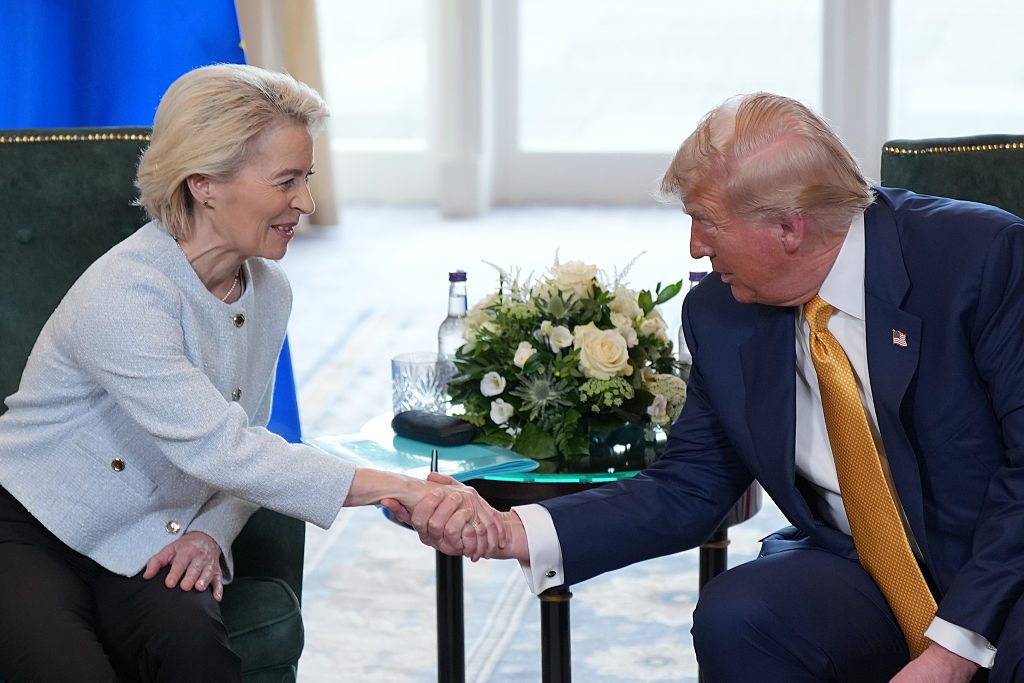
Yesterday, the European Union and the United States finalized a trade agreement imposing a 15% tariff on most EU exports to America — a deal US President Donald Trump triumphantly hailed as “the biggest one of them all”. While the agreement averted an even harsher 30% tariff threatened by Washington, many in Europe are calling it a resounding defeat — or even an unconditional surrender — for Brussels.
It’s easy to see why. The 15% tariff on EU goods entering the US is significantly higher than the 10% that Brussels had hoped to negotiate. Meanwhile, as Trump himself boasted, the EU has “opened up [its] countries at zero tariff” to American exports. Crucially, EU steel and aluminum will continue to face a crushing 50% tariff when sold into the US market.
This asymmetry places European producers at a severe disadvantage, raising costs for strategic industries such as automotive, pharmaceuticals and advanced manufacturing — sectors that underpin the EU’s $1.97 trillion transatlantic trade relationship. The so-called “rebalancing” measures clearly tilt the playing field in favor of the US, forcing European economies to absorb higher costs simply to preserve access to American markets.
Even worse, the EU has committed to $600 billion in new US investments, as well as $750 billion in long-term energy purchases and increased procurement of American military hardware. This further deepens the continent’s structural dependency on US energy supplies and military resources.
The political reaction in Europe has been scathing, with French Minister Benjamin Haddad labeling the agreement “unbalanced”. EU Commission President Ursula von der Leyen tried to present the deal as a pragmatic compromise to avoid an all-out trade war, but few were convinced. As geopolitical commentator Arnaud Bertrand observed on X: “In exchange for all these concessions and extraction of their wealth the EU gets… nothing. This does not even remotely resemble the type of agreements made by two equal sovereign powers. It rather looks like the type of unequal treaties that colonial powers used to impose in the 19th century — except this time, Europe is on the receiving end.”
A few lessons can be drawn. First, the deal should finally shatter the longstanding myth that the EU strengthens its member states by increasing their negotiating power. For decades, Europeans have been told that only by pooling sovereignty into a supranational bloc could they wield enough collective clout to stand up to global powers. This was always a convenient fiction. In reality, the opposite is true: the EU systematically erodes the ability of individual nations to respond flexibly to domestic and external challenges based on their own economic and political priorities. The bloc’s rigid framework — its multilayered and bureaucratic decision-making structure, chronic lack of democratic accountability, and suffocating regulatory overreach — only compounds these weaknesses.
By locking European nations into a supranational straitjacket, Brussels has deprived them of the sovereign tools — industrial policy, trade flexibility, and energy independence — needed to defend their own interests. What’s more, the EU has always been ideologically and strategically wedded to Atlanticism — and its progressive integration with NATO in recent years has only deepened its subordination to the US. This alignment has become embarrassingly apparent under von der Leyen.
As a result, far from making Europe “stronger together”, the EU has delivered an unprecedented loss of leverage and autonomy. The bloc now resembles the very thing it was supposed to overcome: a collection of vassal states, unable to chart an independent course and increasingly reduced to the role of Washington’s economic protectorate.
Trump is not entirely wrong when he accuses the EU of engaging in unfair trade practices. Over the past two decades, Brussels has embraced a hyper-mercantilist, export-driven growth model which systematically suppresses domestic demand in order to bolster price competitiveness on the global stage while keeping imports low. In other words, it has consistently prioritized trade surpluses over internal economic development.
This model has come at a steep cost. European citizens have paid the price through stagnant wages, precarious employment and chronically underfunded public services. Meanwhile, the EU’s trading partners — most notably the US — have been forced to absorb Europe’s ever-growing export surpluses, feeding an increasingly unbalanced global economic relationship.
A rebalancing was indeed long overdue. But this agreement represents the worst possible kind of rebalancing. Instead of using this moment as an opportunity to rethink its fundamentally flawed economic strategy — by raising European wages, boosting internal demand, and accepting that exports might become less competitive as a result — the EU has doubled down on the very model that hollowed out its own economic resilience. Rather than shifting towards a healthier, more domestically-driven growth path, Brussels has chosen to preserve its export-led paradigm at all costs. That now means exposing Europe’s industrial base to a flood of imports, accelerating deindustrialization, and deepening its dependence on foreign markets.
Thomas Fazi is an UnHerd columnist and translator. His latest book is The Covid Consensus, co-authored with Toby Green.
 battleforeurope