



X Close

Tariff deal confirms Europe’s military dependence on US

A losing bet on the US security blanket. Credit: Getty

A losing bet on the US security blanket. Credit: Getty

July 28 2025 - 3:25pm

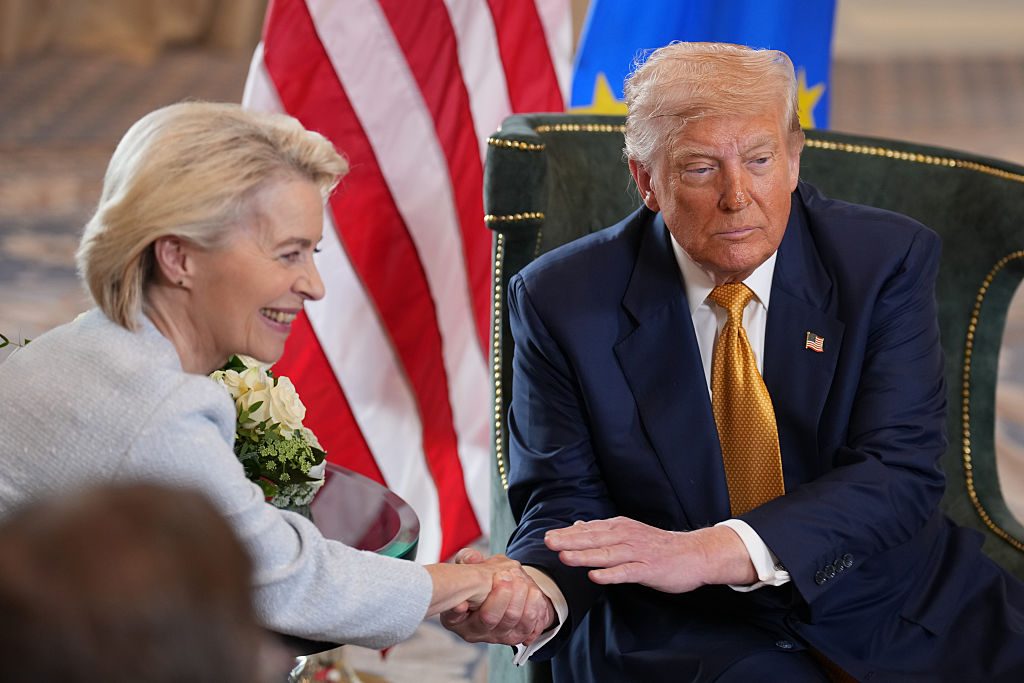
Ursula von der Leyen has helped Europe avoid economic catastrophe — all while doubling down on the continent’s losing bet on America’s security blanket.

Although the tariff deal she struck late on Sunday with Donald Trump — which includes a maximum US tariff of 15% across several import categories, rather than the 30% he had previously threatened — was initially hailed as a win for Europe, dissent has steadily grown since. French Prime Minister François Bayrou called the agreement an act of “submission” to the US, while Hungarian PM and Trump ally Viktor Orbán said the American President had eaten von der Leyen “for breakfast”.

The deal certainly includes several major positives for Europe geopolitically. Besides averting a transatlantic trade war, it also incentivizes European companies to spend big on American energy, opening the door for a desperately needed infusion of liquefied natural gas to replace Russian energy. Militarily, it promises years of weapons sales to the EU, accelerating the arms transfer program Trump approved this month.

Ultimately, the fact that avoiding a worst-case scenario qualifies as a victory for von der Leyen tells us much about the state to which Europe has been reduced.

It’s no secret that Trump’s tariff strategy has always been about coercion. But because Europe is at America’s mercy militarily as well as economically, the tariffs have come to appear less as a demand for hard negotiations and more like an outright ultimatum. The continent cannot hide that it is now wholly dependent on America’s ever-shifting, capricious military umbrella — even though the conditions of its existence have grown more demanding by the month.

Europeans certainly see the link between this latest deal and the continent’s security, and it is no accident that the agreement includes stipulations about significant European investment in American military hardware. Despite appearances, the trade deal is part of a pattern that started at the Nato summit in June, where Europe committed to increasing defense spending to 5% of GDP, and continued with Trump’s decision to transfer weapons to Ukraine this month via European Nato states.

Both of these moments contained nuggets of opportunity for European states, and ultimately led to outcomes that served some of their short-term goals. But in securing these minor wins, they have surrendered the very thing Europe needs to truly thrive in the emerging historical period in which it finds itself: strategic autonomy. And now, however magnanimous Trump’s move to rearm Ukraine may have seemed a few weeks ago, this tariff deal shows that it did not come without heavy strings attached — ones that have now forced Europe to bear the US President’s insult with a smile, with the knowledge that it truly has no other choice.

In a best-case scenario, Sunday’s tariff deal will be enough to satisfy Trump. At worst, however, it will prove to him that Europe remains a malleable plaything for the US, and that debates about future American security support will present fresh opportunities for further extraction. After all, why stop now when Europe has made it clear he has nothing to lose from pushing onward?


Michal Kranz is a freelance journalist reporting on politics, society and defence in Eastern Europe and the Middle East. He runs The Eastern Flank, a Substack newsletter focused on Eastern European geopolitics.
Michal_Kranz

China is threatening America in the AI race

Reports sugget Zhipu AI  has released a new model that can rival leading US systems. Credit: Getty

Reports sugget Zhipu AI has released a new model that can rival leading US systems. Credit: Getty

July 1 2026 - 10:18am

China is trying to catch up with America on artificial intelligence. The Wall Street Journal has reported that Zhipu AI — one of China’s six “AI tiger” LLMs — has released a new model that can rival leading US systems, including Anthropic’s Mythos, in cybersecurity tasks such as pinpointing security bugs. While this marks a milestone in China’s drive to catch up with Western AI capabilities, strong performance on a single benchmark does not mean it has taken the lead. Chinese models still lag behind their Western counterparts in broader capabilities, such as autonomous operation. Skepticism is therefore warranted before resorting to hysterical conclusions, but complacency about the geopolitical implications of China’s AI advances would be an even greater mistake.

On the infrastructure side, Chinese AI is still constrained by access to advanced chips, with American labs way ahead in computing capacity as well as investment. Analysis from earlier this year suggests that Chinese models are likely to be at least a few months behind those in the US. But they are still continuing to make progress, or that the geopolitical importance of AI will be decided only by whose LLM has ventured deeper into the technological frontier. The practical applications of AI, countries’ to capture foreign markets, and the application of AI into the real economy will matter just as much.

Here, China may hold an advantage. As with its dominance across many critical supply chains, Beijing may not need to produce the most advanced AI systems — only those that are affordable and widely deployable. In doing so, it could consolidate global influence by supplying functional, low-cost AI at scale.

Beijing seems to be pursuing exactly that path, developing an AI “open-source” strategy that offers affordable, widely available AI models for companies and individuals to use and modify as they wish. The production of the DeepSeek AI model, which matched the performance of Silicon Valley tools such as ChatGPT at a fraction of the cost for users, created goodwill among Chinese models with developers.

The four most popular models on OpenRouter, an AI hardware platform for developers, are now all Chinese. The goal for China is not only to win the frontier-model race, but to make its systems the default layer of AI adoption across industries and global markets. For most economies, the choice is increasingly between an affordable tool they can deploy now and a more robust one that may be out of reach.

And while the countries adopting Chinese models may be exposed to political pressure and cyber threats from Beijing, safer and more capable alternatives matter little if they are unaffordable. American AI companies are already under pressure to monetize products whose operating costs are rising. If Chinese open-source models become the cheap default for startups, universities, governments and businesses across the developing world, then America’s AI lead will be eroded from below.

Perhaps more concerning for America in the long run is how AI can give Chinese manufacturing even more strength, through the ongoing integration of AI as a general-purpose technology. China’s new Five-Year Plan mentioned AI more than 50 times and includes an “AI+” action plan aimed at spreading AI across the economy.

Beijing has been pioneering automation of its critical infrastructure for years, with promising recent results in increasing warplane production capacity. In that regard, China’s open-model strategy and manufacturing dominance will reinforce each other. Cheap, adaptable models accelerate deployment across the real economy while those deployments generate real-world data and use cases that can feed back into further model improvement.

The United States should not dismiss the importance of its lead in the AI race. That lead worries Beijing, not least because a more automated Chinese economy would also become more vulnerable to AI-generated cyber threats. But nor should Washington assume that China cannot catch up with American capabilities over time.

This AI competition represents part of a broader struggle over tech supply chains and geopolitical influence. Decisions over whether to adopt US or Chinese models could produce a more fragmented global reality, with different regions relying on different cloud providers, chips and security structures. The result will likely be a global economy which is divided into competing spheres, rather than one which produces a single winner.


Miquel Vila is a political and geopolitical risk consultant focusing on industrial strategy, critical infrastructure and global supply chains.

miquelvilam
