




X Close

Zohran Mamdani is watering down his radicalism

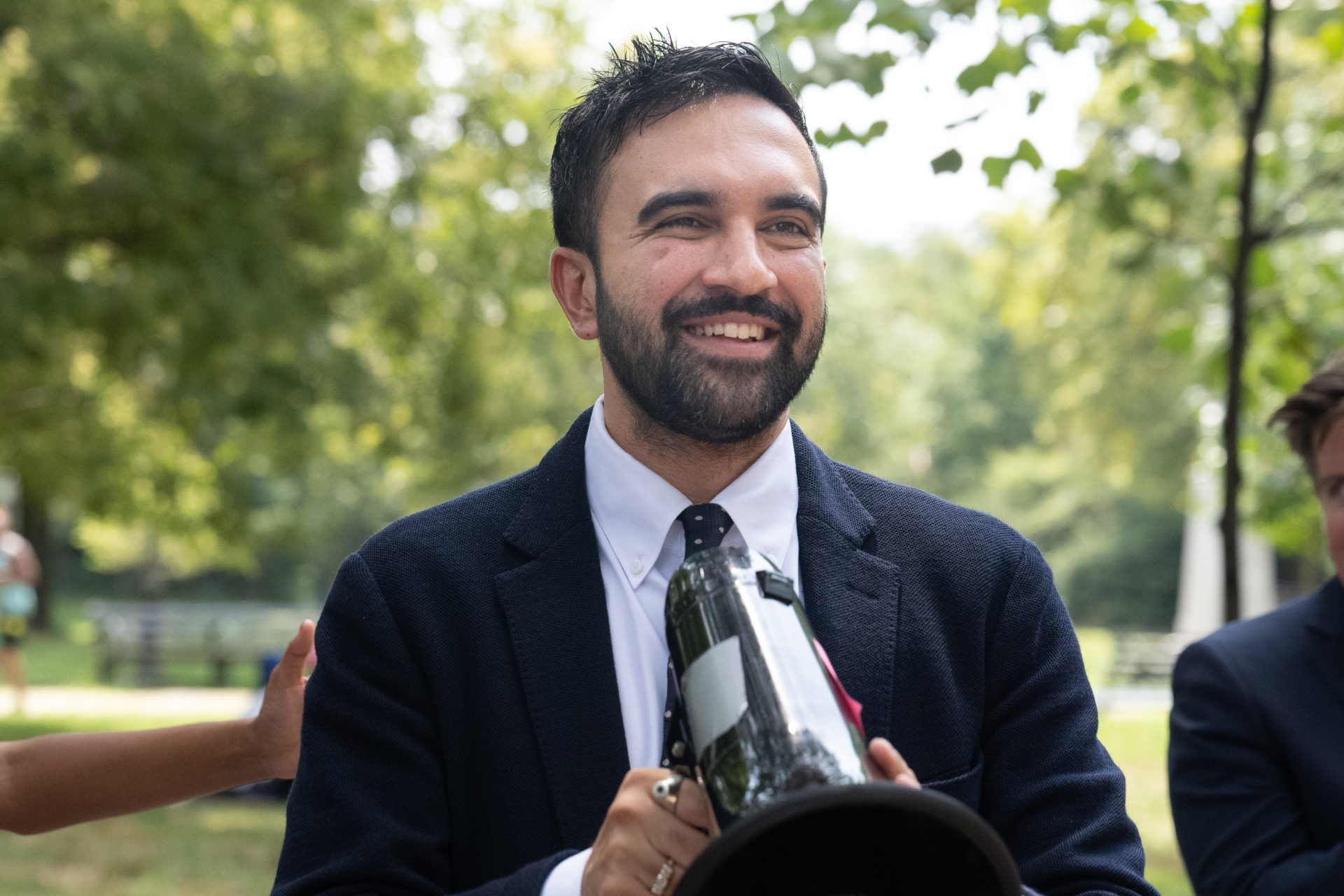
Following in AOC’s footsteps. Credit: Getty.

Following in AOC’s footsteps. Credit: Getty.

August 18 2025 - 6:30pm

When Zohran Mamdani emerged victorious from June’s Democratic primary for New York City mayor, progressive activists celebrated what they saw as a watershed moment for American socialism. Two months later, the revolution appears to be taking a rather familiar detour through the center of Democratic politics.

The 33-year-old state assemblyman, who stormed to the nomination promising free buses and frozen rents, has spent recent weeks courting business leaders, meeting with church congregations, and carefully calibrating his positions. Most notably, he’s walked back his 2020 calls to “defund the police”, now insisting he “will not defund the police” and believes officers have “a critical role to play” in public safety. He has agreed to condemn the phrase “globalize the intifada” after being pressed by Pfizer CEO Albert Bourla at a Partnership for New York City meeting. He also suggested keeping law-and-order-oriented Jessica Tisch as police commissioner, a move guaranteed to further rankle his socialist base.

This Rightward drift shouldn’t surprise anyone who’s followed Democratic politics over the past decade. Alexandria Ocasio-Cortez blazed this particular trail years ago, transforming from insurgent radical into reliable party vote. Her starring role at the 2024 DNC cemented her as a leading Democratic light, but it also signaled her cautious rapprochement with the party’s establishment. Democratic Socialists of America members continue to support her even while the official organization doesn’t, having rescinded its endorsement of her in 2024. Frankly, where else can they go?

Mamdani understands this calculation. His base has limited options: they can back the socialist who’s moderating his positions, or they can watch Andrew Cuomo pick up the keys to Gracie Mansion. Mamdani’s recent speech at an African Methodist Church — in which he pledged to make life in the city “affordable” and “dignified” for everyone — and meetings with business leaders does signal his recognition that governing New York requires more than socialist slogans. The city’s economic foundation rests on industries and interests with which any mayor must engage, regardless of their campaign rhetoric.

Still, policy weakness matters less than one might think. Mamdani’s appeal was never really about sticking to detailed proposals. Young voters facing the prospect of $3,500 studio apartments and AI-racked entry-level job markets don’t particularly care whether their candidate goes to the barricades in support of one set of housing policies or another. They want someone who acknowledges their struggles and promises to fight for them, even if those promises eventually prove hollow.

The dance between Mamdani and establishment Democrats such as Senate minority leader Chuck Schumer and House minority leader Hakeem Jeffries resembles two families negotiating an arranged marriage. Both sides know they’ll have to live together, but they’re still haggling over the fine print. Schumer and Jeffries will eventually endorse Mamdani — they’re party bosses, after all, and can’t simply sit out the general election. But they’re extracting what they can first, forcing Mamdani to shift some of his positions before they’ll embrace him publicly.

And that’s good, because moderation is required. Take housing: as advertised in the primaries, Mamdani’s proposals amount to freezing all stabilized rents, even for those who got lucky with sweetheart deals. In contrast, Cuomo’s recent rent control proposals, including means-testing for rent-stabilized apartments, represent serious, alternative engagement with the city’s housing crisis.

What we’re witnessing is the inevitable collision between socialist aspirations and political reality. Mamdani can promise all he wants, but implementing his policies requires working with a state legislature, navigating union contracts, and managing municipal budgets. The constraints of governance have a remarkable way of moderating even the most radical politicians.

The real question isn’t whether Mamdani will moderate. That process is already underway. It’s whether his base will remember this as a betrayal, or whether they’ll simply accept that this is how politics works in America, where even revolution comes with compromises.


Oliver Bateman is a historian and journalist based in Pittsburgh. He blogs, vlogs, and podcasts at his Substack, Oliver Bateman Does the Work

MoustacheClubUS

China is threatening America in the AI race

Reports sugget Zhipu AI  has released a new model that can rival leading US systems. Credit: Getty

Reports sugget Zhipu AI has released a new model that can rival leading US systems. Credit: Getty

July 1 2026 - 10:18am

China is trying to catch up with America on artificial intelligence. The Wall Street Journal has reported that Zhipu AI — one of China’s six “AI tiger” LLMs — has released a new model that can rival leading US systems, including Anthropic’s Mythos, in cybersecurity tasks such as pinpointing security bugs. While this marks a milestone in China’s drive to catch up with Western AI capabilities, strong performance on a single benchmark does not mean it has taken the lead. Chinese models still lag behind their Western counterparts in broader capabilities, such as autonomous operation. Skepticism is therefore warranted before resorting to hysterical conclusions, but complacency about the geopolitical implications of China’s AI advances would be an even greater mistake.

On the infrastructure side, Chinese AI is still constrained by access to advanced chips, with American labs way ahead in computing capacity as well as investment. Analysis from earlier this year suggests that Chinese models are likely to be at least a few months behind those in the US. But they are still continuing to make progress, or that the geopolitical importance of AI will be decided only by whose LLM has ventured deeper into the technological frontier. The practical applications of AI, countries’ to capture foreign markets, and the application of AI into the real economy will matter just as much.

Here, China may hold an advantage. As with its dominance across many critical supply chains, Beijing may not need to produce the most advanced AI systems — only those that are affordable and widely deployable. In doing so, it could consolidate global influence by supplying functional, low-cost AI at scale.

Beijing seems to be pursuing exactly that path, developing an AI “open-source” strategy that offers affordable, widely available AI models for companies and individuals to use and modify as they wish. The production of the DeepSeek AI model, which matched the performance of Silicon Valley tools such as ChatGPT at a fraction of the cost for users, created goodwill among Chinese models with developers.

The four most popular models on OpenRouter, an AI hardware platform for developers, are now all Chinese. The goal for China is not only to win the frontier-model race, but to make its systems the default layer of AI adoption across industries and global markets. For most economies, the choice is increasingly between an affordable tool they can deploy now and a more robust one that may be out of reach.

And while the countries adopting Chinese models may be exposed to political pressure and cyber threats from Beijing, safer and more capable alternatives matter little if they are unaffordable. American AI companies are already under pressure to monetize products whose operating costs are rising. If Chinese open-source models become the cheap default for startups, universities, governments and businesses across the developing world, then America’s AI lead will be eroded from below.

Perhaps more concerning for America in the long run is how AI can give Chinese manufacturing even more strength, through the ongoing integration of AI as a general-purpose technology. China’s new Five-Year Plan mentioned AI more than 50 times and includes an “AI+” action plan aimed at spreading AI across the economy.

Beijing has been pioneering automation of its critical infrastructure for years, with promising recent results in increasing warplane production capacity. In that regard, China’s open-model strategy and manufacturing dominance will reinforce each other. Cheap, adaptable models accelerate deployment across the real economy while those deployments generate real-world data and use cases that can feed back into further model improvement.

The United States should not dismiss the importance of its lead in the AI race. That lead worries Beijing, not least because a more automated Chinese economy would also become more vulnerable to AI-generated cyber threats. But nor should Washington assume that China cannot catch up with American capabilities over time.

This AI competition represents part of a broader struggle over tech supply chains and geopolitical influence. Decisions over whether to adopt US or Chinese models could produce a more fragmented global reality, with different regions relying on different cloud providers, chips and security structures. The result will likely be a global economy which is divided into competing spheres, rather than one which produces a single winner.


Miquel Vila is a political and geopolitical risk consultant focusing on industrial strategy, critical infrastructure and global supply chains.

miquelvilam