




X Close

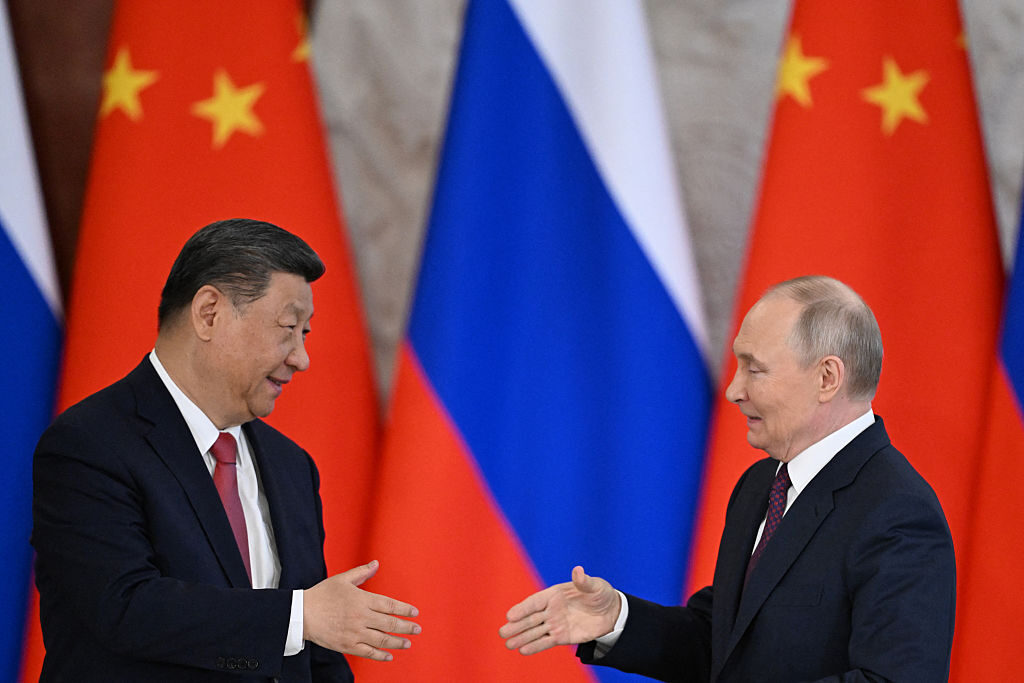
Xi-Putin meeting complicates Trump’s ‘Reverse Nixon’ strategy

Can Trump split them up?
Credit: Getty

Can Trump split them up? Credit: Getty

8 May 2025 - 4:20pm

Arriving in Moscow to commemorate the 80th anniversary of victory in the Second World War, Chinese President Xi Jinping took the opportunity to pen an article in a Russian newspaper, praising how “eighty years ago, the forces of justice around the world, including China and the Soviet Union, united in courageous battles against their common foes”.

China is still coming to the aid of a warring Russia. Xi noted how “in the crucible of the war-torn years […] China, for its part, shipped much-needed strategic supplies to the Soviet Union” and, all those years later, talks between him and Russian leader Vladimir Putin are likely to focus on ensuring Beijing’s continued provision of drones and dual-use components for Russia’s war in Ukraine.

That may not be the end of China’s role in the war, however. While Russian Deputy Foreign Minister Alexander Grushko has criticised the idea as “absolutely inappropriate and absurd”, China may be one of the few countries with both the military resources and Kremlin approval necessary to provide peacekeepers in a post-war scenario, given Russia’s repeated refusal to countenance Western troops being sent to Ukraine. Putin may today be interested in assessing Beijing’s interest in such a prospect.

For his part, Xi will also want to discuss the role of the DPRK in this war. The role of North Korea in the war is known to have made Beijing uneasy. Closer ties between Moscow and Pyongyang reduce Xi’s leverage over the North Korean leader by providing Kim Jong Un with another influential ally. What’s more, China has been concerned that the burgeoning friendship between Putin and Kim may encourage closer co-operation between the US, Japan and South Korea in East Asia, a risk to Beijing’s growing power in the region.

Ukraine is not the only battle on the minds of Xi and Putin. Both are grappling with US economic restrictions, whether sanctions in Russia’s case or Trump’s trade war in China’s. The two leaders will be eager to not only share notes about the best methods for handling the volatile US President but to demonstrate that they are economically beyond America’s control. Strengthening Russia-China economic co-operation will therefore be on the agenda, especially regarding the proposed Power of Siberia 2 pipeline, intended to transport Russian natural gas to China via Mongolia. This would increase Chinese purchases of Russian gas to offset the loss of European market share. However, China has previously insisted that the gas supplied should be at Russia’s heavily subsidised domestic rate. Sources claim that China, clearly hopeful of making progress, is willing to compromise and discuss a higher price.

While a parade commemorating 80 years since victory in the war is likely to be heavy on symbolism, among the pomp and pageantry there will be a message in particular for the US President. Trump has been open about his desire to separate the two countries in what would amount to a “Reverse Nixon” move. In October, he told Tucker Carlson that “the one thing you never want to happen is you never want Russia and China uniting. I’m going to have to un-unite them, and I think I can do that”. Standing side by side in Moscow, Xi and Putin will show that Trump has a lot of work to do.


Bethany Elliott is a writer specialising in Russia and Eastern Europe.

BethanyAElliott

China is threatening America in the AI race

Reports sugget Zhipu AI  has released a new model that can rival leading US systems. Credit: Getty

Reports sugget Zhipu AI has released a new model that can rival leading US systems. Credit: Getty

1 July 2026 - 10:18am

China is trying to catch up with America on artificial intelligence. The Wall Street Journal has reported that Zhipu AI — one of China’s six “AI tiger” LLMs — has released a new model that can rival leading US systems, including Anthropic’s Mythos, in cybersecurity tasks such as pinpointing security bugs. While this marks a milestone in China’s drive to catch up with Western AI capabilities, strong performance on a single benchmark does not mean it has taken the lead. Chinese models still lag behind their Western counterparts in broader capabilities, such as autonomous operation. Skepticism is therefore warranted before resorting to hysterical conclusions, but complacency about the geopolitical implications of China’s AI advances would be an even greater mistake.

On the infrastructure side, Chinese AI is still constrained by access to advanced chips, with American labs way ahead in computing capacity as well as investment. Analysis from earlier this year suggests that Chinese models are likely to be at least a few months behind those in the US. But they are still continuing to make progress, or that the geopolitical importance of AI will be decided only by whose LLM has ventured deeper into the technological frontier. The practical applications of AI, countries’ to capture foreign markets, and the application of AI into the real economy will matter just as much.

Here, China may hold an advantage. As with its dominance across many critical supply chains, Beijing may not need to produce the most advanced AI systems — only those that are affordable and widely deployable. In doing so, it could consolidate global influence by supplying functional, low-cost AI at scale.

Beijing seems to be pursuing exactly that path, developing an AI “open-source” strategy that offers affordable, widely available AI models for companies and individuals to use and modify as they wish. The production of the DeepSeek AI model, which matched the performance of Silicon Valley tools such as ChatGPT at a fraction of the cost for users, created goodwill among Chinese models with developers.

The four most popular models on OpenRouter, an AI hardware platform for developers, are now all Chinese. The goal for China is not only to win the frontier-model race, but to make its systems the default layer of AI adoption across industries and global markets. For most economies, the choice is increasingly between an affordable tool they can deploy now and a more robust one that may be out of reach.

And while the countries adopting Chinese models may be exposed to political pressure and cyber threats from Beijing, safer and more capable alternatives matter little if they are unaffordable. American AI companies are already under pressure to monetize products whose operating costs are rising. If Chinese open-source models become the cheap default for startups, universities, governments and businesses across the developing world, then America’s AI lead will be eroded from below.

Perhaps more concerning for America in the long run is how AI can give Chinese manufacturing even more strength, through the ongoing integration of AI as a general-purpose technology. China’s new Five-Year Plan mentioned AI more than 50 times and includes an “AI+” action plan aimed at spreading AI across the economy.

Beijing has been pioneering automation of its critical infrastructure for years, with promising recent results in increasing warplane production capacity. In that regard, China’s open-model strategy and manufacturing dominance will reinforce each other. Cheap, adaptable models accelerate deployment across the real economy while those deployments generate real-world data and use cases that can feed back into further model improvement.

The United States should not dismiss the importance of its lead in the AI race. That lead worries Beijing, not least because a more automated Chinese economy would also become more vulnerable to AI-generated cyber threats. But nor should Washington assume that China cannot catch up with American capabilities over time.

This AI competition represents part of a broader struggle over tech supply chains and geopolitical influence. Decisions over whether to adopt US or Chinese models could produce a more fragmented global reality, with different regions relying on different cloud providers, chips and security structures. The result will likely be a global economy which is divided into competing spheres, rather than one which produces a single winner.


Miquel Vila is a political and geopolitical risk consultant focusing on industrial strategy, critical infrastructure and global supply chains.

miquelvilam