




X Close

Would a liberal Pope split the Church?

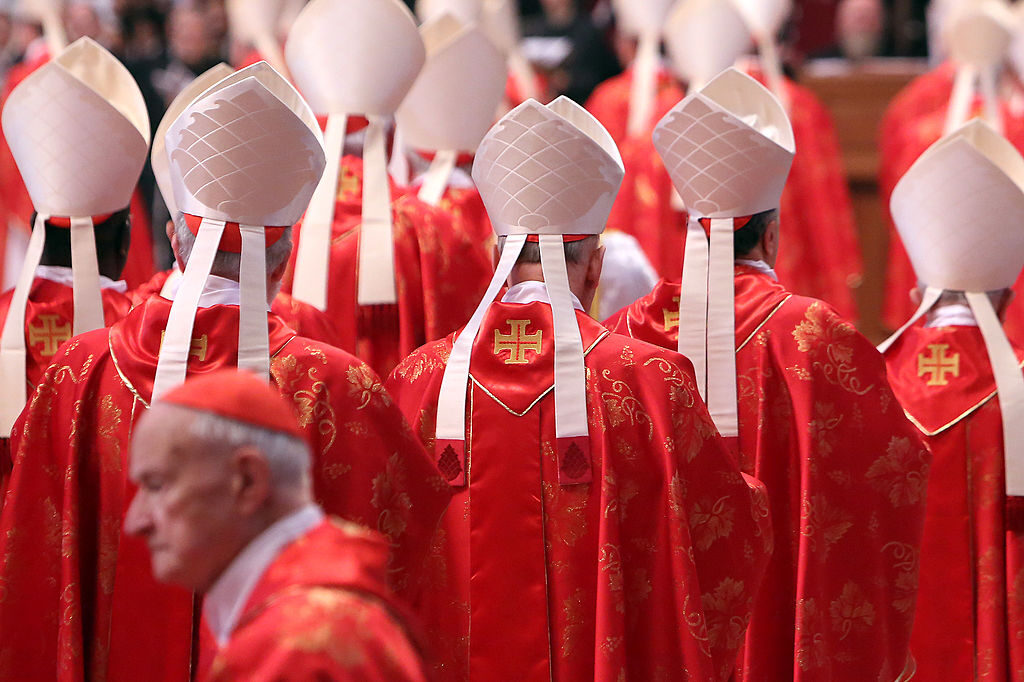
The College of Cardinals can go one of two ways. Credit: Getty

The College of Cardinals can go one of two ways. Credit: Getty

April 25 2025 - 10:00am

One of Pope Francis’s great anxieties over the course of his pontificate was about not provoking divisions. He once told an ally, when discussing their shared plan to soften the Church’s stance on divorce: “If we speak explicitly […] you do not know what a terrible mess we will make. So we won’t speak plainly.” On another occasion, the liberal priest Fr James Martin pressed Francis towards some course of action, in Fr Martin’s words, “about LGBTQ stuff. And he said: ‘Yeah, that’s a good idea. But if I do that, I will provoke a chain reaction.’”

In the end, this subterfuge and caution failed to achieve its intended effect. On those two issues and many more, the Francis era was one of violent division, with cardinals denouncing each other and whole national bishops’ conferences adopting diametrically opposite policies, while the Vatican issued increasingly confusing statements — and occasionally retracted them — in an attempt to keep the lid on.

All of which leads to an obvious question: how might the outcome of the forthcoming papal conclave worsen, or alleviate, those divisions?

Straight out of the blocks comes Cardinal Gerhard Müller, who served as the Vatican’s doctrine chief under Benedict XVI and Francis, but eventually fell out with the latter. According to the Times, Müller has warned that “The Catholic Church risks a schism if it elects another liberal leader like Pope Francis.” The paper doesn’t quote Müller’s actual words on this point: you are left to wonder, for a start, if he predicted a formal schism or just further internal hostilities. Still, it raises a timely point.

Müller’s warning, coming as it does from a fairly conservative voice, might seem rather too convenient. And, in truth, any pope will have to govern — or attempt to govern — a Church whose divisions are beyond any compromise. An example from this week: two days after Francis’s death, the ultra-liberal German bishops published guidelines on “blessing ceremonies” for same-sex relationships, divorced and remarried couples, and others who are outside the bounds of sacramental marriage. Dozens of other bishops’ associations have already said this is flatly incompatible with the Catholic faith; the Vatican, under Francis, also said so, before sort-of retracting the statement and then sort-of retracting the retraction. Expect this one to run and run.

Catholics sometimes complain that the media portrayal of a Church divided between “liberals” and “conservatives” is a caricature; but it isn’t a total caricature. There really are very different understandings, not just of the much-publicised questions around sex and gender, but over the liturgy, the workings of Church authority, and even the fundamental nature of Jesus’ message. And while the world expects the Church to become more liberal on such questions, committed Catholics — especially younger ones — are getting much more conservative. Those differences are becoming more explicit, more intractable, just as the papacy itself is becoming, in practice, a weaker center of unity.

Even so, Cardinal Müller has a point: a more progressive Pope would probably bring the greater risk of further division. That is one lesson of the Francis years. Because the Pope gave the impression of being progressive, he would excite huge expectations of dramatic change. And because liberal Catholics tend to be unclear, even in their own minds, perhaps, about how far they can go, that situation is inherently unstable.

Imagine a progressive Pope says he wants more recognition for women in the Church. Does he mean the Church should address the exploitation of nuns as cheap labor? Does he mean it would be nice to have some more laywomen in the upper reaches of the Vatican bureaucracy? Does he want to create some strictly non-sacramental role of “deaconess”? Or does he want to open the door to ordaining women priests? Or, eventually, to completely revising the institution of the priesthood as hopelessly mired in patriarchy?

In such circumstances, the conservatives feel everything as a threat, the progressives think this is their great chance to push things as far as they can go, nobody trusts what anybody one step to their left is saying, and the result is an almighty brawl.

There is, then, one purely practical advantage to a conservative pope: he can shrug his shoulders and say that the Church’s traditional teaching is clear and it’s not his to meddle with. It doesn’t stop the conflicts. But it does have a way of turning down the temperature.


Dan Hitchens is Senior Editor of First Things and co-author of the forthcoming Cambridge Introduction to Samuel Johnson.

ddhitchens

China is threatening America in the AI race

Reports sugget Zhipu AI  has released a new model that can rival leading US systems. Credit: Getty

Reports sugget Zhipu AI has released a new model that can rival leading US systems. Credit: Getty

July 1 2026 - 10:18am

China is trying to catch up with America on artificial intelligence. The Wall Street Journal has reported that Zhipu AI — one of China’s six “AI tiger” LLMs — has released a new model that can rival leading US systems, including Anthropic’s Mythos, in cybersecurity tasks such as pinpointing security bugs. While this marks a milestone in China’s drive to catch up with Western AI capabilities, strong performance on a single benchmark does not mean it has taken the lead. Chinese models still lag behind their Western counterparts in broader capabilities, such as autonomous operation. Skepticism is therefore warranted before resorting to hysterical conclusions, but complacency about the geopolitical implications of China’s AI advances would be an even greater mistake.

On the infrastructure side, Chinese AI is still constrained by access to advanced chips, with American labs way ahead in computing capacity as well as investment. Analysis from earlier this year suggests that Chinese models are likely to be at least a few months behind those in the US. But they are still continuing to make progress, or that the geopolitical importance of AI will be decided only by whose LLM has ventured deeper into the technological frontier. The practical applications of AI, countries’ to capture foreign markets, and the application of AI into the real economy will matter just as much.

Here, China may hold an advantage. As with its dominance across many critical supply chains, Beijing may not need to produce the most advanced AI systems — only those that are affordable and widely deployable. In doing so, it could consolidate global influence by supplying functional, low-cost AI at scale.

Beijing seems to be pursuing exactly that path, developing an AI “open-source” strategy that offers affordable, widely available AI models for companies and individuals to use and modify as they wish. The production of the DeepSeek AI model, which matched the performance of Silicon Valley tools such as ChatGPT at a fraction of the cost for users, created goodwill among Chinese models with developers.

The four most popular models on OpenRouter, an AI hardware platform for developers, are now all Chinese. The goal for China is not only to win the frontier-model race, but to make its systems the default layer of AI adoption across industries and global markets. For most economies, the choice is increasingly between an affordable tool they can deploy now and a more robust one that may be out of reach.

And while the countries adopting Chinese models may be exposed to political pressure and cyber threats from Beijing, safer and more capable alternatives matter little if they are unaffordable. American AI companies are already under pressure to monetize products whose operating costs are rising. If Chinese open-source models become the cheap default for startups, universities, governments and businesses across the developing world, then America’s AI lead will be eroded from below.

Perhaps more concerning for America in the long run is how AI can give Chinese manufacturing even more strength, through the ongoing integration of AI as a general-purpose technology. China’s new Five-Year Plan mentioned AI more than 50 times and includes an “AI+” action plan aimed at spreading AI across the economy.

Beijing has been pioneering automation of its critical infrastructure for years, with promising recent results in increasing warplane production capacity. In that regard, China’s open-model strategy and manufacturing dominance will reinforce each other. Cheap, adaptable models accelerate deployment across the real economy while those deployments generate real-world data and use cases that can feed back into further model improvement.

The United States should not dismiss the importance of its lead in the AI race. That lead worries Beijing, not least because a more automated Chinese economy would also become more vulnerable to AI-generated cyber threats. But nor should Washington assume that China cannot catch up with American capabilities over time.

This AI competition represents part of a broader struggle over tech supply chains and geopolitical influence. Decisions over whether to adopt US or Chinese models could produce a more fragmented global reality, with different regions relying on different cloud providers, chips and security structures. The result will likely be a global economy which is divided into competing spheres, rather than one which produces a single winner.


Miquel Vila is a political and geopolitical risk consultant focusing on industrial strategy, critical infrastructure and global supply chains.

miquelvilam