




X Close

Will Keir Starmer become the secretary general of the UN?

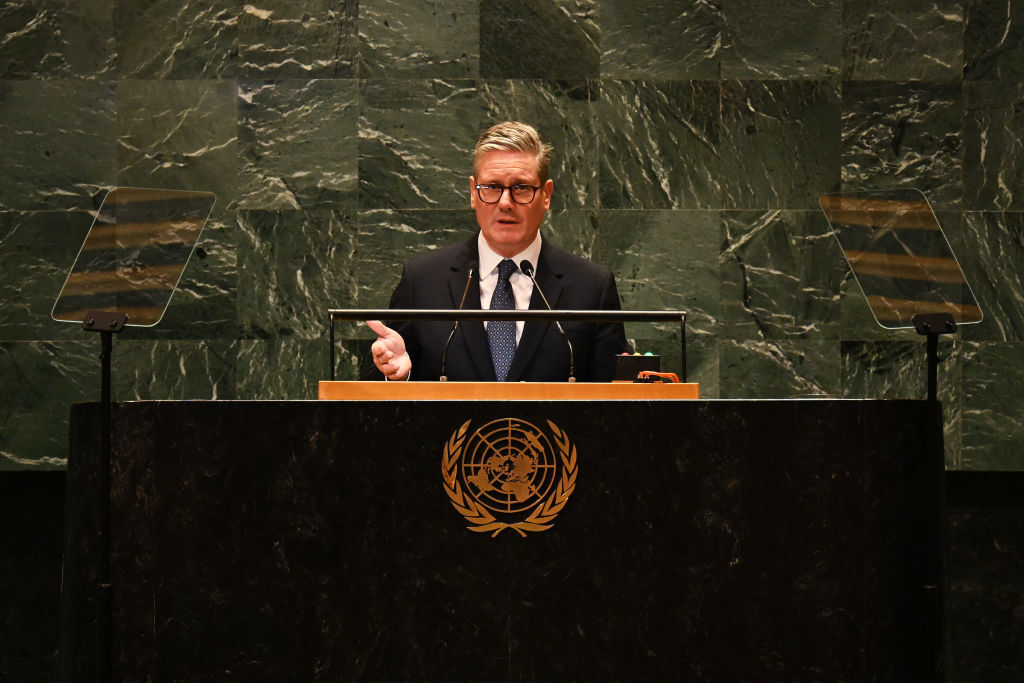
Keir has been tipped for an international role after his time in No. 10. Credit: Getty

Keir has been tipped for an international role after his time in No. 10. Credit: Getty

25 June 2026 - 7:00am

In 2023, Emily Maitlis asked Keir Starmer the question that revealed more about his failed premiership than any other: which does he prefer, Davos or Westminster? For most politicians, the choice between plutocrats in the Swiss Alps and the home of our national democracy would be obvious — at least when the cameras are rolling. But not for Starmer, who said he preferred the après-ski to spending time with fellow MPs.

Starmer’s answer revealed that Labour had a leader, and we would soon have a Prime Minister, who was almost uniquely ill at ease with Westminster politics. After he announced that he would step down as Prime Minister earlier this week, it will at least soon become clear that he will be relieved of the burden of pretending otherwise.

So what next for Starmer? According to the Guardian, he will remain as an MP until the end of his term, but we’d be wise to take that with a pinch of salt. David Cameron, who actually appeared to enjoy being an MP and prime minister, said the same when he resigned in 2016. He lasted just a few months before triggering a by-election. An early contest in Holborn & St Pancras could still prove, for Starmer’s successor, a condition of the lease for N0. 10.

Were he to stay in Parliament, of the eight other members of the no-longer-very-exclusive club of former prime ministers, he will only be joined on the House of Commons benches by Rishi Sunak. Former prime ministers are pretty thin in the House of Lords too, their historic retirement home, as only David Cameron and Theresa May have taken peerages, and few expect Starmer to join them.

If he wishes to keep the grander aspects of office, however, Starmer might transition from domestic politics to the international scene. Already, it is being reported that he could be the next secretary general of the United Nations. He would be the first British holder of that office since the role was properly formed. And if that sounds a remarkable over-promotion for our defenestrated prime minister, he’s got form for rising to the top with breathtaking ease.

If the decision-makers at the UN feel towards him as Labour MPs do, however, then more junior roles — like chief prosecutor at the International Criminal Court — could attract the former Director of Public Prosecutions. This might suit both Starmer’s unpolitical instincts as well as his successor, who will be keen to leave behind the shadow of the past two years. In either role, Starmer would be out of the country, no more than an intermittent figure on the fringes of British politics.

While some former prime ministers have chosen to appoint themselves troublemaker-in-chief for their successors, Starmer seems less likely to do so. Gordon Brown agitated for the scrapping of the two-child benefit cap while Starmer was removing the whip from Labour MPs who voted to do so. Starmer subsequently changed his mind and now lists the move as one of the proudest achievements. And as the vultures prepared to swoop after this year’s local elections, Tony Blair penned an essay diagnosing the ills of the government — and effectively triggered the debate about what Labour, post-Starmer, should do.

Labour’s next prime minister will almost certainly still need to wrestle with Blair and Brown (for Burnham, two former bosses), but it is hard to imagine Starmer being such a boisterous ex-PM. After all, what ideas would he advocate for? If anybody knew — if he knew — then he may not have just resigned as prime minister. So whether Starmer’s post-premiership is spent in Parliament, or on the outer reaches of international technocracy, his departure from No. 10 and from the frontlines of Britain’s political life are likely to be the same. A man without vision, strategy, or panache will make for an underwhelming elder statesman.


Lee David Evans is an historian of the Conservative Party and the John Ramsden Fellow at the Mile End Institute at Queen Mary, University of London. He is the author of Coronations & Defenestration: Choosing (and losing) Tory Leaders and the co-host of the podcast Since Attlee & Churchill.

LeeDavidEvansUK

China is threatening America in the AI race

Reports sugget Zhipu AI  has released a new model that can rival leading US systems. Credit: Getty

Reports sugget Zhipu AI has released a new model that can rival leading US systems. Credit: Getty

1 July 2026 - 10:18am

China is trying to catch up with America on artificial intelligence. The Wall Street Journal has reported that Zhipu AI — one of China’s six “AI tiger” LLMs — has released a new model that can rival leading US systems, including Anthropic’s Mythos, in cybersecurity tasks such as pinpointing security bugs. While this marks a milestone in China’s drive to catch up with Western AI capabilities, strong performance on a single benchmark does not mean it has taken the lead. Chinese models still lag behind their Western counterparts in broader capabilities, such as autonomous operation. Skepticism is therefore warranted before resorting to hysterical conclusions, but complacency about the geopolitical implications of China’s AI advances would be an even greater mistake.

On the infrastructure side, Chinese AI is still constrained by access to advanced chips, with American labs way ahead in computing capacity as well as investment. Analysis from earlier this year suggests that Chinese models are likely to be at least a few months behind those in the US. But they are still continuing to make progress, or that the geopolitical importance of AI will be decided only by whose LLM has ventured deeper into the technological frontier. The practical applications of AI, countries’ to capture foreign markets, and the application of AI into the real economy will matter just as much.

Here, China may hold an advantage. As with its dominance across many critical supply chains, Beijing may not need to produce the most advanced AI systems — only those that are affordable and widely deployable. In doing so, it could consolidate global influence by supplying functional, low-cost AI at scale.

Beijing seems to be pursuing exactly that path, developing an AI “open-source” strategy that offers affordable, widely available AI models for companies and individuals to use and modify as they wish. The production of the DeepSeek AI model, which matched the performance of Silicon Valley tools such as ChatGPT at a fraction of the cost for users, created goodwill among Chinese models with developers.

The four most popular models on OpenRouter, an AI hardware platform for developers, are now all Chinese. The goal for China is not only to win the frontier-model race, but to make its systems the default layer of AI adoption across industries and global markets. For most economies, the choice is increasingly between an affordable tool they can deploy now and a more robust one that may be out of reach.

And while the countries adopting Chinese models may be exposed to political pressure and cyber threats from Beijing, safer and more capable alternatives matter little if they are unaffordable. American AI companies are already under pressure to monetize products whose operating costs are rising. If Chinese open-source models become the cheap default for startups, universities, governments and businesses across the developing world, then America’s AI lead will be eroded from below.

Perhaps more concerning for America in the long run is how AI can give Chinese manufacturing even more strength, through the ongoing integration of AI as a general-purpose technology. China’s new Five-Year Plan mentioned AI more than 50 times and includes an “AI+” action plan aimed at spreading AI across the economy.

Beijing has been pioneering automation of its critical infrastructure for years, with promising recent results in increasing warplane production capacity. In that regard, China’s open-model strategy and manufacturing dominance will reinforce each other. Cheap, adaptable models accelerate deployment across the real economy while those deployments generate real-world data and use cases that can feed back into further model improvement.

The United States should not dismiss the importance of its lead in the AI race. That lead worries Beijing, not least because a more automated Chinese economy would also become more vulnerable to AI-generated cyber threats. But nor should Washington assume that China cannot catch up with American capabilities over time.

This AI competition represents part of a broader struggle over tech supply chains and geopolitical influence. Decisions over whether to adopt US or Chinese models could produce a more fragmented global reality, with different regions relying on different cloud providers, chips and security structures. The result will likely be a global economy which is divided into competing spheres, rather than one which produces a single winner.


Miquel Vila is a political and geopolitical risk consultant focusing on industrial strategy, critical infrastructure and global supply chains.

miquelvilam