




X Close

Will Joe Biden intervene in Venezuela’s election?

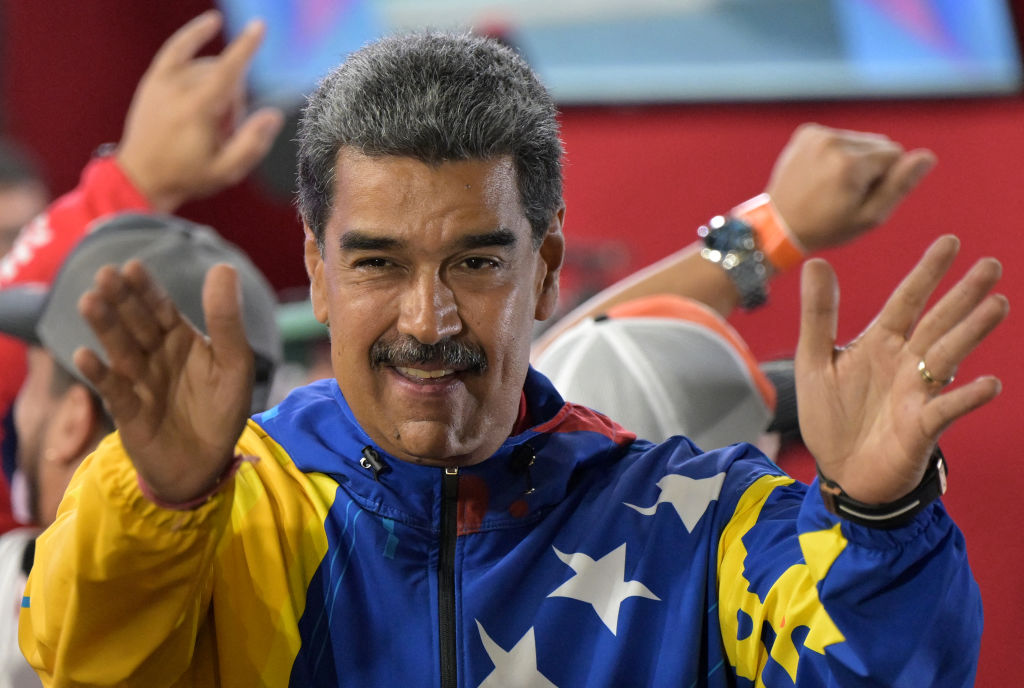
Nicolás Maduro won a disputed victory on Sunday. Credit: Getty

Nicolás Maduro won a disputed victory on Sunday. Credit: Getty

31 July 2024 - 12:00pm

Just days before Venezuela’s presidential election, President Nicolás Maduro warned of a “bloodbath” if the people did not recognise his results. Minister of Defence Vladimir Padrino echoed the intimidation, saying that all those engaged in “electoral terrorism” would face “100 years in jail”. Meanwhile, all the polls gave Edmundo González, the opposition’s candidate, a significant advantage over Maduro. So should we be surprised by the outcome?

It was a fraught election from the start. The official leader of the democratic opposition, María Corina Machado, chose ex-diplomat González as her proxy because she has been banned from running for office since the start of the year. Despite Machado winning the hearts and minds of the overwhelming majority of Venezuelans, the National Electoral Council proclaimed Maduro the winner on Sunday, with 51.2% of the vote against 44.2% for the opposition candidate.

Since then, Machado’s team has recovered around 80% of the tallies, ostensibly giving González a victory with more than 70% of the vote. They have been digitised and made available to the public: all a Venezuelan has to do is type in their ID number and they can see their centre’s result.

A friend of mine was part of the team of people digitalising all this data, by hand, in a limited number of Epson scanners. It is cyber citizenship working to its limits — this is a global electoral monitoring system, an example of how to fight autocracies and defend the will of the people in the era of big data.

The picture looks different from Maduro’s side. There is now a signed order to arrest Machado, and the military and police forces have started to repress the spontaneous protests and opened fire on civilians. The regime had a choice, and it has taken the road of widespread and violent repression in the manner of Cuba and Nicaragua. It will try to build a fortress, turn off the lights, and asphyxiate its people. There are small glimpses of hope, with some policemen and women taking off their official uniform shirts and joining the protests in a remote town in the east of Venezuela: clearly, not all forces are willing to follow commands.

Machado was last seen on the morning of 30 June, greeting her supporters from the top of a truck, in full view and unprotected. A couple of blocks down from her meeting point in Caracas, an influential opposition figure was arrested. According to leaked information, he is being tortured so that he might “confess” to leading an alleged electoral coup, precisely the narrative the government has been trying to defend.

Meanwhile, social media has turned into a fecund soil of warnings and messages of support in favour of the spontaneous protests taking place in Venezuela, and of Machado’s efforts to challenge the fraudulent results.

Where is the US in all this? Joe Biden’s position on Venezuela has been ambivalent and changeable: negotiations in Barbados, followed by partial suspension of sanctions, and back to table talk. It’s hard, then, to predict what America will do next, though Antony Blinken has claimed that “it looks like” the official results don’t represent the will of the country’s people. In light of the massive turnout — the biggest in Venezuela’s democratic history — and the ongoing repression, the US Secretary of State seems to be speaking to Maduro wearing silk gloves.

Donald Trump spoke out against the present Venezuelan regime in 2019; will he do it again if he wins in November? If Maduro stays in power, the exodus of Venezuelans will not just persist but intensify. Trump seems to have a soft spot for the country and its people, but domestic pressures will be significant, and America’s own borders will no doubt come first.

One thing is clear: Sunday’s results are the mirror of the popular will, the same will that gathered and supported the democratic alternative these last couple of months. Active and passive resistance will continue. Venezuela has woken up.

Dr. Paola Romero, born and raised in Venezuela, currently teaches philosophy at the London School of Economics.


China is threatening America in the AI race

Reports sugget Zhipu AI  has released a new model that can rival leading US systems. Credit: Getty

Reports sugget Zhipu AI has released a new model that can rival leading US systems. Credit: Getty

1 July 2026 - 10:18am

China is trying to catch up with America on artificial intelligence. The Wall Street Journal has reported that Zhipu AI — one of China’s six “AI tiger” LLMs — has released a new model that can rival leading US systems, including Anthropic’s Mythos, in cybersecurity tasks such as pinpointing security bugs. While this marks a milestone in China’s drive to catch up with Western AI capabilities, strong performance on a single benchmark does not mean it has taken the lead. Chinese models still lag behind their Western counterparts in broader capabilities, such as autonomous operation. Skepticism is therefore warranted before resorting to hysterical conclusions, but complacency about the geopolitical implications of China’s AI advances would be an even greater mistake.

On the infrastructure side, Chinese AI is still constrained by access to advanced chips, with American labs way ahead in computing capacity as well as investment. Analysis from earlier this year suggests that Chinese models are likely to be at least a few months behind those in the US. But they are still continuing to make progress, or that the geopolitical importance of AI will be decided only by whose LLM has ventured deeper into the technological frontier. The practical applications of AI, countries’ to capture foreign markets, and the application of AI into the real economy will matter just as much.

Here, China may hold an advantage. As with its dominance across many critical supply chains, Beijing may not need to produce the most advanced AI systems — only those that are affordable and widely deployable. In doing so, it could consolidate global influence by supplying functional, low-cost AI at scale.

Beijing seems to be pursuing exactly that path, developing an AI “open-source” strategy that offers affordable, widely available AI models for companies and individuals to use and modify as they wish. The production of the DeepSeek AI model, which matched the performance of Silicon Valley tools such as ChatGPT at a fraction of the cost for users, created goodwill among Chinese models with developers.

The four most popular models on OpenRouter, an AI hardware platform for developers, are now all Chinese. The goal for China is not only to win the frontier-model race, but to make its systems the default layer of AI adoption across industries and global markets. For most economies, the choice is increasingly between an affordable tool they can deploy now and a more robust one that may be out of reach.

And while the countries adopting Chinese models may be exposed to political pressure and cyber threats from Beijing, safer and more capable alternatives matter little if they are unaffordable. American AI companies are already under pressure to monetize products whose operating costs are rising. If Chinese open-source models become the cheap default for startups, universities, governments and businesses across the developing world, then America’s AI lead will be eroded from below.

Perhaps more concerning for America in the long run is how AI can give Chinese manufacturing even more strength, through the ongoing integration of AI as a general-purpose technology. China’s new Five-Year Plan mentioned AI more than 50 times and includes an “AI+” action plan aimed at spreading AI across the economy.

Beijing has been pioneering automation of its critical infrastructure for years, with promising recent results in increasing warplane production capacity. In that regard, China’s open-model strategy and manufacturing dominance will reinforce each other. Cheap, adaptable models accelerate deployment across the real economy while those deployments generate real-world data and use cases that can feed back into further model improvement.

The United States should not dismiss the importance of its lead in the AI race. That lead worries Beijing, not least because a more automated Chinese economy would also become more vulnerable to AI-generated cyber threats. But nor should Washington assume that China cannot catch up with American capabilities over time.

This AI competition represents part of a broader struggle over tech supply chains and geopolitical influence. Decisions over whether to adopt US or Chinese models could produce a more fragmented global reality, with different regions relying on different cloud providers, chips and security structures. The result will likely be a global economy which is divided into competing spheres, rather than one which produces a single winner.


Miquel Vila is a political and geopolitical risk consultant focusing on industrial strategy, critical infrastructure and global supply chains.

miquelvilam