








9 October 2024 - 1:00pm
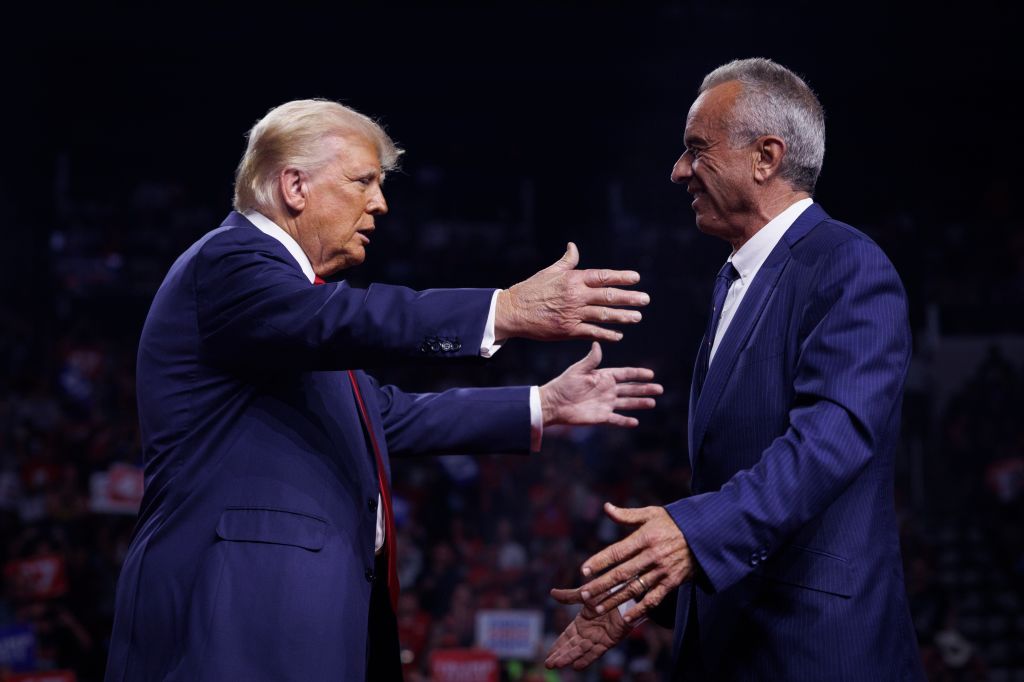
A severe weather warning this week forced the cancellation of a “Make America Healthy Again” (MAHA) virtual town hall featuring Donald Trump, Tulsi Gabbard, and Robert F. Kennedy Jr. The event, part of a series of joint appearances by the unlikely political allies, promised to tackle America’s obesity and chronic disease epidemics. Its postponement does nothing to dampen the peculiar buzz surrounding this new “Blue MAGA” super-team, which has sent shockwaves through the political establishment. But as this alliance takes shape, a question looms: will Trump ultimately betray his newfound ally?
It wouldn’t be the first time Trump has turned on a supporter. Just ask former New Jersey governor Chris Christie, who in 2016 went from being Trump’s primary opponent to his apparent surrogate before becoming his fiercest critic in what seemed like the blink of an eye. Denied a position in the new administration he helped elect, Christie serves as a cautionary tale for anyone entering Hurricane Trump’s path of political destruction — Kennedy included.
Kennedy’s recent endorsement of Trump seemed, at first glance, like a political U-turn. But a closer look reveals a more nuanced picture — one that tells us something important about the shifting tectonics of American politics.
The concept of “sheepdogging” in politics refers to the practice of using a populist candidate to herd voters toward an establishment pick. It’s a term that gained traction after Bernie Sanders’s 2016 primary run, when some accused him of ultimately steering his supporters to Hillary Clinton. It’s possible to see Kennedy playing a similar role for Trump, using his anti-establishment credibility to bring disillusioned Left-leaning and otherwise hard-to-classify progressive voters into the MAGA fold. But this strategy carries risks, particularly if Trump decides to discard Kennedy once he’s served his purpose.
At first glance, the two make for strange bedfellows. Kennedy has long railed against genetically engineered seeds and vaccine mandates, while Trump’s administration rolled out the controversial mRNA Covid-19 vaccines and made a number of regulatory changes that were favourable to the biotechnology industry. What’s more, Kennedy’s enduring environmental activism seems at odds with Trump’s climate change scepticism. Differences like these raise questions about the longevity of their partnership.
But the alliance becomes more comprehensible when viewed through the lens of anti-establishment sentiment. Both men have positioned themselves as outsiders fighting against a “rigged system” and an entrenched “deep state”. In that light, Kennedy’s ongoing crusades against Big Pharma and what he sees as Government overreach during the Covid-19 pandemic align neatly with Trump’s “drain the swamp” rhetoric and scepticism of broad-stroke public health measures such as lockdowns.
This isn’t the first time we’ve seen this kind of putative “against-their-interest” realignment. In the Eighties, many union Democrats flocked to Ronald Reagan, despite his administration’s decidedly anti-union policies. They were drawn by his strong leadership style and cultural conservatism, even as many claimed that he actively worked against their economic interests. It’s equally possible that these workers, many of whom lost their jobs during a period of rapid deindustrialisation overseen by Reagan, threw in their lot with the politician more willing to fulminate against bad behaviours by the country’s trading partners.
Kennedy’s endorsement of Trump did come with some curious caveats. His erstwhile running mate, Nicole Shanahan, told podcast host Adam Carolla that she wanted Trump to admit his Covid-era policies were wrong as a condition of their support — a demand that seems unlikely to be met by a politician not known for apologising. And Trump has made no public commitments to pursue Kennedy’s policy goals in a future administration, something that Christie learnt to his detriment. This suggests that the alliance may be more about optics than substance, setting the stage for a split down the line.
Ultimately, Kennedy’s endorsement of Trump speaks to a fundamental reality of our current political moment. For a significant portion of the electorate, cultural anti-establishment sentiment trumps traditional Left-Right policy divides. Whether you see this as a positive development or a troubling one likely depends on how far away from the centre you sit on the political spectrum, regardless of side.
The old political categories have broken down. As we hurtle toward another contentious 50:50 election, we should remember that in American politics the only constant is change. Kennedy knows the deal: the Trump train goes in one direction, so hop on or get out of the way. Like the politicians who trailed the Reagan revolution, history may soon prove his instincts shrewd. But with Trump’s fickleness unlikely to diminish, will Kennedy find himself cast aside once he becomes a less useful asset?
Oliver Bateman is a historian and journalist based in Pittsburgh. He blogs, vlogs, and podcasts at his Substack, Oliver Bateman Does the Work
 MoustacheClubUS