




X Close

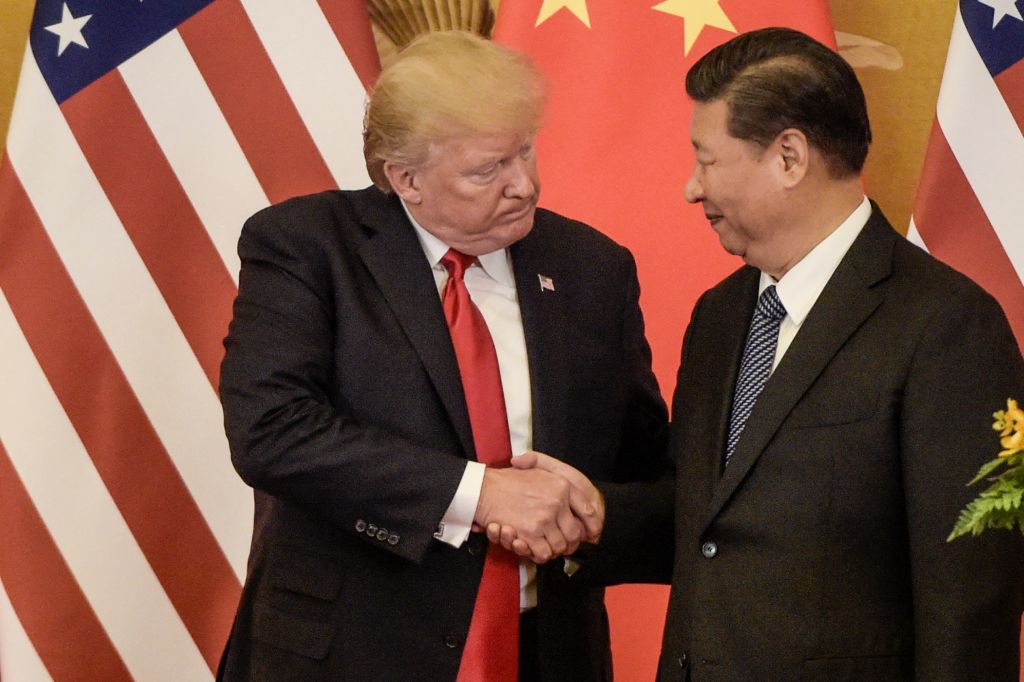
Will China blink first in Trump standoff?

Xi Jinping is playing for a deal. Credit: Getty

Xi Jinping is playing for a deal. Credit: Getty

February 4 2025 - 4:00pm

While campaigning for the presidency last year, Donald Trump threatened to impose 60% tariffs on China. Yet just days after his second inauguration last month, he stated that he would “rather not” place any further taxes on one of the US’s largest trading partners. Around the same time, he also detailed a successful phone call with Chinese leader Xi Jinping, concluding that “it is my expectation that we will solve many problems together, and starting immediately!”

Just a couple of weeks later, however, the picture is different. After Trump introduced a 10% charge on Chinese imports this week, China has responded with tariffs of its own, targeting liquefied natural gas, coal and crude oil.

Everything we have seen so far suggests that the two powers are in the midst of a preliminary — albeit significant — skirmish, in which mutual bluster, subterfuge and posturing will become the new normal. Trump wants a new deal with China following a gradual US decoupling process, and Beijing knows it. Chinese markets in the Global South, from Latin America and Africa to the Middle East and the rest of Asia, have expanded in recent years, yet Xi still recognizes the countries’ importance to one another.

Figures for bilateral trade between America and China have slowly inched down in the last couple of years, but they remain vast. In 2024, the total value of trade goods between the two amounted to around $532 billion, consisting of $131 billion in exports from the US to China and $401 billion imports the other way, amounting to a  $270 billion trade deficit. Annual bilateral trade has totaled more than $500 billion for well over a decade.

The Chinese position may be softened by its current economic turbulence. Local government debt, youth unemployment and the housing market have all been under stress. Growth last year came in at 5%, according to official figures, though some doubt it was anything near as high. China would prefer to strike a deal, and could open more of its sectors up to US investment, take increased numbers of American goods, and make concessions to placate Trump without damaging its own economy.

The big question in all of this is whether the US President really has a clear idea of what he is looking for, and whether he is sufficiently nimble to take any of the strategic opportunities presently available. As the chief trading partner to more than 120 countries, China is a significantly larger player than Mexico and Canada — and presents far more complexity. America is important to Beijing, but not all-important. And despite its current woes, China may well have more grit for a fight ahead than America does, simply because the stakes for the nationalist government — should it be seen to cave in to Washington — are so high.

What is certain is that if a US-China trade war really does kick off, the rest of the world will be impacted. Together, the two countries constitute about 43% of global GDP, so their bilateral argument is invariably everyone’s business. If Trump is thinking tactically (and we have to hope that he is), his current threats will be a prelude to outlining a Sino-American deal rather than a perpetual standoff. China’s government is full of adept negotiators, and can handle this. But if he is just playing games with no clear outcome in mind, it may prove a costly mistake — not just for the US, but for everyone else, too.


Kerry Brown is Director of the Lau China Institute and Professor of Chinese Studies at King’s College, London. His latest book is The Taiwan Story.

Bkerrychina

China is threatening America in the AI race

Reports sugget Zhipu AI  has released a new model that can rival leading US systems. Credit: Getty

Reports sugget Zhipu AI has released a new model that can rival leading US systems. Credit: Getty

July 1 2026 - 10:18am

China is trying to catch up with America on artificial intelligence. The Wall Street Journal has reported that Zhipu AI — one of China’s six “AI tiger” LLMs — has released a new model that can rival leading US systems, including Anthropic’s Mythos, in cybersecurity tasks such as pinpointing security bugs. While this marks a milestone in China’s drive to catch up with Western AI capabilities, strong performance on a single benchmark does not mean it has taken the lead. Chinese models still lag behind their Western counterparts in broader capabilities, such as autonomous operation. Skepticism is therefore warranted before resorting to hysterical conclusions, but complacency about the geopolitical implications of China’s AI advances would be an even greater mistake.

On the infrastructure side, Chinese AI is still constrained by access to advanced chips, with American labs way ahead in computing capacity as well as investment. Analysis from earlier this year suggests that Chinese models are likely to be at least a few months behind those in the US. But they are still continuing to make progress, or that the geopolitical importance of AI will be decided only by whose LLM has ventured deeper into the technological frontier. The practical applications of AI, countries’ to capture foreign markets, and the application of AI into the real economy will matter just as much.

Here, China may hold an advantage. As with its dominance across many critical supply chains, Beijing may not need to produce the most advanced AI systems — only those that are affordable and widely deployable. In doing so, it could consolidate global influence by supplying functional, low-cost AI at scale.

Beijing seems to be pursuing exactly that path, developing an AI “open-source” strategy that offers affordable, widely available AI models for companies and individuals to use and modify as they wish. The production of the DeepSeek AI model, which matched the performance of Silicon Valley tools such as ChatGPT at a fraction of the cost for users, created goodwill among Chinese models with developers.

The four most popular models on OpenRouter, an AI hardware platform for developers, are now all Chinese. The goal for China is not only to win the frontier-model race, but to make its systems the default layer of AI adoption across industries and global markets. For most economies, the choice is increasingly between an affordable tool they can deploy now and a more robust one that may be out of reach.

And while the countries adopting Chinese models may be exposed to political pressure and cyber threats from Beijing, safer and more capable alternatives matter little if they are unaffordable. American AI companies are already under pressure to monetize products whose operating costs are rising. If Chinese open-source models become the cheap default for startups, universities, governments and businesses across the developing world, then America’s AI lead will be eroded from below.

Perhaps more concerning for America in the long run is how AI can give Chinese manufacturing even more strength, through the ongoing integration of AI as a general-purpose technology. China’s new Five-Year Plan mentioned AI more than 50 times and includes an “AI+” action plan aimed at spreading AI across the economy.

Beijing has been pioneering automation of its critical infrastructure for years, with promising recent results in increasing warplane production capacity. In that regard, China’s open-model strategy and manufacturing dominance will reinforce each other. Cheap, adaptable models accelerate deployment across the real economy while those deployments generate real-world data and use cases that can feed back into further model improvement.

The United States should not dismiss the importance of its lead in the AI race. That lead worries Beijing, not least because a more automated Chinese economy would also become more vulnerable to AI-generated cyber threats. But nor should Washington assume that China cannot catch up with American capabilities over time.

This AI competition represents part of a broader struggle over tech supply chains and geopolitical influence. Decisions over whether to adopt US or Chinese models could produce a more fragmented global reality, with different regions relying on different cloud providers, chips and security structures. The result will likely be a global economy which is divided into competing spheres, rather than one which produces a single winner.


Miquel Vila is a political and geopolitical risk consultant focusing on industrial strategy, critical infrastructure and global supply chains.

miquelvilam