




X Close

White House doves are pressuring Trump on Ukraine

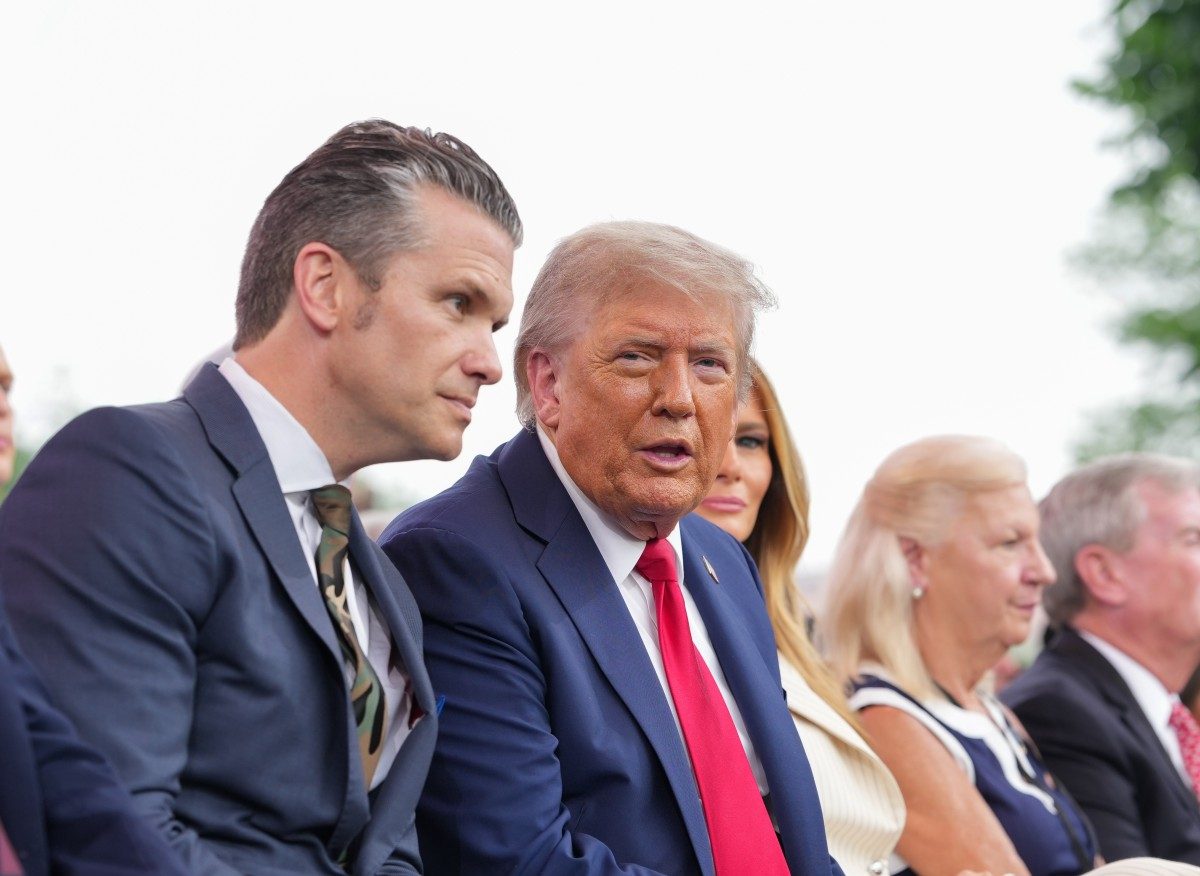
Defense Secretary Pete Hegseth has been vocal on stopping aid to Kyiv. Credit: Getty

Defense Secretary Pete Hegseth has been vocal on stopping aid to Kyiv. Credit: Getty

5 July 2025 - 5:00pm

Donald Trump yesterday seemed to be overcome with newfound goodwill for Volodymyr Zelensky. On a call with his Ukrainian counterpart, the US President agreed to help improve Kyiv’s air-defence systems, and today he said the US “might” even supply Patriot missiles to that end.

Such a move — desperately needed by Ukraine — may appear surprising. Earlier in the week, the US halted shipments of critical weaponry to Ukraine, including air-defence missiles. Yet Trump has never ruled out helping Ukraine in the air. During last month’s Nato summit, he indicated that America would “see if we can make some [Patriots] available”, even while committing only to “see what happens” regarding military aid as a whole.

So what is the source of Trump’s enthusiasm? It could be an emotional response to harrowing footage of shelled Ukrainian cities, or a more calculated desire to distance himself from any blame for such scenes of devastation. Insiders disclose that Russia’s brutal bombing tactics have “surprised” Trump, particularly assaults on areas with children. The conversation with Zelensky came just hours after Russia launched its largest aerial assault on Kyiv since the start of the war, and Trump later explained that he does not “want to see children being killed”. Alternatively, the US President’s eye for a bargain may have prompted him to prioritise air defence. On Thursday, he spoke with German Chancellor Friedrich Merz about Berlin’s proposal to purchase Patriots for Ukraine, with Head of the Ukrainian Presidential Office Andriy Yermak last month suggesting that kit could be partially funded by European allies or frozen Russian assets.

The decision is likely to be a punishment for Vladimir Putin following Trump’s discouraging call with him on Thursday. The Russian leader wasted his counterpart’s time, restating maximalist goals for the war and leaving Trump “very disappointed” that he was unable to make “any progress with him”. This seems to be Trump’s way: a reactive policy which offers concessions piecemeal depending on whichever side has angered or pleased him most recently. See how the US President emerged from a June meeting with Zelensky — during which the Ukrainian leader “couldn’t have been nicer” — with greater sympathy for Kyiv and increased openness to sending Patriots.

While that may constitute Trump’s policy towards Ukraine, it is not necessarily America’s. His vacillations have created a space for members of his administration to push their own, more consistent positions. The halt to weapons shipments was instigated unilaterally by US Defense Secretary Pete Hegseth, having been repeatedly proposed since March by Pentagon policy chief Elbridge Colby. The three-month delay reflected no lack of enthusiasm on Hegseth’s part, instead stemming from personnel changes. Meanwhile, the official justification of the US needing to conserve weaponry was rejected by senior American military officials, implying that the pause was in fact due to the pair’s goal of shifting resources from Ukraine to the Indo-Pacific in order to counter China.

The White House defended the move, yet this incident raises questions about who is truly leading American foreign policy. Colby was privately pushing for stoppages at the same time Trump was publicly promising to look into supplying Patriots. This is not the first time Hegseth has taken matters into his own hands, having attempted to pause weapons deliveries to Ukraine in February and May. Such was his single-minded decision-making this time that members of the State Department and Congress were kept in the dark. Allies of Trump expressed frustration and, as a further indication of splits within the US Government, Germany is engaging directly with Trump about purchasing Patriots in a bid to circumvent Hegseth and Colby, creating a bizarre situation whereby foreign allies are collaborating with the US President in the hope of thwarting his ministers’ machinations.

Yesterday, Zelensky congratulated America on its founding success in fighting for independence. It is a situation he knows all too well. However, as Trump’s lack of an overall strategy sparks no real progress in ending the war, members of his cabinet are implementing their own approaches. Trump may need to win independence from the encroaching power of his own ministers.


Bethany Elliott is a writer specialising in Russia and Eastern Europe.

BethanyAElliott

China is threatening America in the AI race

Reports sugget Zhipu AI  has released a new model that can rival leading US systems. Credit: Getty

Reports sugget Zhipu AI has released a new model that can rival leading US systems. Credit: Getty

1 July 2026 - 10:18am

China is trying to catch up with America on artificial intelligence. The Wall Street Journal has reported that Zhipu AI — one of China’s six “AI tiger” LLMs — has released a new model that can rival leading US systems, including Anthropic’s Mythos, in cybersecurity tasks such as pinpointing security bugs. While this marks a milestone in China’s drive to catch up with Western AI capabilities, strong performance on a single benchmark does not mean it has taken the lead. Chinese models still lag behind their Western counterparts in broader capabilities, such as autonomous operation. Skepticism is therefore warranted before resorting to hysterical conclusions, but complacency about the geopolitical implications of China’s AI advances would be an even greater mistake.

On the infrastructure side, Chinese AI is still constrained by access to advanced chips, with American labs way ahead in computing capacity as well as investment. Analysis from earlier this year suggests that Chinese models are likely to be at least a few months behind those in the US. But they are still continuing to make progress, or that the geopolitical importance of AI will be decided only by whose LLM has ventured deeper into the technological frontier. The practical applications of AI, countries’ to capture foreign markets, and the application of AI into the real economy will matter just as much.

Here, China may hold an advantage. As with its dominance across many critical supply chains, Beijing may not need to produce the most advanced AI systems — only those that are affordable and widely deployable. In doing so, it could consolidate global influence by supplying functional, low-cost AI at scale.

Beijing seems to be pursuing exactly that path, developing an AI “open-source” strategy that offers affordable, widely available AI models for companies and individuals to use and modify as they wish. The production of the DeepSeek AI model, which matched the performance of Silicon Valley tools such as ChatGPT at a fraction of the cost for users, created goodwill among Chinese models with developers.

The four most popular models on OpenRouter, an AI hardware platform for developers, are now all Chinese. The goal for China is not only to win the frontier-model race, but to make its systems the default layer of AI adoption across industries and global markets. For most economies, the choice is increasingly between an affordable tool they can deploy now and a more robust one that may be out of reach.

And while the countries adopting Chinese models may be exposed to political pressure and cyber threats from Beijing, safer and more capable alternatives matter little if they are unaffordable. American AI companies are already under pressure to monetize products whose operating costs are rising. If Chinese open-source models become the cheap default for startups, universities, governments and businesses across the developing world, then America’s AI lead will be eroded from below.

Perhaps more concerning for America in the long run is how AI can give Chinese manufacturing even more strength, through the ongoing integration of AI as a general-purpose technology. China’s new Five-Year Plan mentioned AI more than 50 times and includes an “AI+” action plan aimed at spreading AI across the economy.

Beijing has been pioneering automation of its critical infrastructure for years, with promising recent results in increasing warplane production capacity. In that regard, China’s open-model strategy and manufacturing dominance will reinforce each other. Cheap, adaptable models accelerate deployment across the real economy while those deployments generate real-world data and use cases that can feed back into further model improvement.

The United States should not dismiss the importance of its lead in the AI race. That lead worries Beijing, not least because a more automated Chinese economy would also become more vulnerable to AI-generated cyber threats. But nor should Washington assume that China cannot catch up with American capabilities over time.

This AI competition represents part of a broader struggle over tech supply chains and geopolitical influence. Decisions over whether to adopt US or Chinese models could produce a more fragmented global reality, with different regions relying on different cloud providers, chips and security structures. The result will likely be a global economy which is divided into competing spheres, rather than one which produces a single winner.


Miquel Vila is a political and geopolitical risk consultant focusing on industrial strategy, critical infrastructure and global supply chains.

miquelvilam