




X Close

What UK politicians can learn from Japan’s seismic election result

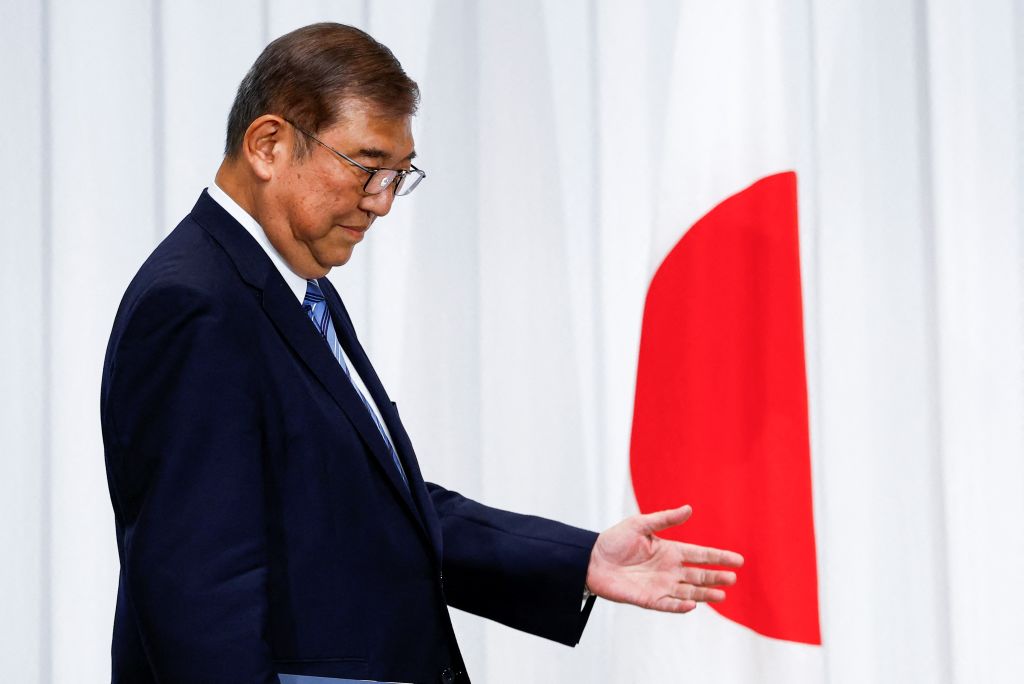
Having only become prime minister a month ago, Shigeru Ishiba is hardly to blame for his party's troubles. Credit: Getty

Having only become prime minister a month ago, Shigeru Ishiba is hardly to blame for his party’s troubles. Credit: Getty

28 October 2024 - 4:00pm

Yesterday’s general election in Japan was unusually dramatic and, potentially at least, one of its most consequential. The Liberal Democratic Party, led by box-fresh Prime Minister Shigeru Ishiba (he has been in office for precisely 27 days), has lost its majority even with its customary sidekicks Komeito added on.

This leaves Japan’s eternal party of Government, which has been in power for all but four of the last 69 years, scrambling around for some coalition. Commentators in Tokyo suspect they will probably manage to cobble something together, but the party will be severely weakened. It is possible, after such a historic drubbing, that Ishiba will need to resign.

The LDP are projected to remain the largest party, but only just. The big winner on the night was the Constitutional Democrats, which increased its seat numbers from 98 to 148. There are a few other small parties who made gains and might have a part to play in a putative coalition, though at the moment no one is expressing any enthusiasm for working with Ishiba’s demoralised and tainted LDP.

Why did this happen and what lessons are there for the West? It would be very unfair to blame the result on Ishiba who is a respected figure in the country and the election result, which he has called simply “tough”. He did drop the ball on the issue of reinstating disgraced lawmakers. He said he wouldn’t although evidence emerged suggesting he might. But that was his only gaffe and he campaigned hard.

No, the hugely disappointing result for the LDP is being blamed on two factors: the faltering Japanese economy — inflation and a weakening yen — and a long series of scandals. Inflation is nightmarish in a country where prices and wages remain static for decades and companies have been known to issue grovelling apologies when even tiny price hikes have had to be announced. Japanese inflation has been running at a traumatising 2-3% in the last few years after 40 years of being close to zero, or even below.

As for the scandals, it was probably quantity rather than quality that did for Ishiba’s party — and here Keir Starmer’s Labour government might want to take note. The most recent and salient was a slush fund scandal related to fundraising parties. It lacked the juiciness or personal details of the recent revelations around Labour donor Lord Alli in the UK but left the same sour taste with the voters.

The problem seems to be that this is just one case of petty misbehaviour and graft too many for the Japanese people. The slush fund row came on top of the intense anger provoked by former prime minister Fumio Kishida’s arguably unconstitutional decision to give Shinzo Abe a state funeral (imagine a state funeral for Tony Blair) after he was assassinated. This came on top of the Unification church brouhaha which followed a quaint-sounding but squalid Cherry Blossom party affair involving more dodgy payments along with numerous nepotistic mini scandals. The Japanese electorate are sick of it all.

The other message, which may be of more interest to Kemi Badenoch or Robert Jenrick’s Conservative Party, is that a change of leader doesn’t make much difference if the brand is tainted. Ishiba’s single word description of the results as “tough”, as in “tough luck”, is apt as he isn’t really to blame for the LDP’s rotten reputation. A non-mainstream figure for much of his career, he even resigned from the party once on principle, making him a very rare and distinguished beast in the Japanese political world. He was presumably brought in from the cold to give a veneer of respectability to a party that desperately needed to win back the public’s trust. It clearly wasn’t enough.

Someone else who may be looking at Japan with interest is Reform UK leader Nigel Farage. The Constitutional Democrats were only formed only eight years ago, and have benefitted hugely simply by not being the LDP. Their leader Yoshihiko Noda, a former prime minister with the now defunct Democratic Party of Japan (DPJ), has vowed, Farage-like, that he will spurn any advances to work with the LDP and seeks to essentially obliterate and replace it. “We are truly on the eve of a change of government,” he said.

We will probably find out in the next six months, possibly during the upper house elections next summer, whether Sunday’s poll will be a blip with normal service resuming in due course, or whether it represents a fundamental realignment. The LDP’s potential coalition partners may just be playing hardball in pursuit of the best possible deal. The LDP may reform and recover. For those hoping for true change it may be another false dawn in the land of the rising sun.

Or maybe not. Perhaps this really is existential for the LDP. In which case, the election may have truly international significance. The Japanese political scene, as with the Japanese economy and other aspects of the society, is often depicted as ossified. But if things can change fundamentally here of all places, it will give hope to many in the West, and strike fear into the hearts of certain others.


Philip Patrick is a lecturer at a Tokyo university and a freelance journalist.
@Pbp19Philip

China is threatening America in the AI race

Reports sugget Zhipu AI  has released a new model that can rival leading US systems. Credit: Getty

Reports sugget Zhipu AI has released a new model that can rival leading US systems. Credit: Getty

1 July 2026 - 10:18am

China is trying to catch up with America on artificial intelligence. The Wall Street Journal has reported that Zhipu AI — one of China’s six “AI tiger” LLMs — has released a new model that can rival leading US systems, including Anthropic’s Mythos, in cybersecurity tasks such as pinpointing security bugs. While this marks a milestone in China’s drive to catch up with Western AI capabilities, strong performance on a single benchmark does not mean it has taken the lead. Chinese models still lag behind their Western counterparts in broader capabilities, such as autonomous operation. Skepticism is therefore warranted before resorting to hysterical conclusions, but complacency about the geopolitical implications of China’s AI advances would be an even greater mistake.

On the infrastructure side, Chinese AI is still constrained by access to advanced chips, with American labs way ahead in computing capacity as well as investment. Analysis from earlier this year suggests that Chinese models are likely to be at least a few months behind those in the US. But they are still continuing to make progress, or that the geopolitical importance of AI will be decided only by whose LLM has ventured deeper into the technological frontier. The practical applications of AI, countries’ to capture foreign markets, and the application of AI into the real economy will matter just as much.

Here, China may hold an advantage. As with its dominance across many critical supply chains, Beijing may not need to produce the most advanced AI systems — only those that are affordable and widely deployable. In doing so, it could consolidate global influence by supplying functional, low-cost AI at scale.

Beijing seems to be pursuing exactly that path, developing an AI “open-source” strategy that offers affordable, widely available AI models for companies and individuals to use and modify as they wish. The production of the DeepSeek AI model, which matched the performance of Silicon Valley tools such as ChatGPT at a fraction of the cost for users, created goodwill among Chinese models with developers.

The four most popular models on OpenRouter, an AI hardware platform for developers, are now all Chinese. The goal for China is not only to win the frontier-model race, but to make its systems the default layer of AI adoption across industries and global markets. For most economies, the choice is increasingly between an affordable tool they can deploy now and a more robust one that may be out of reach.

And while the countries adopting Chinese models may be exposed to political pressure and cyber threats from Beijing, safer and more capable alternatives matter little if they are unaffordable. American AI companies are already under pressure to monetize products whose operating costs are rising. If Chinese open-source models become the cheap default for startups, universities, governments and businesses across the developing world, then America’s AI lead will be eroded from below.

Perhaps more concerning for America in the long run is how AI can give Chinese manufacturing even more strength, through the ongoing integration of AI as a general-purpose technology. China’s new Five-Year Plan mentioned AI more than 50 times and includes an “AI+” action plan aimed at spreading AI across the economy.

Beijing has been pioneering automation of its critical infrastructure for years, with promising recent results in increasing warplane production capacity. In that regard, China’s open-model strategy and manufacturing dominance will reinforce each other. Cheap, adaptable models accelerate deployment across the real economy while those deployments generate real-world data and use cases that can feed back into further model improvement.

The United States should not dismiss the importance of its lead in the AI race. That lead worries Beijing, not least because a more automated Chinese economy would also become more vulnerable to AI-generated cyber threats. But nor should Washington assume that China cannot catch up with American capabilities over time.

This AI competition represents part of a broader struggle over tech supply chains and geopolitical influence. Decisions over whether to adopt US or Chinese models could produce a more fragmented global reality, with different regions relying on different cloud providers, chips and security structures. The result will likely be a global economy which is divided into competing spheres, rather than one which produces a single winner.


Miquel Vila is a political and geopolitical risk consultant focusing on industrial strategy, critical infrastructure and global supply chains.

miquelvilam