




X Close

What falling McDonald’s sales say about the US economy

Tariffs are hurting consumer confidence. Credit: Getty

Tariffs are hurting consumer confidence. Credit: Getty

May 2 2025 - 1:00pm

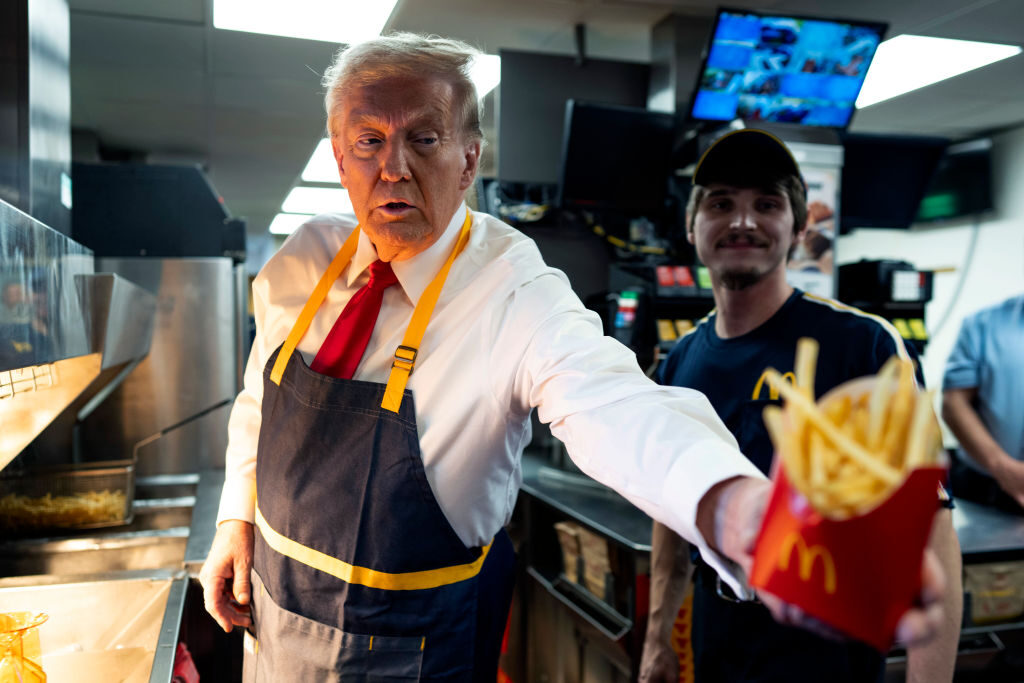
The last time McDonald’s posted a sharp drop in quarterly sales, most Americans were wiping down groceries and doom-scrolling Covid mortality graphs. This week it was reported that the chain’s US same-store revenues have tumbled 3.6%, a fall twice as steep as Wall Street expected. Confronted with higher prices everywhere, Americans are simply staying home and scrambling their own incredibly overpriced eggs.

McDonald’s CEO Chris Kempczinski has admitted that “people are being more judicious” as traffic from households earning under $75,000 has fallen by nearly 10%, a trend also experienced by the chain’s low-cost competitors. “Judicious” is one word for it; another is “insolvent”. A LendingTree survey from last month found that a quarter of all buy-now-pay-later users are financing their groceries, up from 14% a year ago. When shoppers must use microfinance to buy skimmed milk and Kraft Dinner, the notion of “saving” by choosing a value meal collapses.

America’s macro numbers support this belt-tightening shift. Real GDP shrank 0.3% in the first quarter, the first contraction since the pandemic rebound. At the same time, China posted a 5.4% expansion. The world’s biggest burger chain is learning the hard way that its home market is losing not just momentum but confidence: Donald Trump’s fresh tariff volley has rattled consumers; shaved points off sentiment indices; and reminded workers that even if inflation cools, another round of price hikes can be delivered by press conference.

Hard times once buoyed McDonald’s. In 2008, what was then called the Dollar Menu — the name was discontinued in 2020 due to inflationary pressures — proved a recessionary magnet, lifting global comparable sales 6.9% while sit-down rivals wilted. The chain opened nearly 600 stores that year and boasted 68 straight months of growth. Cheap burgers looked like a counter-cyclical superpower. But 2025 isn’t 2008. Food-at-home prices have risen by 25% since 2021, wages have not kept pace, and many of the customers who used to pop in for a “value” lunch are now using Klarna to split a DoorDash order into four installments.

The answer from McDonald’s has been more coupons, more gimmicks, and a highly functional “McValue” platform which corrals every two-for-one offer and Monday-only flash sale into a single app tab. Regulars, my Happy Meal-obsessed daughter and me included, scroll through “Deal Drop” notifications as though checking the futures market.

The trouble is that desperation shows. A $5 bundle which includes a Big Mac, fries, and a Minecraft figurine may briefly spike app downloads, but it also telegraphs that management fears further losses. Meanwhile, rival chain Taco Bell managed to buck the low-cost food downturn and post a 9% same-store lift by hawking late-night snack boxes and limited-run melts without signaling panic, essentially doubling down on desperate payments from hungry, cash-strapped Millennials.

Retail analysts note that fast food is traditionally the last rung on the spending ladder: when diners abandon it, they are not so much trading down as dropping out. Lottery-like app deals hide inflation-powered sticker shock, but an individual Big Mac in many US cities now costs over $5 on its own. Downloading an app to shave a dollar off lunch feels like clipping ration coupons, which may explain why some consumers choose the nuclear option: they stop eating out altogether.

Globally, McDonald’s can still point to resilience in Japan and the Middle East, yet in the United Kingdom — another inflation-pinched market — sales slid, following the American pattern. Meanwhile, regardless of whether or not it’s cooking the books, China’s brisk first-quarter growth offers a mirror into which America may not enjoy looking. Beijing is touting double-digit gains in logistics and mid-single-digit rises in retail dining — including 3% growth across 5,900 McDonald’s branches in the country.

When a nation built on consumption can no longer afford its most affordable made-to-order calories, it has moved beyond typical economic cycles into something more profound. The American consumer, long the credit card holder powering global growth, is sputtering not from choice but from exhaustion. The once-shiny golden arches have dimmed not because we want something better, but because millions can no longer afford even that.


Oliver Bateman is a historian and journalist based in Pittsburgh. He blogs, vlogs, and podcasts at his Substack, Oliver Bateman Does the Work

MoustacheClubUS

China is threatening America in the AI race

Reports sugget Zhipu AI  has released a new model that can rival leading US systems. Credit: Getty

Reports sugget Zhipu AI has released a new model that can rival leading US systems. Credit: Getty

July 1 2026 - 10:18am

China is trying to catch up with America on artificial intelligence. The Wall Street Journal has reported that Zhipu AI — one of China’s six “AI tiger” LLMs — has released a new model that can rival leading US systems, including Anthropic’s Mythos, in cybersecurity tasks such as pinpointing security bugs. While this marks a milestone in China’s drive to catch up with Western AI capabilities, strong performance on a single benchmark does not mean it has taken the lead. Chinese models still lag behind their Western counterparts in broader capabilities, such as autonomous operation. Skepticism is therefore warranted before resorting to hysterical conclusions, but complacency about the geopolitical implications of China’s AI advances would be an even greater mistake.

On the infrastructure side, Chinese AI is still constrained by access to advanced chips, with American labs way ahead in computing capacity as well as investment. Analysis from earlier this year suggests that Chinese models are likely to be at least a few months behind those in the US. But they are still continuing to make progress, or that the geopolitical importance of AI will be decided only by whose LLM has ventured deeper into the technological frontier. The practical applications of AI, countries’ to capture foreign markets, and the application of AI into the real economy will matter just as much.

Here, China may hold an advantage. As with its dominance across many critical supply chains, Beijing may not need to produce the most advanced AI systems — only those that are affordable and widely deployable. In doing so, it could consolidate global influence by supplying functional, low-cost AI at scale.

Beijing seems to be pursuing exactly that path, developing an AI “open-source” strategy that offers affordable, widely available AI models for companies and individuals to use and modify as they wish. The production of the DeepSeek AI model, which matched the performance of Silicon Valley tools such as ChatGPT at a fraction of the cost for users, created goodwill among Chinese models with developers.

The four most popular models on OpenRouter, an AI hardware platform for developers, are now all Chinese. The goal for China is not only to win the frontier-model race, but to make its systems the default layer of AI adoption across industries and global markets. For most economies, the choice is increasingly between an affordable tool they can deploy now and a more robust one that may be out of reach.

And while the countries adopting Chinese models may be exposed to political pressure and cyber threats from Beijing, safer and more capable alternatives matter little if they are unaffordable. American AI companies are already under pressure to monetize products whose operating costs are rising. If Chinese open-source models become the cheap default for startups, universities, governments and businesses across the developing world, then America’s AI lead will be eroded from below.

Perhaps more concerning for America in the long run is how AI can give Chinese manufacturing even more strength, through the ongoing integration of AI as a general-purpose technology. China’s new Five-Year Plan mentioned AI more than 50 times and includes an “AI+” action plan aimed at spreading AI across the economy.

Beijing has been pioneering automation of its critical infrastructure for years, with promising recent results in increasing warplane production capacity. In that regard, China’s open-model strategy and manufacturing dominance will reinforce each other. Cheap, adaptable models accelerate deployment across the real economy while those deployments generate real-world data and use cases that can feed back into further model improvement.

The United States should not dismiss the importance of its lead in the AI race. That lead worries Beijing, not least because a more automated Chinese economy would also become more vulnerable to AI-generated cyber threats. But nor should Washington assume that China cannot catch up with American capabilities over time.

This AI competition represents part of a broader struggle over tech supply chains and geopolitical influence. Decisions over whether to adopt US or Chinese models could produce a more fragmented global reality, with different regions relying on different cloud providers, chips and security structures. The result will likely be a global economy which is divided into competing spheres, rather than one which produces a single winner.


Miquel Vila is a political and geopolitical risk consultant focusing on industrial strategy, critical infrastructure and global supply chains.

miquelvilam