



X Close

US plan for a quick Ukraine ceasefire is a non-starter

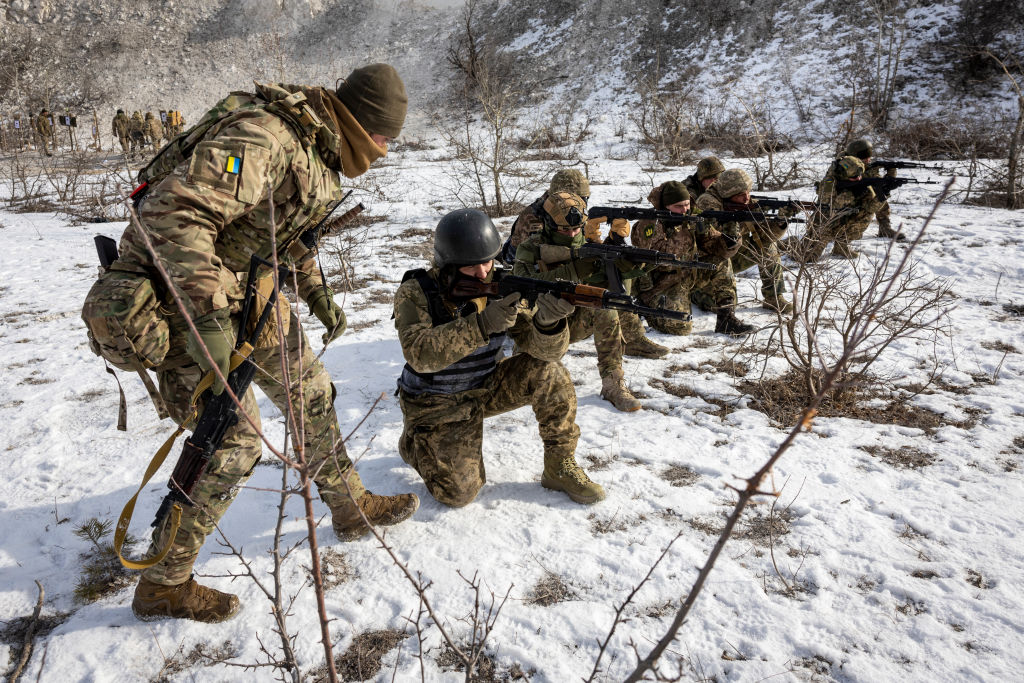
'From all the evidence of the past year, the longer the war goes on the more ground Ukraine will lose.' Credit: Getty

'From all the evidence of the past year, the longer the war goes on the more ground Ukraine will lose.' Credit: Getty

February 11 2025 - 1:45pm

At the Munich Security Conference later this week, US Vice President JD Vance and envoy to Ukraine and Russia Keith Kellogg will use the stage to present European leaders with part of the Trump administration’s peace plan for the region. NATO membership for Kyiv will be excluded, and Russia will effectively be left with the Ukrainian land it currently holds — with the possible exception of a territorial swap involving Ukrainian withdrawal from Russia’s Kursk province, if its army can hold the territory long enough.

These “concessions” are in fact closer to recognitions of reality. Donald Trump has no intention of taking on additional security commitments in Europe, and it is militarily impossible for Ukraine to reconquer its lost territories unless Washington intervenes directly — which the US President certainly will not do.

Assuming that Trump’s recent conversation with Vladimir Putin was sufficiently frank, certain factors should now be obvious. Of these, the most important is that the idea floated by US officials of a ceasefire before a comprehensive settlement will be dead on arrival. The Russians have made clear they will not agree to this, given that their own military advances and the threat of Ukrainian collapse are Putin’s principal points of leverage in negotiations. If America fails to grasp this, a great deal of time — and many more lives — will be wasted.

The other reason why the Trump administration should give up on the idea of an early ceasefire is that there are many people in Ukraine, Europe and Washington who want the talks to fail in a way that can be blamed on Russia. Consequently, they could suggest that there is implacable opposition in Moscow to a compromise peace. The genuine hardliners in Russia, who are indeed opposed to compromise, would no doubt be glad to have evidence that the West is making impossible demands.

Another idea which is dead on arrival is that of a powerful European “peacekeeping” force for Ukraine. This will be vetoed by Russia; but, equally importantly, as soon as the Europeans say they would only provide such a force if its safety is formally guaranteed by the US, the Trump administration will abandon it. That is, if it has not done so already. A peacekeeping force will be necessary to separate the two sides and enforce a ceasefire, but it will have to come from neutral countries.

The general contours of a viable peace involve the US meeting wider Russian security concerns, and the Kremlin in return giving up its maximalist ambitions in Ukraine. What is less clear is how far, and how quickly, either side will be prepared to go. This will only become apparent during the negotiations themselves. Will the Trump administration be willing to offer significant NATO arms limitations? Will Putin abandon his demand for additional Ukrainian territory, beyond what Russia currently holds?

The extent of Russia’s eventual captured territory will be decided on the battlefield. From all the evidence of the past year, the longer the war goes on the more ground Ukraine will lose. Yet Russian forces are advancing very slowly. The key effect of drones has been to make it extremely difficult to create the local mass necessary for a decisive breakthrough. Tanks cannot be brought up to the front line at all; infantry can only be brought up in tiny packets. On the other hand, drones don’t compensate completely for Ukraine’s critical lack of troops. The danger of Ukrainian collapse is another reason why the Trump administration cannot afford to waste any time in these negotiations.


Anatol Lieven is a former war correspondent and Director of the Eurasia Program at the Quincy Institute for Responsible Statecraft in Washington DC.

lieven_anatol

China is threatening America in the AI race

Reports sugget Zhipu AI  has released a new model that can rival leading US systems. Credit: Getty

Reports sugget Zhipu AI has released a new model that can rival leading US systems. Credit: Getty

July 1 2026 - 10:18am

China is trying to catch up with America on artificial intelligence. The Wall Street Journal has reported that Zhipu AI — one of China’s six “AI tiger” LLMs — has released a new model that can rival leading US systems, including Anthropic’s Mythos, in cybersecurity tasks such as pinpointing security bugs. While this marks a milestone in China’s drive to catch up with Western AI capabilities, strong performance on a single benchmark does not mean it has taken the lead. Chinese models still lag behind their Western counterparts in broader capabilities, such as autonomous operation. Skepticism is therefore warranted before resorting to hysterical conclusions, but complacency about the geopolitical implications of China’s AI advances would be an even greater mistake.

On the infrastructure side, Chinese AI is still constrained by access to advanced chips, with American labs way ahead in computing capacity as well as investment. Analysis from earlier this year suggests that Chinese models are likely to be at least a few months behind those in the US. But they are still continuing to make progress, or that the geopolitical importance of AI will be decided only by whose LLM has ventured deeper into the technological frontier. The practical applications of AI, countries’ to capture foreign markets, and the application of AI into the real economy will matter just as much.

Here, China may hold an advantage. As with its dominance across many critical supply chains, Beijing may not need to produce the most advanced AI systems — only those that are affordable and widely deployable. In doing so, it could consolidate global influence by supplying functional, low-cost AI at scale.

Beijing seems to be pursuing exactly that path, developing an AI “open-source” strategy that offers affordable, widely available AI models for companies and individuals to use and modify as they wish. The production of the DeepSeek AI model, which matched the performance of Silicon Valley tools such as ChatGPT at a fraction of the cost for users, created goodwill among Chinese models with developers.

The four most popular models on OpenRouter, an AI hardware platform for developers, are now all Chinese. The goal for China is not only to win the frontier-model race, but to make its systems the default layer of AI adoption across industries and global markets. For most economies, the choice is increasingly between an affordable tool they can deploy now and a more robust one that may be out of reach.

And while the countries adopting Chinese models may be exposed to political pressure and cyber threats from Beijing, safer and more capable alternatives matter little if they are unaffordable. American AI companies are already under pressure to monetize products whose operating costs are rising. If Chinese open-source models become the cheap default for startups, universities, governments and businesses across the developing world, then America’s AI lead will be eroded from below.

Perhaps more concerning for America in the long run is how AI can give Chinese manufacturing even more strength, through the ongoing integration of AI as a general-purpose technology. China’s new Five-Year Plan mentioned AI more than 50 times and includes an “AI+” action plan aimed at spreading AI across the economy.

Beijing has been pioneering automation of its critical infrastructure for years, with promising recent results in increasing warplane production capacity. In that regard, China’s open-model strategy and manufacturing dominance will reinforce each other. Cheap, adaptable models accelerate deployment across the real economy while those deployments generate real-world data and use cases that can feed back into further model improvement.

The United States should not dismiss the importance of its lead in the AI race. That lead worries Beijing, not least because a more automated Chinese economy would also become more vulnerable to AI-generated cyber threats. But nor should Washington assume that China cannot catch up with American capabilities over time.

This AI competition represents part of a broader struggle over tech supply chains and geopolitical influence. Decisions over whether to adopt US or Chinese models could produce a more fragmented global reality, with different regions relying on different cloud providers, chips and security structures. The result will likely be a global economy which is divided into competing spheres, rather than one which produces a single winner.


Miquel Vila is a political and geopolitical risk consultant focusing on industrial strategy, critical infrastructure and global supply chains.

miquelvilam
