




X Close

US-Iran deal looks like a total capitulation

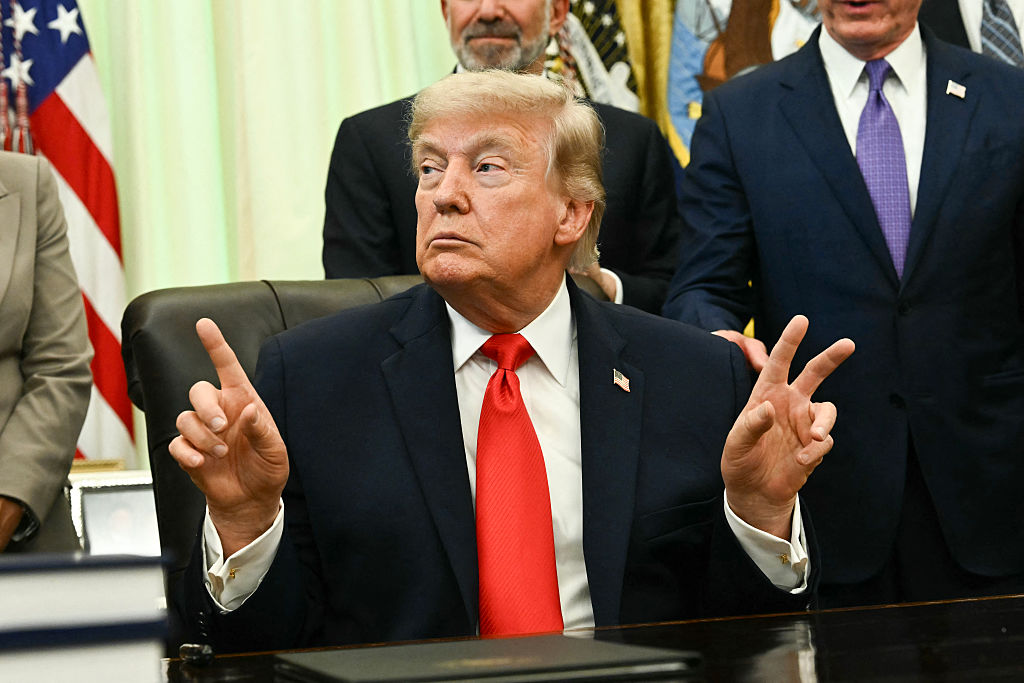
The art of the deal? Credit: Getty

The art of the deal? Credit: Getty

17 June 2026 - 6:15pm

Days after striking a framework peace deal with Iran, the Trump administration still hasn’t bothered to release the document to the public. But if the leaked contents are accurate, then the Memorandum of Understanding (MOU) that is designed to buy time for a deeper, more technical negotiation over Iran’s nuclear programme is, if not unimpressive, a damning indictment of the entire war.

At its core, the 14-point draft, which will be signed by Vice President JD Vance and Iranian Parliamentary Speaker Mohammad Bagher Ghalibaf this Friday, is a bid to rewind back to 27 February, the day before the conflict began. According to the MOU, the war will cease on all fronts, including in Lebanon where Israel and Hezbollah continue to fight. Upon the MOU’s signing, the United States will lift the naval blockade on Iran’s ports, and Tehran will “immediately take steps” to bring maritime traffic in the Strait of Hormuz back to pre-war levels over the next 30 days. The plan also binds Washington to initiate discussions with regional partners on a massive $300 billion reconstruction plan for Iran over a 60-day time frame, the same length of time US and Iranian officials will sit down to navigate a path forward on Tehran’s nuclear work.

But there’s no use sugarcoating it: judging from the leaked language, the Iranians have won out in this negotiation so far. The number of concessions Tehran was able to wrangle out of the Trump administration was considerable. For instance, upon signing, the US Treasury Department will issue waivers to allow Iran to export crude oil and petrochemical products to the global market again. Banking sanctions will be waived as well, which means money from those crude oil sales can be accessed by the Iranians (the mechanics of how this would all work are still unclear). If nuclear negotiations progress, the US will make some of Iran’s frozen assets available — at least $100 billion of Tehran’s own money is stuck in overseas accounts. And the nuclear portion of the negotiation will only begin after all of this is implemented to Iran’s satisfaction, which means the Trump administration is basically frontloading economic incentives before the meaty nuclear issue is hammered out.

What does the United States receive? Other than an Iranian assurance that the Strait of Hormuz will be open again, not much. Iran promised never to produce a nuclear weapon in the MOU, but this is not exactly a bombshell; Tehran has committed to this multiple times before, including at the very top of the Obama-era Joint Comprehensive Plan of Action that Trump shredded in his first term. The details of how this commitment will be verified, the extent to which Iran will be able to retain some of its nuclear infrastructure and enriched uranium stockpile, how long an enrichment ban will last or whether there will be an enrichment ban at all are still to be determined. Trump, perhaps in response to the bad media coverage this week, is already threatening to resume airstrikes if the talks don’t go his way.

Analysts will harp on about the MOU’s terms. Trump’s boosters will attempt to package it as the best thing since sliced bread. His critics will blast the document as far worse than Obama’s JCPOA.

But the specific terms are something of a distraction from the main event. Generally, peace agreements are a reflection of the balance of power on the ground, the combatants’ ability and willingness to continue fighting, and the interests at stake. The United States had superior military power at its disposal, but Iran had geography, a higher pain threshold and a more vital interest: survival. Iranian capitulation was always a fantasy.

The framework accord did not emerge from a vacuum. It wasn’t just the result of inexperienced, underqualified or overwhelmed American negotiators who didn’t know what they were doing or were fleeced by those on the other side of the table. Rather, the MOU is a product of how the war turned out. Trump became tired of perpetuating a morass that spiked energy prices at home, brought his approval ratings into the gutter and created an election-year problem for his party. Four months after beginning an unnecessary conflict, and belatedly seeing that the costs were piling up, he searched for an exit ramp. And he was willing to pay a hefty price to get it.


Daniel R. DePetris is a fellow at Defense Priorities and a syndicated foreign affairs columnist for the Chicago Tribune.

DanDePetris

China is threatening America in the AI race

Reports sugget Zhipu AI  has released a new model that can rival leading US systems. Credit: Getty

Reports sugget Zhipu AI has released a new model that can rival leading US systems. Credit: Getty

1 July 2026 - 10:18am

China is trying to catch up with America on artificial intelligence. The Wall Street Journal has reported that Zhipu AI — one of China’s six “AI tiger” LLMs — has released a new model that can rival leading US systems, including Anthropic’s Mythos, in cybersecurity tasks such as pinpointing security bugs. While this marks a milestone in China’s drive to catch up with Western AI capabilities, strong performance on a single benchmark does not mean it has taken the lead. Chinese models still lag behind their Western counterparts in broader capabilities, such as autonomous operation. Skepticism is therefore warranted before resorting to hysterical conclusions, but complacency about the geopolitical implications of China’s AI advances would be an even greater mistake.

On the infrastructure side, Chinese AI is still constrained by access to advanced chips, with American labs way ahead in computing capacity as well as investment. Analysis from earlier this year suggests that Chinese models are likely to be at least a few months behind those in the US. But they are still continuing to make progress, or that the geopolitical importance of AI will be decided only by whose LLM has ventured deeper into the technological frontier. The practical applications of AI, countries’ to capture foreign markets, and the application of AI into the real economy will matter just as much.

Here, China may hold an advantage. As with its dominance across many critical supply chains, Beijing may not need to produce the most advanced AI systems — only those that are affordable and widely deployable. In doing so, it could consolidate global influence by supplying functional, low-cost AI at scale.

Beijing seems to be pursuing exactly that path, developing an AI “open-source” strategy that offers affordable, widely available AI models for companies and individuals to use and modify as they wish. The production of the DeepSeek AI model, which matched the performance of Silicon Valley tools such as ChatGPT at a fraction of the cost for users, created goodwill among Chinese models with developers.

The four most popular models on OpenRouter, an AI hardware platform for developers, are now all Chinese. The goal for China is not only to win the frontier-model race, but to make its systems the default layer of AI adoption across industries and global markets. For most economies, the choice is increasingly between an affordable tool they can deploy now and a more robust one that may be out of reach.

And while the countries adopting Chinese models may be exposed to political pressure and cyber threats from Beijing, safer and more capable alternatives matter little if they are unaffordable. American AI companies are already under pressure to monetize products whose operating costs are rising. If Chinese open-source models become the cheap default for startups, universities, governments and businesses across the developing world, then America’s AI lead will be eroded from below.

Perhaps more concerning for America in the long run is how AI can give Chinese manufacturing even more strength, through the ongoing integration of AI as a general-purpose technology. China’s new Five-Year Plan mentioned AI more than 50 times and includes an “AI+” action plan aimed at spreading AI across the economy.

Beijing has been pioneering automation of its critical infrastructure for years, with promising recent results in increasing warplane production capacity. In that regard, China’s open-model strategy and manufacturing dominance will reinforce each other. Cheap, adaptable models accelerate deployment across the real economy while those deployments generate real-world data and use cases that can feed back into further model improvement.

The United States should not dismiss the importance of its lead in the AI race. That lead worries Beijing, not least because a more automated Chinese economy would also become more vulnerable to AI-generated cyber threats. But nor should Washington assume that China cannot catch up with American capabilities over time.

This AI competition represents part of a broader struggle over tech supply chains and geopolitical influence. Decisions over whether to adopt US or Chinese models could produce a more fragmented global reality, with different regions relying on different cloud providers, chips and security structures. The result will likely be a global economy which is divided into competing spheres, rather than one which produces a single winner.


Miquel Vila is a political and geopolitical risk consultant focusing on industrial strategy, critical infrastructure and global supply chains.

miquelvilam