




X Close

Trump’s gold card scheme is a gift to foreign regimes

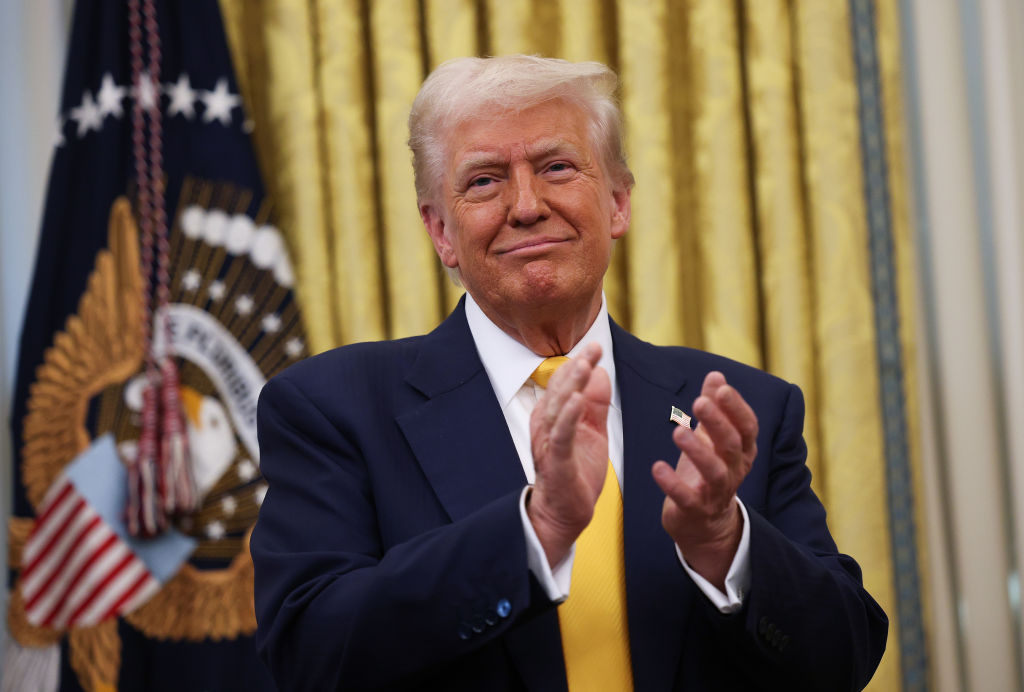
A free pass for oligarchs? Credit: Getty

A free pass for oligarchs? Credit: Getty

26 February 2025 - 8:00pm

As part of his shake-up of the US immigration system, Donald Trump has this week proposed to replace its existing investor citizenship programme, known as EB-5, with a new “gold card” scheme. The gold card allows wealthy investors to obtain a path to citizenship in exchange for a hefty $5 million injection into the domestic economy. This raises the contribution threshold significantly as the previous visa only had a $1,050,000 investment minimum, or $800,000 directed to distressed areas.

While standing next to the President, Commerce Secretary Howard Lutnick promised that candidates for the new gold card will “have to go through vetting […] to make sure they’re wonderful world-class global citizens”. Yet when a reporter asked if Russian oligarchs will simply buy their way to citizenship under the plan, Trump deigned to offer any reassurances, saying: “Yeah, possibly […] I know some Russian oligarchs that are very nice people.”

The exchange highlights the possibility, implicit in many such schemes, of malicious foreign entities using the avenue to buy and exert political or economic influence within the host country — under the benign guise of creating American jobs and opportunities. Indeed, the largest demand for investor citizenship programmes globally comes from none other than “China, the Middle East and Russia”, precisely the places known for running aggressive foreign interference operations and with whom Americans ought to be wary about fostering closer integration.

Other Western countries that have offered their own gold card, such as the United Kingdom, Canada, and Ireland, have recently had to shut down these immigration streams after running into problems with adverse side effects of foreign capital infusion, such as heightened risk of money laundering and severe distortions in property markets. In the case of the US, Lutnick himself admitted that the EB-5 programme “was full of nonsense, make-believe and fraud”, asserting that the problem was “the low price”. However, it is not clear that increasing that price to $5 million would fundamentally alter the dynamic, given that the amount is practically chump change for obscenely rich global oligarchs and their foreign government patrons.

For instance, the “wealthy Chinese” often denounced by Trump-aligned border hawks in their efforts against birthright citizenship can simply go through the simpler route of buying a gold card, either for themselves or their proxies. After all, their influence had been such that, during Trump’s first term, the White House openly entertained expanding visas for Chinese investors in March 2020, as the “Wuhan virus” surged. In other words, his record does not inspire confidence.

But the larger question for the administration this time around is what such a policy says about its basic conception of citizenship. As his other immigration reform priorities signal a dramatic tightening of the limits of the American political community, does this anti-globalist president really want to return to the cheap subordination of national civic belonging to the whims and imperatives of borderless, globalised capital? It is bad enough that Trump 2.0 has been so visibly influenced by homegrown oligarchs; does it need to cater to foreign ones, too?


Michael Cuenco is Senior Editor at American Affairs.
1TrueCuencoism

China is threatening America in the AI race

Reports sugget Zhipu AI  has released a new model that can rival leading US systems. Credit: Getty

Reports sugget Zhipu AI has released a new model that can rival leading US systems. Credit: Getty

1 July 2026 - 10:18am

China is trying to catch up with America on artificial intelligence. The Wall Street Journal has reported that Zhipu AI — one of China’s six “AI tiger” LLMs — has released a new model that can rival leading US systems, including Anthropic’s Mythos, in cybersecurity tasks such as pinpointing security bugs. While this marks a milestone in China’s drive to catch up with Western AI capabilities, strong performance on a single benchmark does not mean it has taken the lead. Chinese models still lag behind their Western counterparts in broader capabilities, such as autonomous operation. Skepticism is therefore warranted before resorting to hysterical conclusions, but complacency about the geopolitical implications of China’s AI advances would be an even greater mistake.

On the infrastructure side, Chinese AI is still constrained by access to advanced chips, with American labs way ahead in computing capacity as well as investment. Analysis from earlier this year suggests that Chinese models are likely to be at least a few months behind those in the US. But they are still continuing to make progress, or that the geopolitical importance of AI will be decided only by whose LLM has ventured deeper into the technological frontier. The practical applications of AI, countries’ to capture foreign markets, and the application of AI into the real economy will matter just as much.

Here, China may hold an advantage. As with its dominance across many critical supply chains, Beijing may not need to produce the most advanced AI systems — only those that are affordable and widely deployable. In doing so, it could consolidate global influence by supplying functional, low-cost AI at scale.

Beijing seems to be pursuing exactly that path, developing an AI “open-source” strategy that offers affordable, widely available AI models for companies and individuals to use and modify as they wish. The production of the DeepSeek AI model, which matched the performance of Silicon Valley tools such as ChatGPT at a fraction of the cost for users, created goodwill among Chinese models with developers.

The four most popular models on OpenRouter, an AI hardware platform for developers, are now all Chinese. The goal for China is not only to win the frontier-model race, but to make its systems the default layer of AI adoption across industries and global markets. For most economies, the choice is increasingly between an affordable tool they can deploy now and a more robust one that may be out of reach.

And while the countries adopting Chinese models may be exposed to political pressure and cyber threats from Beijing, safer and more capable alternatives matter little if they are unaffordable. American AI companies are already under pressure to monetize products whose operating costs are rising. If Chinese open-source models become the cheap default for startups, universities, governments and businesses across the developing world, then America’s AI lead will be eroded from below.

Perhaps more concerning for America in the long run is how AI can give Chinese manufacturing even more strength, through the ongoing integration of AI as a general-purpose technology. China’s new Five-Year Plan mentioned AI more than 50 times and includes an “AI+” action plan aimed at spreading AI across the economy.

Beijing has been pioneering automation of its critical infrastructure for years, with promising recent results in increasing warplane production capacity. In that regard, China’s open-model strategy and manufacturing dominance will reinforce each other. Cheap, adaptable models accelerate deployment across the real economy while those deployments generate real-world data and use cases that can feed back into further model improvement.

The United States should not dismiss the importance of its lead in the AI race. That lead worries Beijing, not least because a more automated Chinese economy would also become more vulnerable to AI-generated cyber threats. But nor should Washington assume that China cannot catch up with American capabilities over time.

This AI competition represents part of a broader struggle over tech supply chains and geopolitical influence. Decisions over whether to adopt US or Chinese models could produce a more fragmented global reality, with different regions relying on different cloud providers, chips and security structures. The result will likely be a global economy which is divided into competing spheres, rather than one which produces a single winner.


Miquel Vila is a political and geopolitical risk consultant focusing on industrial strategy, critical infrastructure and global supply chains.

miquelvilam