




X Close

Trump’s Gaza plan leaves MAGA at ideological crossroads

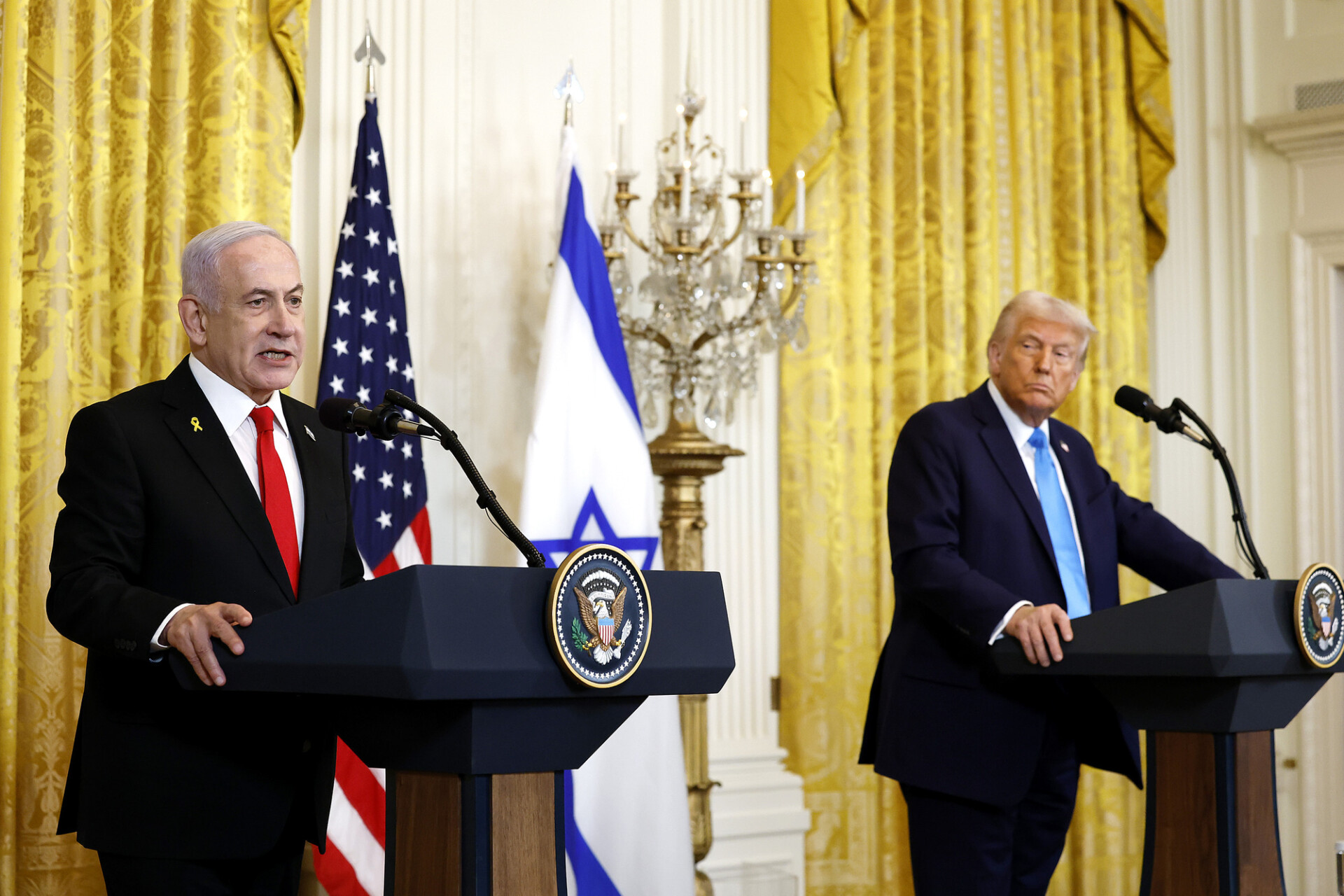
'MAGA world is of two minds,' one source in the White House told UnHerd. Credit: Getty

‘MAGA world is of two minds,’ one source in the White House told UnHerd. Credit: Getty

5 February 2025 - 9:00pm

“It is not the duty of US troops to solve ancient conflicts in faraway lands that many people have never even heard of,” said Donald Trump. “We are not the policemen of the world.”

Trump made those remarks in 2020 at a West Point graduation ceremony. Politico dragged the line back up on Wednesday morning, mere hours after the President surprised even his own senior advisers with the sudden announcement that he intends for the US to “take over the Gaza Strip.” MAGA is now at an ideological crossroads.

Trump’s line at West Point is just one expression of a sentiment that twice won him the White House. Much of the President’s political appeal is built on a staunch opposition to forever wars and nation building. The question for MAGA is whether taking over Gaza counts.

“MAGA world is of two minds,” one source in the White House told UnHerd. “There is the ideologically-driven crowd versus the people who solely exist to advance the Trump agenda. At times, they overlap. If you’re upset about the President not adhering to your niche ideology you should reconsider your line of work”. “The mandate voters gave us was for Trump and his vision,” said the source, “not for junior staff to mouth off.”

As insiders told UnHerd’s newsletter Area 47, the next test for Trumpism will be how the President handles the ongoing ceasefire plan. On the bigger picture question, Trump’s congressional allies carefully pushed back on the announcement. Lindsey Graham, one of the most hawkish Republicans in the Senate, said: “The idea of Americans going in on the ground in Gaza is a non-starter for every senator.”

Meanwhile Sen. Josh Hawley, from MAGA’s intellectual wing, told The New York Times, “I don’t think it’s the best use of United States resources to spend a bunch of money in Gaza. I’d prefer that to be spent in the United States first”. Jack Posobiec of Human Events sounded a similar note, posting on X, “I want to develop EAST Palestine.”

Conservative attorney Will Chamberlain, on the other hand, argued: “You guys aren’t thinking big enough about what Trump is saying about Gaza. The Gaza Strip will be OURS. American property. American sovereignty. An overseas territory. Not someone else’s territory where we are guests. OUR property where we can enforce OUR immigration rules.”

Trump’s plan is both hyper-pragmatic, rejecting the decades-long cycle of violence, while at the same time lacking achievability. This led some on the Right to assume the shock announcement was a negotiating tactic. “I have no interest in the United States owning or developing Gaza. Much less do I want American lives and treasure spent rebuilding some little strip of land thousands of miles away,” said Matt Walsh. “But I have to assume that this is a negotiating tactic by Trump. We’ve seen this kind of approach work repeatedly just in the past few weeks.”

At a Wednesday briefing, White House Press Secretary Karoline Leavitt reiterated that Trump “has not committed to sending Marines or any boots on the ground to Gaza.” Leavitt referred to Trump as the “peacemaker-in-chief” and said the US would not be paying to rebuild Gaza but would instead work with partners in the region to develop the land, temporarily relocate residents, and make the area safe.

An American takeover of the Gaza Strip would not come peacefully. As he left office, Secretary of State Antony Blinken announced”: “We assess that Hamas has recruited almost as many new militants as it has lost.” Hamas, unsurprisingly, called Trump’s new plan “a crime against humanity.” Saudi Arabia and Turkey oppose the measure, with other countries whose cooperation would be key likely to follow. If the US and Israel want to move the people of Gaza, who’ve fought for years to stay on their land, it will require force — barring some unforeseen development.

Israel has long muddled the boundaries of Trump’s “America First” ideology, pitting some realists who found common cause with the movement on, for example, Ukraine, against conservatives who appreciate Trump’s rejection of the Beltway blob because they believe it’s under the sway of Iran sympathisers and antisemites.

Is MAGA realist or neoconservative? The correct answer is the one hiding in plain sight: it’s whatever Trump decides, and he couldn’t care less about DC labels.


Emily Jashinsky is UnHerd‘s Washington correspondent.

emilyjashinsky

China is threatening America in the AI race

Reports sugget Zhipu AI  has released a new model that can rival leading US systems. Credit: Getty

Reports sugget Zhipu AI has released a new model that can rival leading US systems. Credit: Getty

1 July 2026 - 10:18am

China is trying to catch up with America on artificial intelligence. The Wall Street Journal has reported that Zhipu AI — one of China’s six “AI tiger” LLMs — has released a new model that can rival leading US systems, including Anthropic’s Mythos, in cybersecurity tasks such as pinpointing security bugs. While this marks a milestone in China’s drive to catch up with Western AI capabilities, strong performance on a single benchmark does not mean it has taken the lead. Chinese models still lag behind their Western counterparts in broader capabilities, such as autonomous operation. Skepticism is therefore warranted before resorting to hysterical conclusions, but complacency about the geopolitical implications of China’s AI advances would be an even greater mistake.

On the infrastructure side, Chinese AI is still constrained by access to advanced chips, with American labs way ahead in computing capacity as well as investment. Analysis from earlier this year suggests that Chinese models are likely to be at least a few months behind those in the US. But they are still continuing to make progress, or that the geopolitical importance of AI will be decided only by whose LLM has ventured deeper into the technological frontier. The practical applications of AI, countries’ to capture foreign markets, and the application of AI into the real economy will matter just as much.

Here, China may hold an advantage. As with its dominance across many critical supply chains, Beijing may not need to produce the most advanced AI systems — only those that are affordable and widely deployable. In doing so, it could consolidate global influence by supplying functional, low-cost AI at scale.

Beijing seems to be pursuing exactly that path, developing an AI “open-source” strategy that offers affordable, widely available AI models for companies and individuals to use and modify as they wish. The production of the DeepSeek AI model, which matched the performance of Silicon Valley tools such as ChatGPT at a fraction of the cost for users, created goodwill among Chinese models with developers.

The four most popular models on OpenRouter, an AI hardware platform for developers, are now all Chinese. The goal for China is not only to win the frontier-model race, but to make its systems the default layer of AI adoption across industries and global markets. For most economies, the choice is increasingly between an affordable tool they can deploy now and a more robust one that may be out of reach.

And while the countries adopting Chinese models may be exposed to political pressure and cyber threats from Beijing, safer and more capable alternatives matter little if they are unaffordable. American AI companies are already under pressure to monetize products whose operating costs are rising. If Chinese open-source models become the cheap default for startups, universities, governments and businesses across the developing world, then America’s AI lead will be eroded from below.

Perhaps more concerning for America in the long run is how AI can give Chinese manufacturing even more strength, through the ongoing integration of AI as a general-purpose technology. China’s new Five-Year Plan mentioned AI more than 50 times and includes an “AI+” action plan aimed at spreading AI across the economy.

Beijing has been pioneering automation of its critical infrastructure for years, with promising recent results in increasing warplane production capacity. In that regard, China’s open-model strategy and manufacturing dominance will reinforce each other. Cheap, adaptable models accelerate deployment across the real economy while those deployments generate real-world data and use cases that can feed back into further model improvement.

The United States should not dismiss the importance of its lead in the AI race. That lead worries Beijing, not least because a more automated Chinese economy would also become more vulnerable to AI-generated cyber threats. But nor should Washington assume that China cannot catch up with American capabilities over time.

This AI competition represents part of a broader struggle over tech supply chains and geopolitical influence. Decisions over whether to adopt US or Chinese models could produce a more fragmented global reality, with different regions relying on different cloud providers, chips and security structures. The result will likely be a global economy which is divided into competing spheres, rather than one which produces a single winner.


Miquel Vila is a political and geopolitical risk consultant focusing on industrial strategy, critical infrastructure and global supply chains.

miquelvilam