




X Close

Trump’s foreign policy is alienating Americans

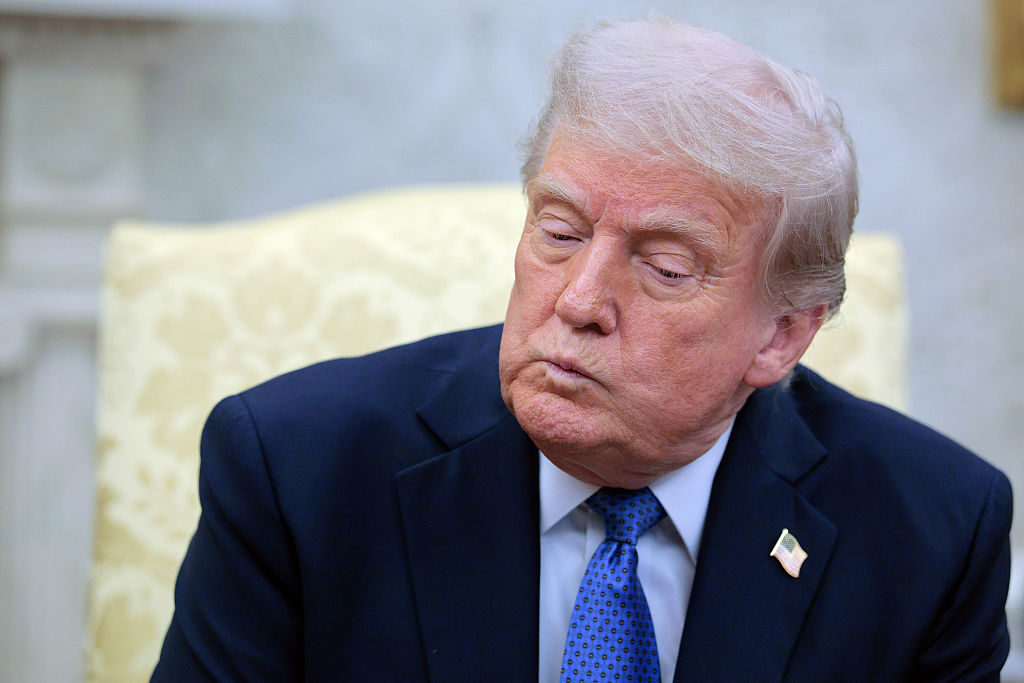
The President's actions should ultimately be judged on whether they serve the national interest or not. Credit: Getty

The President’s actions should ultimately be judged on whether they serve the national interest or not. Credit: Getty

27 April 2025 - 8:30pm

Is the honeymoon over? Two new polls this week paint a grim picture for Donald Trump. According to Pew, 56% of respondents express a lack of confidence in the President’s foreign policy decisions, while half believe his administration has weakened the US internationally compared to the Biden administration. Results from CNN are even more damning: Trump’s net approval on foreign policy has declined 15 percentage points since his inauguration in January. This marks the lowest approval ever recorded for a president at this stage of his tenure.

There are several reasons for this dip. The Trump administration is still in its early days, which means that there aren’t many major foreign policy successes to catalogue yet. Trump is a highly ambitious man who wants to do great things and make his mark on history. But he can also be extraordinarily impatient and has a tendency to juggle so many balls in the air that a few of them are bound to fall to the ground.

That does not make life easy for this national security team, which is stretched thin. One man, billionaire envoy Steve Witkoff, is in the prestigious but unenviable position of negotiating with the Russians, the Iranians, the Israelis and Hamas all at the same time. Whether it’s the war in Ukraine, Gaza, the ongoing nuclear talks with Iran or the trade talks with China that haven’t started yet, all these lines of effort require time, skill and tenacity to resolve — assuming they can be resolved at all.

Of course, Trump does have some foreign policy wins under his belt. The administration’s pressure on Panama coerced the government to remove itself from China’s Belt and Road infrastructure initiative earlier than previously scheduled. Meanwhile, Central America (minus Daniel Ortega’s Nicaragua) is now participating in Washington’s migration policy, if only to stave off whatever economic repercussions Trump might have in store for these countries if they don’t cooperate. The Europeans are boosting their military budgets, with even Spain and Italy, traditionally Europe’s most lax defence spenders, changing their tune.

Trump’s brusque tactics, however, shortchange these accomplishments. The ends are clouded by the means, and the means usually centre on the President using a sharp stick to get what he wants. Whether it’s through tariffs, rhetorical bomb-throwing or threats to reassess longstanding defence relationships, Trump is more interested in subservience than compromise. This rubs a lot of people up the wrong way and could, over time, cause some of these targeted countries to hedge against the United States by seeking alternative foreign relationships elsewhere.

Finally, one can’t underestimate the power of the status quo. Before Trump came along, US foreign policy was static, listless and based on the same three old assumptions: America is the chief defender of the so-called rules-based international order, the chief bulwark against authoritarians, and a superpower which has the responsibility to dip its toes into every international issue. Although there was some variance across administrations — Barack Obama hated his predecessor’s fondness for preventive wars, for instance — US foreign policy was largely the same over the last 40 years. In short: you knew what you were getting.

Yet Trump doesn’t care about the rules-based order, doesn’t buy into the democracy versus authoritarianism framing, and is often as hard on allies as he is on adversaries. He still thinks America is the world’s most exceptional nation due its military strength and economic stamina. But he dismisses the notion that it should be fighting other states’ battles and protecting allies indefinitely. There are no optimistic, emotional Reagan-esque “shining city on a hill” moments from Trump. Instead, what we’re getting is a mix of William McKinley and James Polk.

Whatever the reasons for the lacklustre poll numbers, Trump’s foreign policy decisions should ultimately be judged on whether they serve the US national interests, not on whether they win a popularity contest.


Daniel R. DePetris is a fellow at Defense Priorities and a syndicated foreign affairs columnist for the Chicago Tribune.

DanDePetris

China is threatening America in the AI race

Reports sugget Zhipu AI  has released a new model that can rival leading US systems. Credit: Getty

Reports sugget Zhipu AI has released a new model that can rival leading US systems. Credit: Getty

1 July 2026 - 10:18am

China is trying to catch up with America on artificial intelligence. The Wall Street Journal has reported that Zhipu AI — one of China’s six “AI tiger” LLMs — has released a new model that can rival leading US systems, including Anthropic’s Mythos, in cybersecurity tasks such as pinpointing security bugs. While this marks a milestone in China’s drive to catch up with Western AI capabilities, strong performance on a single benchmark does not mean it has taken the lead. Chinese models still lag behind their Western counterparts in broader capabilities, such as autonomous operation. Skepticism is therefore warranted before resorting to hysterical conclusions, but complacency about the geopolitical implications of China’s AI advances would be an even greater mistake.

On the infrastructure side, Chinese AI is still constrained by access to advanced chips, with American labs way ahead in computing capacity as well as investment. Analysis from earlier this year suggests that Chinese models are likely to be at least a few months behind those in the US. But they are still continuing to make progress, or that the geopolitical importance of AI will be decided only by whose LLM has ventured deeper into the technological frontier. The practical applications of AI, countries’ to capture foreign markets, and the application of AI into the real economy will matter just as much.

Here, China may hold an advantage. As with its dominance across many critical supply chains, Beijing may not need to produce the most advanced AI systems — only those that are affordable and widely deployable. In doing so, it could consolidate global influence by supplying functional, low-cost AI at scale.

Beijing seems to be pursuing exactly that path, developing an AI “open-source” strategy that offers affordable, widely available AI models for companies and individuals to use and modify as they wish. The production of the DeepSeek AI model, which matched the performance of Silicon Valley tools such as ChatGPT at a fraction of the cost for users, created goodwill among Chinese models with developers.

The four most popular models on OpenRouter, an AI hardware platform for developers, are now all Chinese. The goal for China is not only to win the frontier-model race, but to make its systems the default layer of AI adoption across industries and global markets. For most economies, the choice is increasingly between an affordable tool they can deploy now and a more robust one that may be out of reach.

And while the countries adopting Chinese models may be exposed to political pressure and cyber threats from Beijing, safer and more capable alternatives matter little if they are unaffordable. American AI companies are already under pressure to monetize products whose operating costs are rising. If Chinese open-source models become the cheap default for startups, universities, governments and businesses across the developing world, then America’s AI lead will be eroded from below.

Perhaps more concerning for America in the long run is how AI can give Chinese manufacturing even more strength, through the ongoing integration of AI as a general-purpose technology. China’s new Five-Year Plan mentioned AI more than 50 times and includes an “AI+” action plan aimed at spreading AI across the economy.

Beijing has been pioneering automation of its critical infrastructure for years, with promising recent results in increasing warplane production capacity. In that regard, China’s open-model strategy and manufacturing dominance will reinforce each other. Cheap, adaptable models accelerate deployment across the real economy while those deployments generate real-world data and use cases that can feed back into further model improvement.

The United States should not dismiss the importance of its lead in the AI race. That lead worries Beijing, not least because a more automated Chinese economy would also become more vulnerable to AI-generated cyber threats. But nor should Washington assume that China cannot catch up with American capabilities over time.

This AI competition represents part of a broader struggle over tech supply chains and geopolitical influence. Decisions over whether to adopt US or Chinese models could produce a more fragmented global reality, with different regions relying on different cloud providers, chips and security structures. The result will likely be a global economy which is divided into competing spheres, rather than one which produces a single winner.


Miquel Vila is a political and geopolitical risk consultant focusing on industrial strategy, critical infrastructure and global supply chains.

miquelvilam