




X Close

Trump won’t defeat Brics

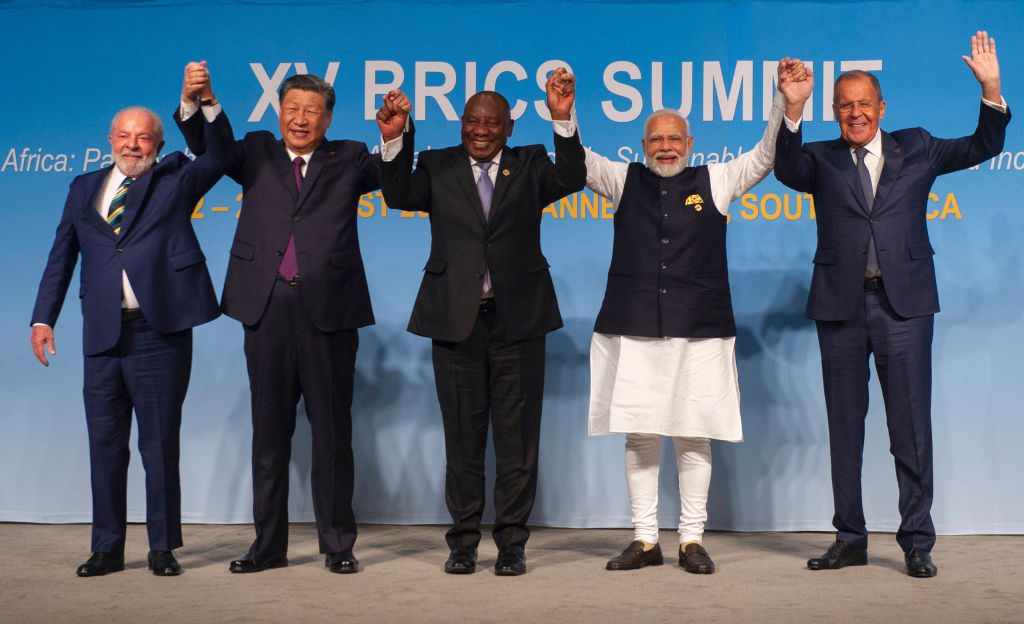
‘Three cheers for multipolarity.’ Credit: Getty

‘Three cheers for multipolarity.’ Credit: Getty

July 9 2025 - 5:30pm

Having beaten a rapid retreat following the opening volley of “Liberation Day” in April, Donald Trump has now made another sally in his global trade war. On Sunday night, he threatened to impose higher rates on any country aligning itself with the “anti-American policies” of the Brics+ group. Posting on his social media platform Truth Social, Trump’s warning was timed to coincide with the Brics+ summit that was drawing to a close in Rio de Janeiro. Brazilian President Lula shot back, declaring that the world does not need an “emperor” and that the US President was targeting sovereign nations. But what is it about the Brics countries that draws Trump’s ire, and how vulnerable are they to the threat of extra tariffs?

Formed in 2009, during the peak era of US global supremacy, the Brics group initially cast itself as a haven to help consolidate emerging powers, precisely because they were in no position to tangle with America. As US power has declined since, the group has grown more self-confident, styling its members as the “global majority”. Radical activists and Brics state media have puffed the group up into nothing less than a grand anti-imperialist front, destined to overturn centuries of Western hegemony and free the world’s peoples from US domination.

In truth, there is little basis for such lurid fantasies of Third-World revolt. It is worth remembering that the Brics label was hatched neither in Moscow nor Beijing, but instead as a marketing gimmick by the Goldman Sachs banker Jim O’Neill, who was looking to build new investment vehicles around emerging markets at the start of the century. While expanding Brics to include large economies such as Indonesia and Saudi Arabia will certainly inflate its overall share of the global economy, it will not strengthen the group’s geopolitical significance.

Scattered across continents and oceans, the diversity of the group’s members does not make up for their geographic diffusion, comprising a variety of regimes — ranging from democracies such as India and Brazil to autocracies such Russia and China — as well as internal contradictions between its core members. These tensions come in the form of sharing disputed borders (China and India) and economic rivalry (with Chinese exports eating away at Brazilian industry). The addition of regional foes such as Saudi Arabia and Iran will do nothing to settle this volatile mix. To cap it all off, Russia’s Vladimir Putin and China’s Xi Jinping both notably snubbed the Rio summit this month, sending delegates in their stead, and the gathering was muted on how strongly to denounce Israel’s war in Gaza.

The reason Trump has threatened the Brics+ countries with extra tariffs is not because he is worried about being swept away by the “global majority”. Rather, it is due to Brics+ efforts to set up global trading arrangements based on blockchain rather than the US dollar, thereby outflanking the financial basis of American hegemony. The status of the dollar lies at the crux of Trump’s trade war, with the tariffs constituting a knight’s move rather than a frontal assault. They are intended to grow American exports by deflating the value of the dollar while simultaneously keeping its role as the world’s dominant reserve currency.

Trump’s convoluted and seemingly haphazard strategy is unlikely to succeed in preserving the status of the dollar. But the Brics states are not ready to abandon the greenback in favor of a blockchain system devised by St Petersburg State University either. We have the prospect of a very stoppable force crashing into a very moveable object: what happens in such a confrontation?

For the moment, the world defaults to gold, with purchases of the precious metal pushing the euro into third place as a global currency asset. Instead of a clash between “the old stagnant bloc” of the West and the “emerging bloc of Brics countries” as each was styled by Bolivia’s Left-wing president Luis Arce in Rio, we are seeing something stranger and more historically novel. This is a world which is bipolar in geopolitical terms, with China and the US as contending superpowers, but increasingly multipolar in financial terms, as the status of the dollar is eroded but not replaced, and in which old currencies will be routed through new digital systems. This is a world rich in opportunity for mid-sized powers and smaller states – if they are willing to break with the decrepit institutions and ideologies of the 20th century.


Philip Cunliffe is Associate Professor of International Relations at the Department of Risk and Disaster Reduction, University College London. He is the author of seven books, including, most recently: The National Interest: Politics after Globalization.

thephilippics

China is threatening America in the AI race

Reports sugget Zhipu AI  has released a new model that can rival leading US systems. Credit: Getty

Reports sugget Zhipu AI has released a new model that can rival leading US systems. Credit: Getty

July 1 2026 - 10:18am

China is trying to catch up with America on artificial intelligence. The Wall Street Journal has reported that Zhipu AI — one of China’s six “AI tiger” LLMs — has released a new model that can rival leading US systems, including Anthropic’s Mythos, in cybersecurity tasks such as pinpointing security bugs. While this marks a milestone in China’s drive to catch up with Western AI capabilities, strong performance on a single benchmark does not mean it has taken the lead. Chinese models still lag behind their Western counterparts in broader capabilities, such as autonomous operation. Skepticism is therefore warranted before resorting to hysterical conclusions, but complacency about the geopolitical implications of China’s AI advances would be an even greater mistake.

On the infrastructure side, Chinese AI is still constrained by access to advanced chips, with American labs way ahead in computing capacity as well as investment. Analysis from earlier this year suggests that Chinese models are likely to be at least a few months behind those in the US. But they are still continuing to make progress, or that the geopolitical importance of AI will be decided only by whose LLM has ventured deeper into the technological frontier. The practical applications of AI, countries’ to capture foreign markets, and the application of AI into the real economy will matter just as much.

Here, China may hold an advantage. As with its dominance across many critical supply chains, Beijing may not need to produce the most advanced AI systems — only those that are affordable and widely deployable. In doing so, it could consolidate global influence by supplying functional, low-cost AI at scale.

Beijing seems to be pursuing exactly that path, developing an AI “open-source” strategy that offers affordable, widely available AI models for companies and individuals to use and modify as they wish. The production of the DeepSeek AI model, which matched the performance of Silicon Valley tools such as ChatGPT at a fraction of the cost for users, created goodwill among Chinese models with developers.

The four most popular models on OpenRouter, an AI hardware platform for developers, are now all Chinese. The goal for China is not only to win the frontier-model race, but to make its systems the default layer of AI adoption across industries and global markets. For most economies, the choice is increasingly between an affordable tool they can deploy now and a more robust one that may be out of reach.

And while the countries adopting Chinese models may be exposed to political pressure and cyber threats from Beijing, safer and more capable alternatives matter little if they are unaffordable. American AI companies are already under pressure to monetize products whose operating costs are rising. If Chinese open-source models become the cheap default for startups, universities, governments and businesses across the developing world, then America’s AI lead will be eroded from below.

Perhaps more concerning for America in the long run is how AI can give Chinese manufacturing even more strength, through the ongoing integration of AI as a general-purpose technology. China’s new Five-Year Plan mentioned AI more than 50 times and includes an “AI+” action plan aimed at spreading AI across the economy.

Beijing has been pioneering automation of its critical infrastructure for years, with promising recent results in increasing warplane production capacity. In that regard, China’s open-model strategy and manufacturing dominance will reinforce each other. Cheap, adaptable models accelerate deployment across the real economy while those deployments generate real-world data and use cases that can feed back into further model improvement.

The United States should not dismiss the importance of its lead in the AI race. That lead worries Beijing, not least because a more automated Chinese economy would also become more vulnerable to AI-generated cyber threats. But nor should Washington assume that China cannot catch up with American capabilities over time.

This AI competition represents part of a broader struggle over tech supply chains and geopolitical influence. Decisions over whether to adopt US or Chinese models could produce a more fragmented global reality, with different regions relying on different cloud providers, chips and security structures. The result will likely be a global economy which is divided into competing spheres, rather than one which produces a single winner.


Miquel Vila is a political and geopolitical risk consultant focusing on industrial strategy, critical infrastructure and global supply chains.

miquelvilam