



X Close

Trump is playing a dangerous game with the Federal Reserve

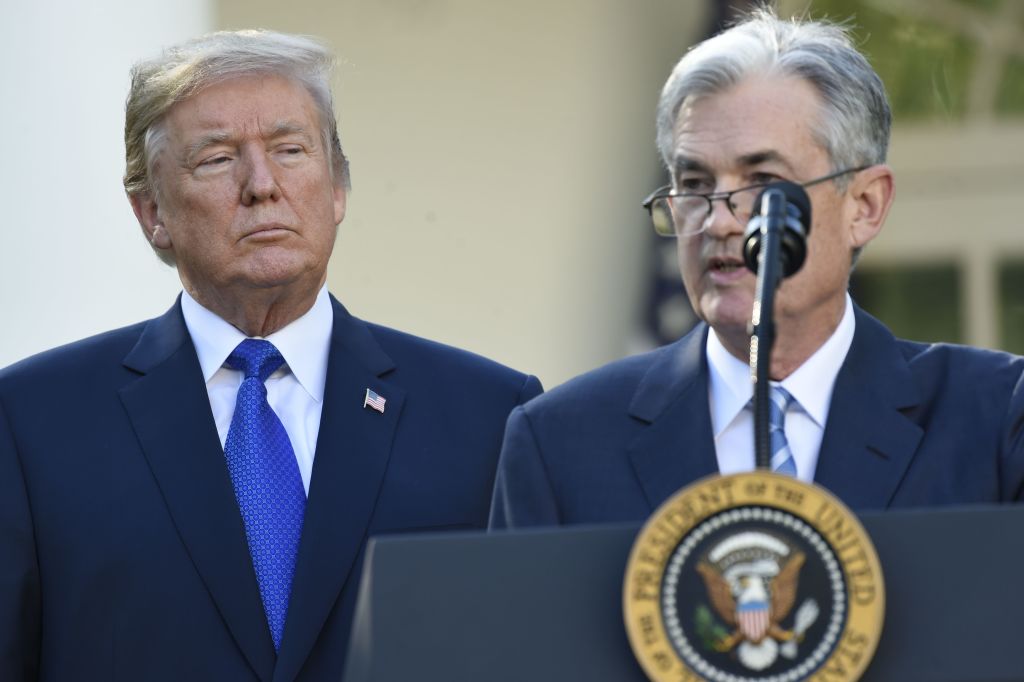
Jerome Powell speaks after being nominated for Chairman of the Federal Reserve by US President Donald Trump in 2017. Credit: SAUL LOEB/AFP via Getty

Jerome Powell speaks after being nominated for Chairman of the Federal Reserve by US President Donald Trump in 2017. Credit: SAUL LOEB/AFP via Getty

August 9 2024 - 4:00pm

‘I made a lot of money, I was very successful,’ said Donald Trump, when asked if he felt the president should have a direct say in the Federal Reserve’s policy decisions. ‘I have a better instinct than, in many cases, people that would be on the Federal Reserve or the chairman.’

We’ve been here before. Prior to Liz Truss’s disastrous 2022 mini-budget, she sidelined the Office for Budget Responsibility and wanted to review the Bank of England’s independence, convinced that their groupthink made them unable to grasp how her radical re-orientation of policy would revive the nation’s economy. In this she channeled the thinking of her economic gurus, who wanted to return to the days when the Treasury controlled both monetary policy and economic forecasting. In short, they reckoned they had a better instinct than the ‘anti-growth coalition’ that had come to direct Britain’s economic framework.

A US President can’t just take control of Fed policy the way a British prime minister could notionally do with the Old Lady. Most Fed governors are selected by the regional Reserve Banks, so lie beyond the president’s influence. But the commander-in-chief gets to choose the chairman, and so could find someone like-minded. And to the extent the chairman has an outsized influence at the committee meetings which set interest rates, the president could apply considerable leverage through this back-channel.

We can probably guess what a Trump-directed Federal Reserve would then look like, because the United States had something similar before. During the presidency of Richard Nixon, Fed chairman Arthur Burns submitted to pressure from the president to keep interest rates low amid the period’s high inflation. This enabled the Nixon administration to run large fiscal deficits, since the Fed ‘monetized’ government debts by effectively printing new money to cover the shortfalls.

But the addition of new money supply to the economy worsened inflation. It was only later in the decade, when President Jimmy Carter appointed Paul Volcker as Fed chairman, that this policy was reversed. Volcker’s famous ‘Saturday Night Special,’ at which he announced the start of a period of sharply higher interest rates, forced governments to tighten their belts, and wrestled inflation back to the ground.

Ever since, it’s been orthodoxy for politicians to stay out of monetary policy, something enshrined in Britain in 1997 when Chancellor Gordon Brown gave the Bank of England operational independence. This has always rankled those who feel it’s undemocratic to give so much power over the country’s economic direction to an independent, unaccountable body. But the argument for central bank independence resembles what Winston Churchill said of democracy — a lousy regime, except for all the others. Or put simply, do we really want another Liz Truss moment?

The US is not Britain, of course. Trump would like to pull a Truss, raising the deficit to cut taxes, all while keeping interest rates low. But such measures would be much less likely to cause a market panic of the sort Britain experienced in the autumn of 2022. With by far the world’s deepest capital markets, not to mention its reserve currency, the US would not likely witness the dumping of government bonds on a scale anything like what Britain did.

Nevertheless, it would probably experience a gradual reduction in demand for its bonds, which would result in a steady rise in interest rates amid rising inflation. The pot might not boil immediately. Nevertheless the water in which the proverbial frog sat would likely keep getting hotter until the US got its next Volcker moment. Trump’s best hope would be to have finished his term before then.


John Rapley is an author and academic who divides his time between London, Johannesburg and Ottawa. His books include Why Empires Fall: Rome, America and the Future of the West (with Peter Heather, Penguin, 2023) and Twilight of the Money Gods: Economics as a Religion (Simon & Schuster, 2017).

jarapley

China is threatening America in the AI race

Reports sugget Zhipu AI  has released a new model that can rival leading US systems. Credit: Getty

Reports sugget Zhipu AI has released a new model that can rival leading US systems. Credit: Getty

July 1 2026 - 10:18am

China is trying to catch up with America on artificial intelligence. The Wall Street Journal has reported that Zhipu AI — one of China’s six “AI tiger” LLMs — has released a new model that can rival leading US systems, including Anthropic’s Mythos, in cybersecurity tasks such as pinpointing security bugs. While this marks a milestone in China’s drive to catch up with Western AI capabilities, strong performance on a single benchmark does not mean it has taken the lead. Chinese models still lag behind their Western counterparts in broader capabilities, such as autonomous operation. Skepticism is therefore warranted before resorting to hysterical conclusions, but complacency about the geopolitical implications of China’s AI advances would be an even greater mistake.

On the infrastructure side, Chinese AI is still constrained by access to advanced chips, with American labs way ahead in computing capacity as well as investment. Analysis from earlier this year suggests that Chinese models are likely to be at least a few months behind those in the US. But they are still continuing to make progress, or that the geopolitical importance of AI will be decided only by whose LLM has ventured deeper into the technological frontier. The practical applications of AI, countries’ to capture foreign markets, and the application of AI into the real economy will matter just as much.

Here, China may hold an advantage. As with its dominance across many critical supply chains, Beijing may not need to produce the most advanced AI systems — only those that are affordable and widely deployable. In doing so, it could consolidate global influence by supplying functional, low-cost AI at scale.

Beijing seems to be pursuing exactly that path, developing an AI “open-source” strategy that offers affordable, widely available AI models for companies and individuals to use and modify as they wish. The production of the DeepSeek AI model, which matched the performance of Silicon Valley tools such as ChatGPT at a fraction of the cost for users, created goodwill among Chinese models with developers.

The four most popular models on OpenRouter, an AI hardware platform for developers, are now all Chinese. The goal for China is not only to win the frontier-model race, but to make its systems the default layer of AI adoption across industries and global markets. For most economies, the choice is increasingly between an affordable tool they can deploy now and a more robust one that may be out of reach.

And while the countries adopting Chinese models may be exposed to political pressure and cyber threats from Beijing, safer and more capable alternatives matter little if they are unaffordable. American AI companies are already under pressure to monetize products whose operating costs are rising. If Chinese open-source models become the cheap default for startups, universities, governments and businesses across the developing world, then America’s AI lead will be eroded from below.

Perhaps more concerning for America in the long run is how AI can give Chinese manufacturing even more strength, through the ongoing integration of AI as a general-purpose technology. China’s new Five-Year Plan mentioned AI more than 50 times and includes an “AI+” action plan aimed at spreading AI across the economy.

Beijing has been pioneering automation of its critical infrastructure for years, with promising recent results in increasing warplane production capacity. In that regard, China’s open-model strategy and manufacturing dominance will reinforce each other. Cheap, adaptable models accelerate deployment across the real economy while those deployments generate real-world data and use cases that can feed back into further model improvement.

The United States should not dismiss the importance of its lead in the AI race. That lead worries Beijing, not least because a more automated Chinese economy would also become more vulnerable to AI-generated cyber threats. But nor should Washington assume that China cannot catch up with American capabilities over time.

This AI competition represents part of a broader struggle over tech supply chains and geopolitical influence. Decisions over whether to adopt US or Chinese models could produce a more fragmented global reality, with different regions relying on different cloud providers, chips and security structures. The result will likely be a global economy which is divided into competing spheres, rather than one which produces a single winner.


Miquel Vila is a political and geopolitical risk consultant focusing on industrial strategy, critical infrastructure and global supply chains.

miquelvilam
