




X Close

Trump is changing his tune on Canada

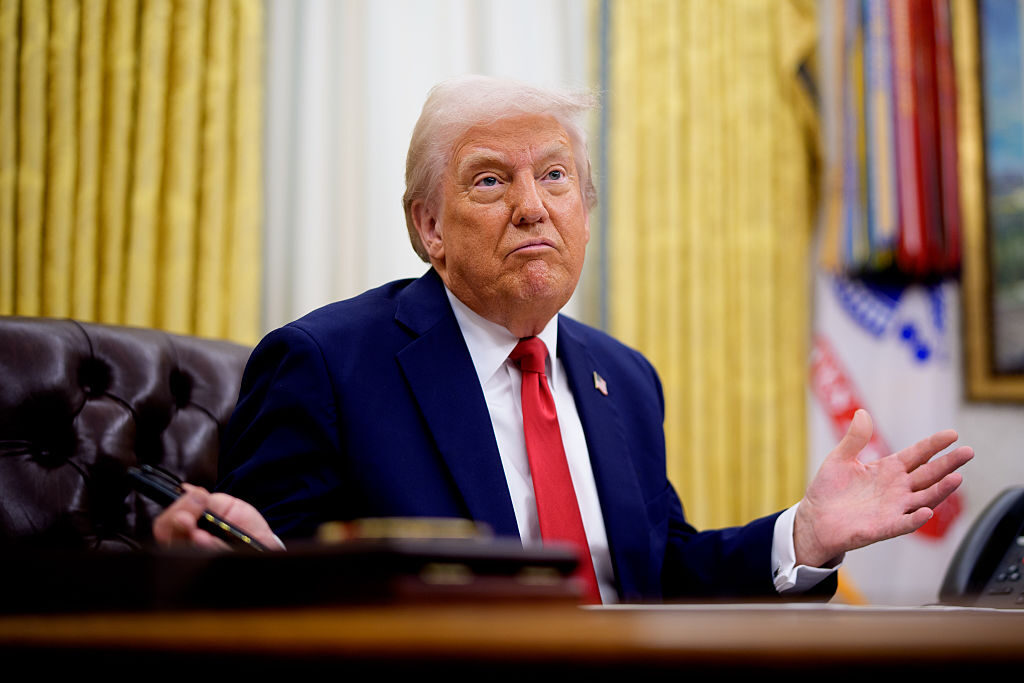
Talk of the '51st state' has evaporated. Credit: Getty

Talk of the ’51st state’ has evaporated. Credit: Getty

2 April 2025 - 4:10pm

As Donald Trump’s so-called “Liberation Day” on tariffs arrives, observers are wondering whether Canada’s change of leadership will have any effect on the eventual settlement. And if the first phone call last week between US President Donald Trump and Canadian PM Mark Carney is any indication, the American administration seems ready to take a softer tone toward its northern ally — even as both sides remain firm in their readiness to wage a tit-for-tat trade war, with Canada’s Foreign Minister saying as much today.

The shift became clear after the call when Trump posted a more restrained and respectful message on Truth Social, referring to Canada’s leader by his title (instead of “governor”) and dropping all talk of “the 51st State”. At a press conference, Trump explicitly noted that he was “not referring to Canada” when talking about “countries that have taken advantage of us”, after previously claiming that Canada was a “nasty” trade partner. For his part, Carney affirmed that Trump “respected Canada’s sovereignty”, something he had laid down as a precondition for meeting with his American counterpart.

What explains this sudden change in the US President’s rhetoric and, more importantly, will it last? Perhaps learning from his predecessor’s blunders, Carney has been careful to adopt a negotiating posture with the US that is both smarter and more confident. For instance, where Trudeau casually — if unwittingly — conceded the fact of Canada’s economic dependence on American trade last year, Carney has been adamant in affirming Canada’s available options for reorienting its economic and strategic relationships. This was most evident in his decision to make Paris and London the destinations of his first official trip as PM, snubbing Washington — the traditional place to go for new Canadian leaders. Carney also questioned the viability of continuing to buy American F-35s, before flatly declaring the US-Canada relationship to be effectively “over”.

This willingness to assert independence from Washington has evidently rattled the US — as evidenced by an earlier Truth Social post threatening more tariffs on both Canada and the EU should they establish closer trade ties. But such moves have also allowed Ottawa to illustrate, in no uncertain terms, what leverage it does have before its larger and more powerful neighbour.

Canada’s auto and steel sectors are already bracing for layoffs with the toll of Trump’s tariffs projected at around 1.5 million job losses, amounting to a recession. Yet there are also signs, in line with Trump’s milder tone, that the US is considering lessening the impact of its 25% global auto tariffs on Canada, with whom its manufacturing sector is deeply integrated.

As Trump himself indicated, he is interested in meeting with Carney after the election — in language suggesting he foresees a Liberal victory — in order to work out a deal (i.e. a renegotiation of USMCA) that will be “great for both the United States and Canada”. It is unlikely, however, for either side to desire a return to the status quo ante, most of all the Canadians whose trust in the US has been mortally damaged. USMCA was, after all, signed by Trump himself in 2018. His dramatic contravention of the terms of his own trade deal has basically erased American credibility in the eyes of Canada and, indeed, much of the rest of the world.

In that case, a new settlement is more likely to be negotiated around a gradual unbundling of the two economies, as the US looks to be more internally self-sufficient, and as Canada looks for more reliable trading partners beyond the American orbit. Such an outcome would at least allow both Ottawa and Washington to pursue divergent paths while giving their economies time to plan and adapt accordingly.

To the real estate negotiator in the White House, who has been known to respond to strength and decisiveness, Carney’s headstrong tactics may be enough to move the needle, at least a bit. Though as ex-Trump adviser-turned-critic John Bolton cautioned, nobody should “over-conclude” anything about the notoriously fickle President. And to the voters of Canada, Carney’s actions could serve as yet more proof that he is the man to lead the country through tumultuous times ahead: the polls seem to suggest as much.


Michael Cuenco is Senior Editor at American Affairs.
1TrueCuencoism

China is threatening America in the AI race

Reports sugget Zhipu AI  has released a new model that can rival leading US systems. Credit: Getty

Reports sugget Zhipu AI has released a new model that can rival leading US systems. Credit: Getty

1 July 2026 - 10:18am

China is trying to catch up with America on artificial intelligence. The Wall Street Journal has reported that Zhipu AI — one of China’s six “AI tiger” LLMs — has released a new model that can rival leading US systems, including Anthropic’s Mythos, in cybersecurity tasks such as pinpointing security bugs. While this marks a milestone in China’s drive to catch up with Western AI capabilities, strong performance on a single benchmark does not mean it has taken the lead. Chinese models still lag behind their Western counterparts in broader capabilities, such as autonomous operation. Skepticism is therefore warranted before resorting to hysterical conclusions, but complacency about the geopolitical implications of China’s AI advances would be an even greater mistake.

On the infrastructure side, Chinese AI is still constrained by access to advanced chips, with American labs way ahead in computing capacity as well as investment. Analysis from earlier this year suggests that Chinese models are likely to be at least a few months behind those in the US. But they are still continuing to make progress, or that the geopolitical importance of AI will be decided only by whose LLM has ventured deeper into the technological frontier. The practical applications of AI, countries’ to capture foreign markets, and the application of AI into the real economy will matter just as much.

Here, China may hold an advantage. As with its dominance across many critical supply chains, Beijing may not need to produce the most advanced AI systems — only those that are affordable and widely deployable. In doing so, it could consolidate global influence by supplying functional, low-cost AI at scale.

Beijing seems to be pursuing exactly that path, developing an AI “open-source” strategy that offers affordable, widely available AI models for companies and individuals to use and modify as they wish. The production of the DeepSeek AI model, which matched the performance of Silicon Valley tools such as ChatGPT at a fraction of the cost for users, created goodwill among Chinese models with developers.

The four most popular models on OpenRouter, an AI hardware platform for developers, are now all Chinese. The goal for China is not only to win the frontier-model race, but to make its systems the default layer of AI adoption across industries and global markets. For most economies, the choice is increasingly between an affordable tool they can deploy now and a more robust one that may be out of reach.

And while the countries adopting Chinese models may be exposed to political pressure and cyber threats from Beijing, safer and more capable alternatives matter little if they are unaffordable. American AI companies are already under pressure to monetize products whose operating costs are rising. If Chinese open-source models become the cheap default for startups, universities, governments and businesses across the developing world, then America’s AI lead will be eroded from below.

Perhaps more concerning for America in the long run is how AI can give Chinese manufacturing even more strength, through the ongoing integration of AI as a general-purpose technology. China’s new Five-Year Plan mentioned AI more than 50 times and includes an “AI+” action plan aimed at spreading AI across the economy.

Beijing has been pioneering automation of its critical infrastructure for years, with promising recent results in increasing warplane production capacity. In that regard, China’s open-model strategy and manufacturing dominance will reinforce each other. Cheap, adaptable models accelerate deployment across the real economy while those deployments generate real-world data and use cases that can feed back into further model improvement.

The United States should not dismiss the importance of its lead in the AI race. That lead worries Beijing, not least because a more automated Chinese economy would also become more vulnerable to AI-generated cyber threats. But nor should Washington assume that China cannot catch up with American capabilities over time.

This AI competition represents part of a broader struggle over tech supply chains and geopolitical influence. Decisions over whether to adopt US or Chinese models could produce a more fragmented global reality, with different regions relying on different cloud providers, chips and security structures. The result will likely be a global economy which is divided into competing spheres, rather than one which produces a single winner.


Miquel Vila is a political and geopolitical risk consultant focusing on industrial strategy, critical infrastructure and global supply chains.

miquelvilam