




X Close

Trump could lose AI race by clinging to coal

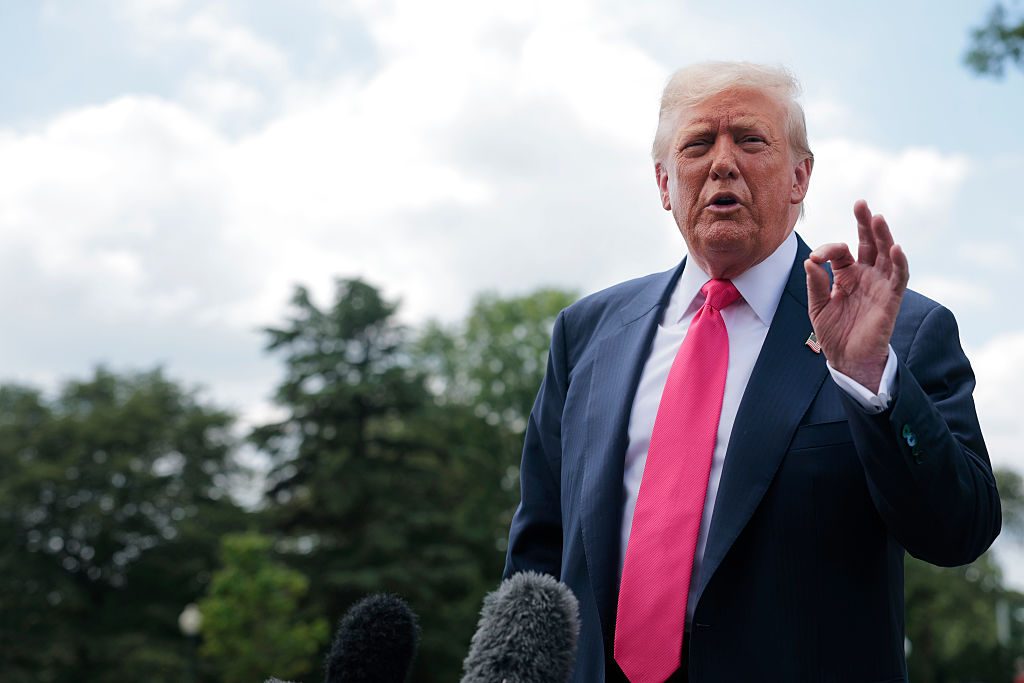
A new golden age has been put on pause. Credit: Getty

A new golden age has been put on pause. Credit: Getty

16 July 2025 - 5:30pm

Donald Trump yesterday came to Pennsylvania’s Steel City, a symbol of America’s industrial past, to announce the country’s next “golden age” in the race with China for AI supremacy. It was a grand announcement, but the US is by no means storming ahead.

“America’s destiny is to dominate every industry and be the first in every technology, and that includes being the world’s number one superpower in artificial intelligence,” the President said at the Pennsylvania Energy & Innovation Summit. “And we are way ahead of China,” he added, admitting that at first AI was “not my thing”.

Republican Senator Dave McCormick had convened hundreds of investors, Big Tech leaders, and policymakers in Pittsburgh to announce $92 billion of private-sector investment in natural gas, nuclear power, and data centres that he said will create tens of thousands of jobs in the state.

Trump’s presence cemented Pennsylvania, which swung for the Republican candidate in 2016 and 2024, as the pivotal player in re-industrialising America and competing with China — rhetoric that Democratic Governor Josh Shapiro used when Amazon announced a $20 billion investment in Pennsylvania data centre campuses just a month ago.

While the data centre investments bring impressive dollar figures, it is unlikely that these initiatives will spark a true techno-industrial renaissance. First, once construction is over, data centres don’t need that many workers to operate. Tax revenues are their main benefit, which has allowed Loudoun County, Virginia — the data centre capital of the United States — to have the lowest real estate property tax rate in Northern Virginia.

And then there’s the question of whether regular electricity customers will have to pay for all the costs that go into the power plants and transmission lines these centres will need. A 2024 Virginia audit found that accommodating data centres’ increased energy demand would hike up monthly electricity costs for a typical customer by $14 to $37 by 2040. It’s no wonder, then, that locals in northeast Pennsylvania are protesting against power lines which the utility company wants to build to power data centres.

Trump promised to let tech companies build their own power plants next to data centres, powered by natural gas, nuclear power, and coal — but not wind. His Big Beautiful Bill, which he lauded as “the biggest tax cut in history”, attempts to resurrect America’s dirty coal industry, even as solar-powered electricity now costs less than natural gas. It will also phase out tax credits for solar, wind, and electric vehicles, putting at risk billions of dollars of renewable investments and kneecapping former president Joe Biden’s push for clean energy.

At a time when Saudi Arabia is investing billions of dollars in solar and wind power to generate the force necessary for AI data centres, Trump seems to want to turn the United States — or Pennsylvania with its massive natural gas reserves — into a petrostate. Given that China has leapfrogged the US in solar, batteries, critical mineral processing, and electric vehicles, the President appears to be tying one arm behind his back.

Though heavily reliant on coal, China’s truly “all-of-the-above” energy mix produces twice the electricity of the US — electricity Big Tech companies such as Amazon and Google say they need to power data centres and advance AI. Recognising this threat, Trump has ordered the Department of Energy to remove regulatory barriers and help add 300 GW of nuclear capacity by 2050. Already, Amazon is building a data centre campus next to a Pennsylvania power plant just as Microsoft brings Three Mile Island back online. Manufacturer Westinghouse used the summit to announce plans to build 10 nuclear reactors across the country.

“Lots of jobs. Lots of success. It’s going to be beautiful to behold,” Trump said. “We have a true golden age for America.” And as for China, “we’re not catching them, we’re leading.”

Ethan Dodd is a DC-based journalist covering the reindustrialization of America. Follow him on X: @ethandasaxman.


China is threatening America in the AI race

Reports sugget Zhipu AI  has released a new model that can rival leading US systems. Credit: Getty

Reports sugget Zhipu AI has released a new model that can rival leading US systems. Credit: Getty

1 July 2026 - 10:18am

China is trying to catch up with America on artificial intelligence. The Wall Street Journal has reported that Zhipu AI — one of China’s six “AI tiger” LLMs — has released a new model that can rival leading US systems, including Anthropic’s Mythos, in cybersecurity tasks such as pinpointing security bugs. While this marks a milestone in China’s drive to catch up with Western AI capabilities, strong performance on a single benchmark does not mean it has taken the lead. Chinese models still lag behind their Western counterparts in broader capabilities, such as autonomous operation. Skepticism is therefore warranted before resorting to hysterical conclusions, but complacency about the geopolitical implications of China’s AI advances would be an even greater mistake.

On the infrastructure side, Chinese AI is still constrained by access to advanced chips, with American labs way ahead in computing capacity as well as investment. Analysis from earlier this year suggests that Chinese models are likely to be at least a few months behind those in the US. But they are still continuing to make progress, or that the geopolitical importance of AI will be decided only by whose LLM has ventured deeper into the technological frontier. The practical applications of AI, countries’ to capture foreign markets, and the application of AI into the real economy will matter just as much.

Here, China may hold an advantage. As with its dominance across many critical supply chains, Beijing may not need to produce the most advanced AI systems — only those that are affordable and widely deployable. In doing so, it could consolidate global influence by supplying functional, low-cost AI at scale.

Beijing seems to be pursuing exactly that path, developing an AI “open-source” strategy that offers affordable, widely available AI models for companies and individuals to use and modify as they wish. The production of the DeepSeek AI model, which matched the performance of Silicon Valley tools such as ChatGPT at a fraction of the cost for users, created goodwill among Chinese models with developers.

The four most popular models on OpenRouter, an AI hardware platform for developers, are now all Chinese. The goal for China is not only to win the frontier-model race, but to make its systems the default layer of AI adoption across industries and global markets. For most economies, the choice is increasingly between an affordable tool they can deploy now and a more robust one that may be out of reach.

And while the countries adopting Chinese models may be exposed to political pressure and cyber threats from Beijing, safer and more capable alternatives matter little if they are unaffordable. American AI companies are already under pressure to monetize products whose operating costs are rising. If Chinese open-source models become the cheap default for startups, universities, governments and businesses across the developing world, then America’s AI lead will be eroded from below.

Perhaps more concerning for America in the long run is how AI can give Chinese manufacturing even more strength, through the ongoing integration of AI as a general-purpose technology. China’s new Five-Year Plan mentioned AI more than 50 times and includes an “AI+” action plan aimed at spreading AI across the economy.

Beijing has been pioneering automation of its critical infrastructure for years, with promising recent results in increasing warplane production capacity. In that regard, China’s open-model strategy and manufacturing dominance will reinforce each other. Cheap, adaptable models accelerate deployment across the real economy while those deployments generate real-world data and use cases that can feed back into further model improvement.

The United States should not dismiss the importance of its lead in the AI race. That lead worries Beijing, not least because a more automated Chinese economy would also become more vulnerable to AI-generated cyber threats. But nor should Washington assume that China cannot catch up with American capabilities over time.

This AI competition represents part of a broader struggle over tech supply chains and geopolitical influence. Decisions over whether to adopt US or Chinese models could produce a more fragmented global reality, with different regions relying on different cloud providers, chips and security structures. The result will likely be a global economy which is divided into competing spheres, rather than one which produces a single winner.


Miquel Vila is a political and geopolitical risk consultant focusing on industrial strategy, critical infrastructure and global supply chains.

miquelvilam