




X Close

Trump-Carney G7 meeting has not defused trade fears

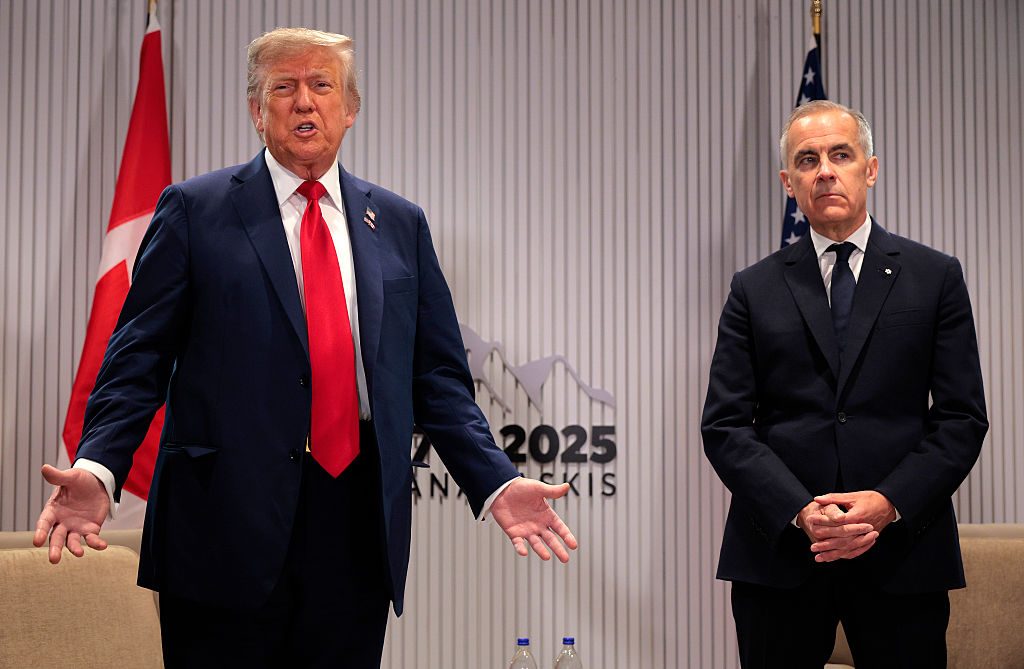
Trump acknowledged on Monday that Canada and the US have 'different concepts' of trade. Credit: Getty

Trump acknowledged on Monday that Canada and the US have ‘different concepts’ of trade. Credit: Getty

17 June 2025 - 7:00am

Against the imposing backdrop of the Canadian Rockies, the leaders of the G7 are meeting in Kananaskis, Alberta to tackle a growing array of world problems: brutal wars in the Middle East and Ukraine, climate change, and the rise of AI. But perhaps the greatest challenge, with the most immediate impact on the global economy, was right there in the room with them — before he had to cut short his visit to focus on brewing conflict with Iran. US President Donald Trump vows to continue his trade war against the same allied economies represented at the summit, as his counterparts seek ways to respond to his grievances and cut a deal.

Yesterday’s meeting fortuitously fell on the 10th anniversary of Trump’s famous escalator ride, which inaugurated the era of geopolitical disruption that the G7 must now confront. And while France’s Emmanuel Macron is the senior statesman at this year’s meeting, it is the host nation’s leader, Canadian Prime Minister Mark Carney, who most fully embodies the “institutional memory” of the liberal international order, having attended meetings like these for more than a decade as a central bank governor on either side of the Atlantic. His bilateral meeting with Trump yesterday carried tremendous stakes; after an earlier White House encounter established what the President has called “a very good relationship” between the two at a personal level, it remains to be seen whether that will translate into any actual relief for Canada’s increasingly tariff-strangled economy.

To those looking for clarity, Trump yesterday simply reaffirmed what we already knew: that there is a stark philosophical gap between himself and everyone else. At the press event, while standing next to Carney, the US President said that they had “different concepts”: he backs tariffs because they are “simple, easy, precise”, while “Mark has a more complex idea but also very good.”

As his US-Canada friendship pin glimmered before photographers, Trump teased that a deal was doable, even within days (an unlikely prospect). He veered off into a characteristic stream of consciousness on everything from re-inviting Vladimir Putin (“it’s always been the G8”), to attacking Democratic cities over immigration, to being noncommittal over what to do on the brewing Israel-Iran war. An uneasy-looking Carney stepped in to end the event, before beginning the meeting at which more nice words were reportedly exchanged.

But how much longer the suspense-laden pleasantries can continue without yielding tangible results is anyone’s guess. Already, unemployment in Canada is ticking upward as jobs begin to evaporate from trade-exposed sectors, while a recession looms on the horizon. Carney’s promise to make Canada “the fastest growing economy” in the G7 becomes exponentially more difficult to execute if he does not stanch the bleeding.

Even as the alluring prospect of diversification — represented by European leaders such as Macron and Germany’s Frederich Merz — offers an escape hatch from over-reliance on the US market, Carney must forge a settlement that restores some semblance of normality between the two North American states, or else he won’t have much of an economy left to diversify. The summit concludes today and the bar for success remains low. But in the long run, neither Carney nor any other leader in attendance can rely on good vibes alone.


Michael Cuenco is Senior Editor at American Affairs.
1TrueCuencoism

China is threatening America in the AI race

Reports sugget Zhipu AI  has released a new model that can rival leading US systems. Credit: Getty

Reports sugget Zhipu AI has released a new model that can rival leading US systems. Credit: Getty

1 July 2026 - 10:18am

China is trying to catch up with America on artificial intelligence. The Wall Street Journal has reported that Zhipu AI — one of China’s six “AI tiger” LLMs — has released a new model that can rival leading US systems, including Anthropic’s Mythos, in cybersecurity tasks such as pinpointing security bugs. While this marks a milestone in China’s drive to catch up with Western AI capabilities, strong performance on a single benchmark does not mean it has taken the lead. Chinese models still lag behind their Western counterparts in broader capabilities, such as autonomous operation. Skepticism is therefore warranted before resorting to hysterical conclusions, but complacency about the geopolitical implications of China’s AI advances would be an even greater mistake.

On the infrastructure side, Chinese AI is still constrained by access to advanced chips, with American labs way ahead in computing capacity as well as investment. Analysis from earlier this year suggests that Chinese models are likely to be at least a few months behind those in the US. But they are still continuing to make progress, or that the geopolitical importance of AI will be decided only by whose LLM has ventured deeper into the technological frontier. The practical applications of AI, countries’ to capture foreign markets, and the application of AI into the real economy will matter just as much.

Here, China may hold an advantage. As with its dominance across many critical supply chains, Beijing may not need to produce the most advanced AI systems — only those that are affordable and widely deployable. In doing so, it could consolidate global influence by supplying functional, low-cost AI at scale.

Beijing seems to be pursuing exactly that path, developing an AI “open-source” strategy that offers affordable, widely available AI models for companies and individuals to use and modify as they wish. The production of the DeepSeek AI model, which matched the performance of Silicon Valley tools such as ChatGPT at a fraction of the cost for users, created goodwill among Chinese models with developers.

The four most popular models on OpenRouter, an AI hardware platform for developers, are now all Chinese. The goal for China is not only to win the frontier-model race, but to make its systems the default layer of AI adoption across industries and global markets. For most economies, the choice is increasingly between an affordable tool they can deploy now and a more robust one that may be out of reach.

And while the countries adopting Chinese models may be exposed to political pressure and cyber threats from Beijing, safer and more capable alternatives matter little if they are unaffordable. American AI companies are already under pressure to monetize products whose operating costs are rising. If Chinese open-source models become the cheap default for startups, universities, governments and businesses across the developing world, then America’s AI lead will be eroded from below.

Perhaps more concerning for America in the long run is how AI can give Chinese manufacturing even more strength, through the ongoing integration of AI as a general-purpose technology. China’s new Five-Year Plan mentioned AI more than 50 times and includes an “AI+” action plan aimed at spreading AI across the economy.

Beijing has been pioneering automation of its critical infrastructure for years, with promising recent results in increasing warplane production capacity. In that regard, China’s open-model strategy and manufacturing dominance will reinforce each other. Cheap, adaptable models accelerate deployment across the real economy while those deployments generate real-world data and use cases that can feed back into further model improvement.

The United States should not dismiss the importance of its lead in the AI race. That lead worries Beijing, not least because a more automated Chinese economy would also become more vulnerable to AI-generated cyber threats. But nor should Washington assume that China cannot catch up with American capabilities over time.

This AI competition represents part of a broader struggle over tech supply chains and geopolitical influence. Decisions over whether to adopt US or Chinese models could produce a more fragmented global reality, with different regions relying on different cloud providers, chips and security structures. The result will likely be a global economy which is divided into competing spheres, rather than one which produces a single winner.


Miquel Vila is a political and geopolitical risk consultant focusing on industrial strategy, critical infrastructure and global supply chains.

miquelvilam