




X Close

Trans activists only have themselves to blame for Trump’s success

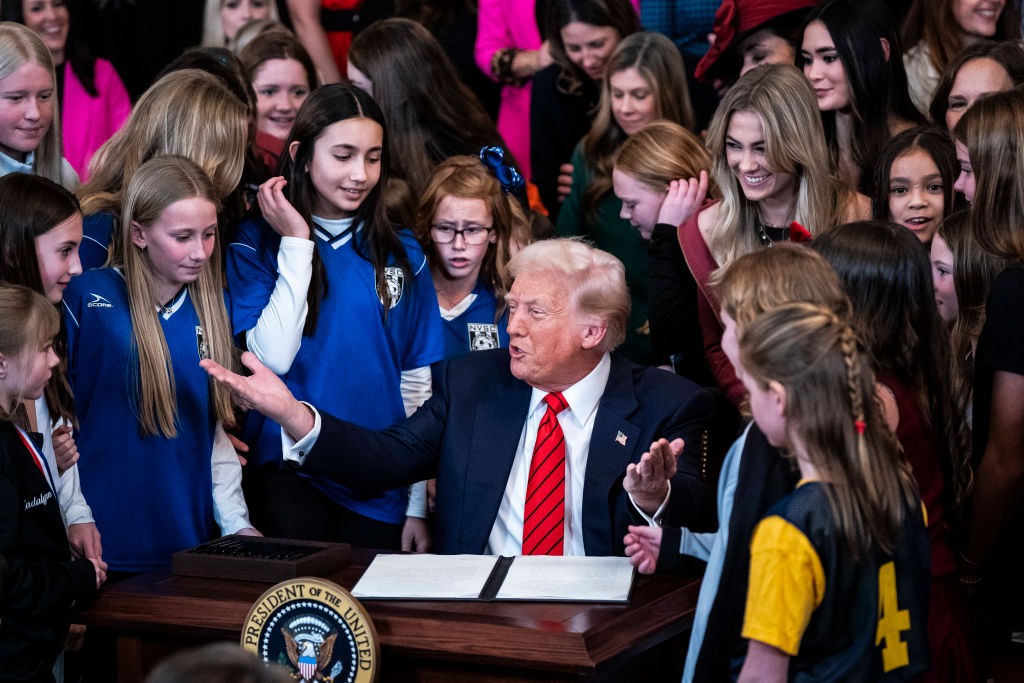
Feminist-in-chief? Credit: Getty

Feminist-in-chief? Credit: Getty

7 February 2025 - 10:20am

What do you do when you’re the perfect progressive — pro-kindness, pro-inclusion, pro-everything pure — and you realise an argument you should have been making has fallen into the wrong hands? Do you seek to reclaim it, or do you dig in?

The thought arises when looking at new images of Donald Trump signing an Executive Order excluding male people from female sports. Surrounded by young girls, Mr Grab ’Em By The Pussy chose National Girls and Women in Sports Day to play the feminist. It’s opportunistic, yes. It doesn’t make this — the most popular thing he has done since becoming President, gaining the approval of 67% of Democrat voters — a bad decision.

Despite the misleading headlines, suggesting that some marginalised sub-group of women, or “trans people” in general have been banned from all sporting activities, this EO should not be considered controversial. Nor should it, after decades of lip service being paid to women and girls’ right to equal participation in sport at all levels, have been remotely necessary.

Not so long ago, it seemed that the case for female people having their own competitions, changing rooms and prizes would never have to be made again. Then came “the transgender tipping point” and the progressive rush to swear allegiance to the dictum “trans women are women”. A sudden refusal to allow for any distinction between sex and gender identity threw women’s rights into disarray. It should never have been left to Trump to clear up the mess.

With sports, the problems were obvious from the start. One didn’t need to see photographs of trans swimmer Lia Thomas, weightlifter Laurel Hubbard or cyclist Veronica Ivy to know the situation was unfair. Female sports are for female, not feminine, people, and female people are not smaller, weaker, slower men.

Because this went against the TWAW declaration, it was decided by the righteous and good that this was a “complicated” and “nuanced” debate. Direct opposition to male people in female sports was coded as Right-wing and bigoted, a refusal to accept people for who they are.

Sporting organisations, eager to showcase their inclusive credentials, refused to commit wholeheartedly to safeguarding rights and opportunities female athletes had already fought hard to obtain. In its 2021 “Framework on Fairness, Inclusion and Non-Discrimination on the Basis of Gender Identity and Sex Variations”, the International Olympic Committee insisted that “even the most rigorous scientific research may not be able to generate clear-cut, indisputable and universal conclusions regarding performance advantage and eligibility criteria for sex-segregated competition.” It also maintained that “no athlete should be made to compete in a category that does not align with their gender identity.”

In recent years, thanks in no small part to feminist-led campaigns, there has been some progress in the reclaiming of a female sports category. Yet even when organisations such as World Rugby and World Athletics have chosen to exclude males, it has been with the assurance that our knowledge of “the science” is currently too patchy, not that we already know what women are. As World Athletics president Seb Coe put it in 2023: “we’re not saying no forever.”

Why wouldn’t Trump take advantage of such a mess? The EO’s passing and the largely positive public response serve as an illustration of just how far a minority of self-identified progressives strayed from most people’s understanding of what is fair.

One can expect a ripple effect, due not just to the global nature of sporting events, but also to the feeling that if people on both sides of the political spectrum can support the policy there, why not elsewhere? We have always known why women’s sports exist. We don’t need more “science”.

It will be hard for those who betrayed women and girls so badly to admit they were wrong. How can you face the fact that on this one issue, Trump proved to be a more reliable feminist than you? Far easier to claim his wrongness on other issues makes you right on this one. Only you’re not.

Look again at that picture of the signing. Perhaps it shouldn’t be Trump surrounded by those girls. It had to be someone, though.


Victoria Smith is a writer and creator of the Glosswitch newsletter.

glosswitch

China is threatening America in the AI race

Reports sugget Zhipu AI  has released a new model that can rival leading US systems. Credit: Getty

Reports sugget Zhipu AI has released a new model that can rival leading US systems. Credit: Getty

1 July 2026 - 10:18am

China is trying to catch up with America on artificial intelligence. The Wall Street Journal has reported that Zhipu AI — one of China’s six “AI tiger” LLMs — has released a new model that can rival leading US systems, including Anthropic’s Mythos, in cybersecurity tasks such as pinpointing security bugs. While this marks a milestone in China’s drive to catch up with Western AI capabilities, strong performance on a single benchmark does not mean it has taken the lead. Chinese models still lag behind their Western counterparts in broader capabilities, such as autonomous operation. Skepticism is therefore warranted before resorting to hysterical conclusions, but complacency about the geopolitical implications of China’s AI advances would be an even greater mistake.

On the infrastructure side, Chinese AI is still constrained by access to advanced chips, with American labs way ahead in computing capacity as well as investment. Analysis from earlier this year suggests that Chinese models are likely to be at least a few months behind those in the US. But they are still continuing to make progress, or that the geopolitical importance of AI will be decided only by whose LLM has ventured deeper into the technological frontier. The practical applications of AI, countries’ to capture foreign markets, and the application of AI into the real economy will matter just as much.

Here, China may hold an advantage. As with its dominance across many critical supply chains, Beijing may not need to produce the most advanced AI systems — only those that are affordable and widely deployable. In doing so, it could consolidate global influence by supplying functional, low-cost AI at scale.

Beijing seems to be pursuing exactly that path, developing an AI “open-source” strategy that offers affordable, widely available AI models for companies and individuals to use and modify as they wish. The production of the DeepSeek AI model, which matched the performance of Silicon Valley tools such as ChatGPT at a fraction of the cost for users, created goodwill among Chinese models with developers.

The four most popular models on OpenRouter, an AI hardware platform for developers, are now all Chinese. The goal for China is not only to win the frontier-model race, but to make its systems the default layer of AI adoption across industries and global markets. For most economies, the choice is increasingly between an affordable tool they can deploy now and a more robust one that may be out of reach.

And while the countries adopting Chinese models may be exposed to political pressure and cyber threats from Beijing, safer and more capable alternatives matter little if they are unaffordable. American AI companies are already under pressure to monetize products whose operating costs are rising. If Chinese open-source models become the cheap default for startups, universities, governments and businesses across the developing world, then America’s AI lead will be eroded from below.

Perhaps more concerning for America in the long run is how AI can give Chinese manufacturing even more strength, through the ongoing integration of AI as a general-purpose technology. China’s new Five-Year Plan mentioned AI more than 50 times and includes an “AI+” action plan aimed at spreading AI across the economy.

Beijing has been pioneering automation of its critical infrastructure for years, with promising recent results in increasing warplane production capacity. In that regard, China’s open-model strategy and manufacturing dominance will reinforce each other. Cheap, adaptable models accelerate deployment across the real economy while those deployments generate real-world data and use cases that can feed back into further model improvement.

The United States should not dismiss the importance of its lead in the AI race. That lead worries Beijing, not least because a more automated Chinese economy would also become more vulnerable to AI-generated cyber threats. But nor should Washington assume that China cannot catch up with American capabilities over time.

This AI competition represents part of a broader struggle over tech supply chains and geopolitical influence. Decisions over whether to adopt US or Chinese models could produce a more fragmented global reality, with different regions relying on different cloud providers, chips and security structures. The result will likely be a global economy which is divided into competing spheres, rather than one which produces a single winner.


Miquel Vila is a political and geopolitical risk consultant focusing on industrial strategy, critical infrastructure and global supply chains.

miquelvilam