



X Close

To win in 2028, AOC should learn from Trump

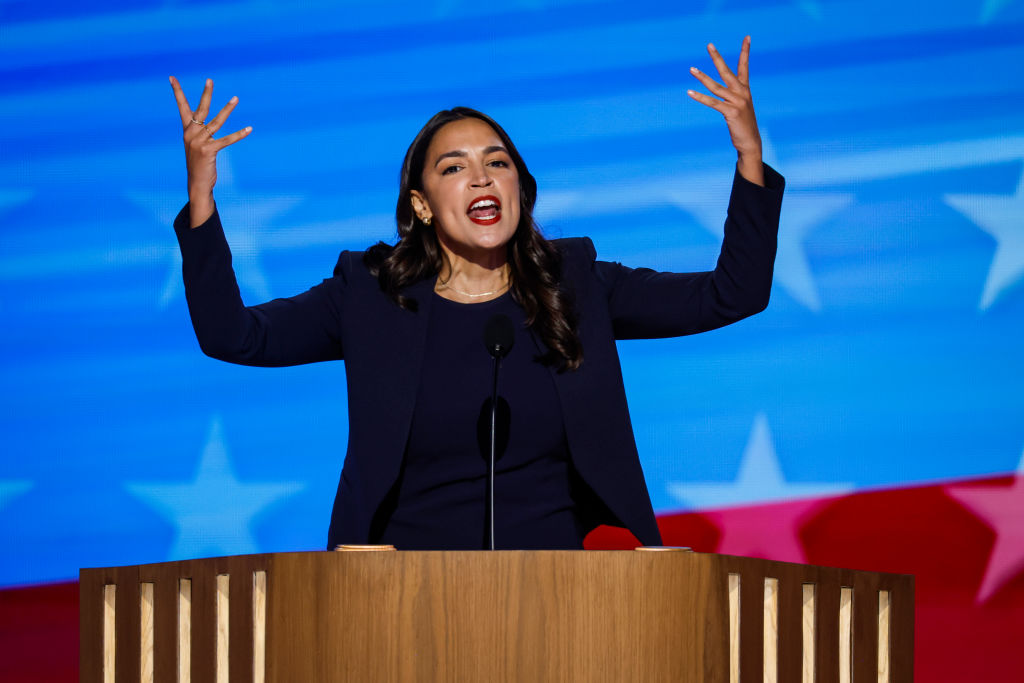
Make the Democrats populist again. Credit: Getty

Make the Democrats populist again. Credit: Getty

24 March 2025 - 6:30pm

Alexandria Ocasio-Cortez is not yet on her way to becoming the Democratic Party’s next presidential nominee. But the 35-year-old New York congresswoman is positioning herself well for a run. Bernie Sanders, the 83-year-old Vermont senator who was the standard-bearer for the party’s Left wing in 2016 and 2020, has all but officially designated Ocasio-Cortez his heir. Under the banner of “Fighting Oligarchy”, the two have been holding rallies together which draw crowds of impressively presidential proportions. On Friday, more than 30,000 people turned out to hear them in Denver.

Sanders, of course, fell short of winning his party’s nomination on the two occasions that he ran for president. At the time, his fellow Democrats believed that his Left-wing brand of populism would bring defeat. Is Ocasio-Cortez now giving them a reason to change their minds? Still in her mid-thirties, she would bring much-needed youthful vigour to a decaying party, but her prospects for 2028 depend less on whether she’s a better messenger than Sanders than on whether the time has come for their message.

Donald Trump showed what Right-wing populism can achieve. Should Democrats have faith that Left-wing populism can do as well or better? Hillary Clinton and Kamala Harris both lost to Trump by running as anti-populists, upholders of elite respectability in the face of a challenge to the establishment. Joe Biden campaigned that way, too — and won. But in retrospect, his success in 2020, not Trump’s in 2016, appears to be the exception.

In fact, populism, broadly understood, has an impressive record and in recent decades has twice rescued Democrats from their doldrums. Bill Clinton styled himself as a populist when he defeated President George H.W. Bush in 1992. Barack Obama’s political inexperience wound up being a strength, rather than a liability, when he took on Hillary Clinton for the Democratic nomination in 2008 and subsequently won the White House. In short, Americans like political outsiders.

What they don’t like, however, are ideologues. Rather than subscribing strictly to any particular ideology, many voters simply dislike much of the country’s leadership class in politics, business, and culture. Campaigning against those leaders is therefore a good starting point. Voters want more economic opportunity for themselves, so populists who promise not only to make the country richer but to share the wealth more widely tend to receive an eager hearing. Given how off-putting undiluted Left- or Right-wing ideology is for the average American, though, populism cannot afford to be too philosophical. After all, too much consistency in applying abstract principles leads to political positions which strike the average American as perverse.

Trump understood all this intuitively. He denounced the leadership of both political parties and much of American society, not even sparing the military. He promised to bring back jobs, and this promise — rather than the fine details of how it would be fulfilled — was what voters responded to.

With Republicans now in power, Democrats have an opportunity to stand as an anti-establishment party. If Ocasio-Cortez can convince voters that her economic message is based around common sense rather than ideological Leftism, she may be able to outflank the 2028 Republican nominee, who will be in the position of having to defend whatever condition the economy is in by then.

The final lesson of successful populism will be the most difficult for AOC, however. Not only must she avoid the extremes to which Left-wing theory leads — on gender, immigration, and defunding the police, for example — she also must be seen to rebuke the ideologues on behalf of ordinary people, the way Bill Clinton rebuked the anti-cop “Sister Souljah” wing of his party and Trump often defies the strictures of movement conservatism.

Without the good luck of a bad economy and an appeal to voters’ common sense, AOC is unlikely to go any further than Bernie ever went. Yet she’s young and knows the road back to power for Democrats begins with denouncing establishment politics and promising Americans a better deal. And if Ocasio-Cortez is too much a prisoner of progressive ideology to capitalise on the opportunity she recognises, someone else — seeing what works for her as well as what doesn’t — will soon enough become the Democrats’ answer to Trump.


Daniel McCarthy is the editor of Modern Age: A Conservative Review

ToryAnarchist

China is threatening America in the AI race

Reports sugget Zhipu AI  has released a new model that can rival leading US systems. Credit: Getty

Reports sugget Zhipu AI has released a new model that can rival leading US systems. Credit: Getty

1 July 2026 - 10:18am

China is trying to catch up with America on artificial intelligence. The Wall Street Journal has reported that Zhipu AI — one of China’s six “AI tiger” LLMs — has released a new model that can rival leading US systems, including Anthropic’s Mythos, in cybersecurity tasks such as pinpointing security bugs. While this marks a milestone in China’s drive to catch up with Western AI capabilities, strong performance on a single benchmark does not mean it has taken the lead. Chinese models still lag behind their Western counterparts in broader capabilities, such as autonomous operation. Skepticism is therefore warranted before resorting to hysterical conclusions, but complacency about the geopolitical implications of China’s AI advances would be an even greater mistake.

On the infrastructure side, Chinese AI is still constrained by access to advanced chips, with American labs way ahead in computing capacity as well as investment. Analysis from earlier this year suggests that Chinese models are likely to be at least a few months behind those in the US. But they are still continuing to make progress, or that the geopolitical importance of AI will be decided only by whose LLM has ventured deeper into the technological frontier. The practical applications of AI, countries’ to capture foreign markets, and the application of AI into the real economy will matter just as much.

Here, China may hold an advantage. As with its dominance across many critical supply chains, Beijing may not need to produce the most advanced AI systems — only those that are affordable and widely deployable. In doing so, it could consolidate global influence by supplying functional, low-cost AI at scale.

Beijing seems to be pursuing exactly that path, developing an AI “open-source” strategy that offers affordable, widely available AI models for companies and individuals to use and modify as they wish. The production of the DeepSeek AI model, which matched the performance of Silicon Valley tools such as ChatGPT at a fraction of the cost for users, created goodwill among Chinese models with developers.

The four most popular models on OpenRouter, an AI hardware platform for developers, are now all Chinese. The goal for China is not only to win the frontier-model race, but to make its systems the default layer of AI adoption across industries and global markets. For most economies, the choice is increasingly between an affordable tool they can deploy now and a more robust one that may be out of reach.

And while the countries adopting Chinese models may be exposed to political pressure and cyber threats from Beijing, safer and more capable alternatives matter little if they are unaffordable. American AI companies are already under pressure to monetize products whose operating costs are rising. If Chinese open-source models become the cheap default for startups, universities, governments and businesses across the developing world, then America’s AI lead will be eroded from below.

Perhaps more concerning for America in the long run is how AI can give Chinese manufacturing even more strength, through the ongoing integration of AI as a general-purpose technology. China’s new Five-Year Plan mentioned AI more than 50 times and includes an “AI+” action plan aimed at spreading AI across the economy.

Beijing has been pioneering automation of its critical infrastructure for years, with promising recent results in increasing warplane production capacity. In that regard, China’s open-model strategy and manufacturing dominance will reinforce each other. Cheap, adaptable models accelerate deployment across the real economy while those deployments generate real-world data and use cases that can feed back into further model improvement.

The United States should not dismiss the importance of its lead in the AI race. That lead worries Beijing, not least because a more automated Chinese economy would also become more vulnerable to AI-generated cyber threats. But nor should Washington assume that China cannot catch up with American capabilities over time.

This AI competition represents part of a broader struggle over tech supply chains and geopolitical influence. Decisions over whether to adopt US or Chinese models could produce a more fragmented global reality, with different regions relying on different cloud providers, chips and security structures. The result will likely be a global economy which is divided into competing spheres, rather than one which produces a single winner.


Miquel Vila is a political and geopolitical risk consultant focusing on industrial strategy, critical infrastructure and global supply chains.

miquelvilam
