




X Close

The media is distorting EHRC ruling on women-only spaces

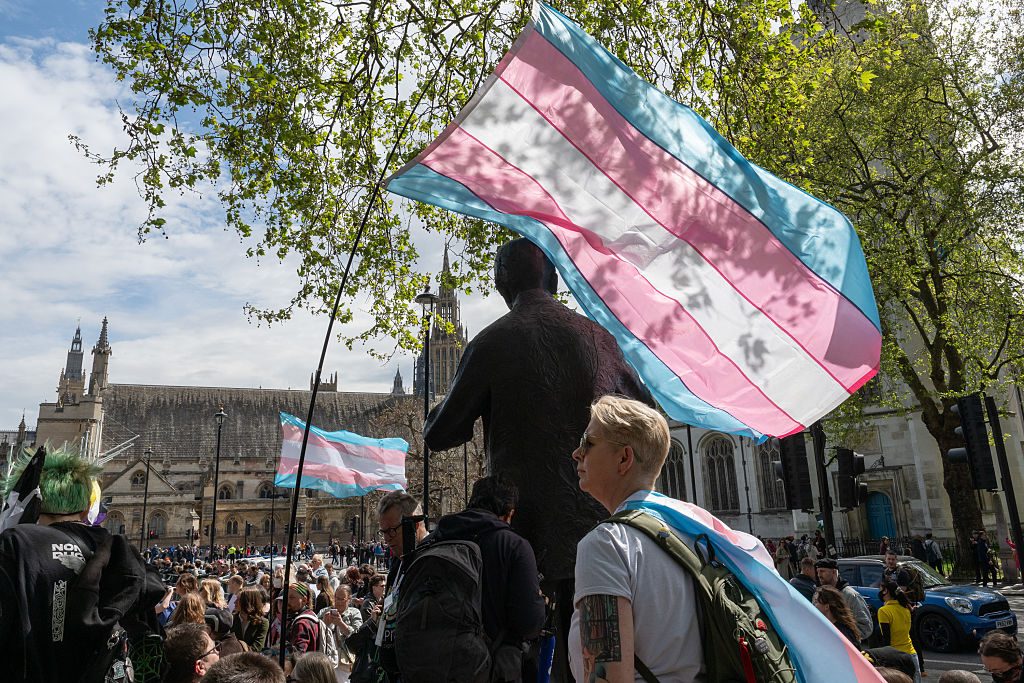
A win for women is not a human rights loss. Credit: Getty

A win for women is not a human rights loss. Credit: Getty

August 9 2025 - 8:00am

If the “gender wars” of the past decade have taught us anything, it’s that framing matters. Take, for instance, the shocking headlines that have emerged in response to the EHRC’s latest recommendations on women-only spaces.

According to the Times and the Independent, trans women are to be “banned from single-sex spaces”. Except this isn’t true. As the Telegraph more accurately puts it, trans women — that is, biologically male people who claim to be women — are to be “banned from public female-only spaces”.

Such a ruling should not be controversial. As the barrister Naomi Cunningham points out, “single-sex spaces for women can’t have men in them, because if they do, they’re not single-sex”.

The difference in headlines is all-important. The first example suggests a singling out of trans women, targeting them for exclusion merely for being trans. The second simply states that female-only spaces are to be female-only in more than just name.

Even so, the Telegraph headline could have been better. Rather than make it all about banned trans women, why not focus on the women whose rights are being restored? Why not express the news as a positive — “women’s access to female-only toilets, changing rooms and refuges to be protected”? We ought to be seeing the EHRC move as progress (or, at the very least, a reclaiming of ground that should never have been lost).

That women are not the subject of headlines regarding our own rights is an indication of how fragile these rights remain, and of what we will be up against when it comes to enforcing them. The panic and outpouring of misogyny that followed the For Women Scotland Supreme Court ruling and subsequent EHRC guidance are the result of years of misinformation and outright lies.

At the heart of it all is the miscasting of members of a dominant group (males) as vulnerable victims of members of a subordinate group (females). In academic articles, Stonewall training sessions, books, and newspaper think pieces, something very justifiable and ordinary — women’s fear of male violence and right to privacy — has been recast as privileged, bigoted “cis” women’s paranoia about anyone who is different.

How deeply ingrained this narrative has become was seen recently in the Sandie Peggie employment tribunal. Dr Beth Upton, a male employee who failed to respect Peggie’s need for a female-only changing room, ought to have been seen as precisely the kind of man who creates the need for such spaces. Instead Upton’s colleagues and employer rushed to portray Peggie as the aggressor.

To many people, it is obvious how wrong this is. There is nothing different or boundary-shattering about the likes of Upton. Nonetheless, the past decade has seen a certain class of people embrace the idea that some male people are in fact vulnerable women. The law may have been clarified, but it will be a long time before such people stop insisting that the law is both confusing and a gross violation of human rights.

None of this serves trans people well. Not only will some be terrified by headlines falsely insisting they are banned from public life, but those who truly do “just want to pee” have been ill-served by activists who wanted an awful lot more. In all this time, had there been a campaign to make everyone more accepting of people who are genuinely gender non-conforming, feminists would have been right behind it. Isn’t it time for male-only spaces to become more inclusive of the feminine male?

Given that resistance to the EHRC ruling is being led by the Good Law Project, it is unlikely that women will lose their spaces all over again. A legal victory is one thing, though; an entire reframing of what has happened, one that centers women and their needs, will take a lot longer to emerge.

It is depressing to see a win for women positioned as a human rights loss. Female people are human, too. Let’s hope that 10 years from now, we’ll recognize whom this story really belongs to.


Victoria Smith is a writer and creator of the Glosswitch newsletter.

glosswitch

China is threatening America in the AI race

Reports sugget Zhipu AI  has released a new model that can rival leading US systems. Credit: Getty

Reports sugget Zhipu AI has released a new model that can rival leading US systems. Credit: Getty

July 1 2026 - 10:18am

China is trying to catch up with America on artificial intelligence. The Wall Street Journal has reported that Zhipu AI — one of China’s six “AI tiger” LLMs — has released a new model that can rival leading US systems, including Anthropic’s Mythos, in cybersecurity tasks such as pinpointing security bugs. While this marks a milestone in China’s drive to catch up with Western AI capabilities, strong performance on a single benchmark does not mean it has taken the lead. Chinese models still lag behind their Western counterparts in broader capabilities, such as autonomous operation. Skepticism is therefore warranted before resorting to hysterical conclusions, but complacency about the geopolitical implications of China’s AI advances would be an even greater mistake.

On the infrastructure side, Chinese AI is still constrained by access to advanced chips, with American labs way ahead in computing capacity as well as investment. Analysis from earlier this year suggests that Chinese models are likely to be at least a few months behind those in the US. But they are still continuing to make progress, or that the geopolitical importance of AI will be decided only by whose LLM has ventured deeper into the technological frontier. The practical applications of AI, countries’ to capture foreign markets, and the application of AI into the real economy will matter just as much.

Here, China may hold an advantage. As with its dominance across many critical supply chains, Beijing may not need to produce the most advanced AI systems — only those that are affordable and widely deployable. In doing so, it could consolidate global influence by supplying functional, low-cost AI at scale.

Beijing seems to be pursuing exactly that path, developing an AI “open-source” strategy that offers affordable, widely available AI models for companies and individuals to use and modify as they wish. The production of the DeepSeek AI model, which matched the performance of Silicon Valley tools such as ChatGPT at a fraction of the cost for users, created goodwill among Chinese models with developers.

The four most popular models on OpenRouter, an AI hardware platform for developers, are now all Chinese. The goal for China is not only to win the frontier-model race, but to make its systems the default layer of AI adoption across industries and global markets. For most economies, the choice is increasingly between an affordable tool they can deploy now and a more robust one that may be out of reach.

And while the countries adopting Chinese models may be exposed to political pressure and cyber threats from Beijing, safer and more capable alternatives matter little if they are unaffordable. American AI companies are already under pressure to monetize products whose operating costs are rising. If Chinese open-source models become the cheap default for startups, universities, governments and businesses across the developing world, then America’s AI lead will be eroded from below.

Perhaps more concerning for America in the long run is how AI can give Chinese manufacturing even more strength, through the ongoing integration of AI as a general-purpose technology. China’s new Five-Year Plan mentioned AI more than 50 times and includes an “AI+” action plan aimed at spreading AI across the economy.

Beijing has been pioneering automation of its critical infrastructure for years, with promising recent results in increasing warplane production capacity. In that regard, China’s open-model strategy and manufacturing dominance will reinforce each other. Cheap, adaptable models accelerate deployment across the real economy while those deployments generate real-world data and use cases that can feed back into further model improvement.

The United States should not dismiss the importance of its lead in the AI race. That lead worries Beijing, not least because a more automated Chinese economy would also become more vulnerable to AI-generated cyber threats. But nor should Washington assume that China cannot catch up with American capabilities over time.

This AI competition represents part of a broader struggle over tech supply chains and geopolitical influence. Decisions over whether to adopt US or Chinese models could produce a more fragmented global reality, with different regions relying on different cloud providers, chips and security structures. The result will likely be a global economy which is divided into competing spheres, rather than one which produces a single winner.


Miquel Vila is a political and geopolitical risk consultant focusing on industrial strategy, critical infrastructure and global supply chains.

miquelvilam