



X Close

The Left is outshining Democrats on social media

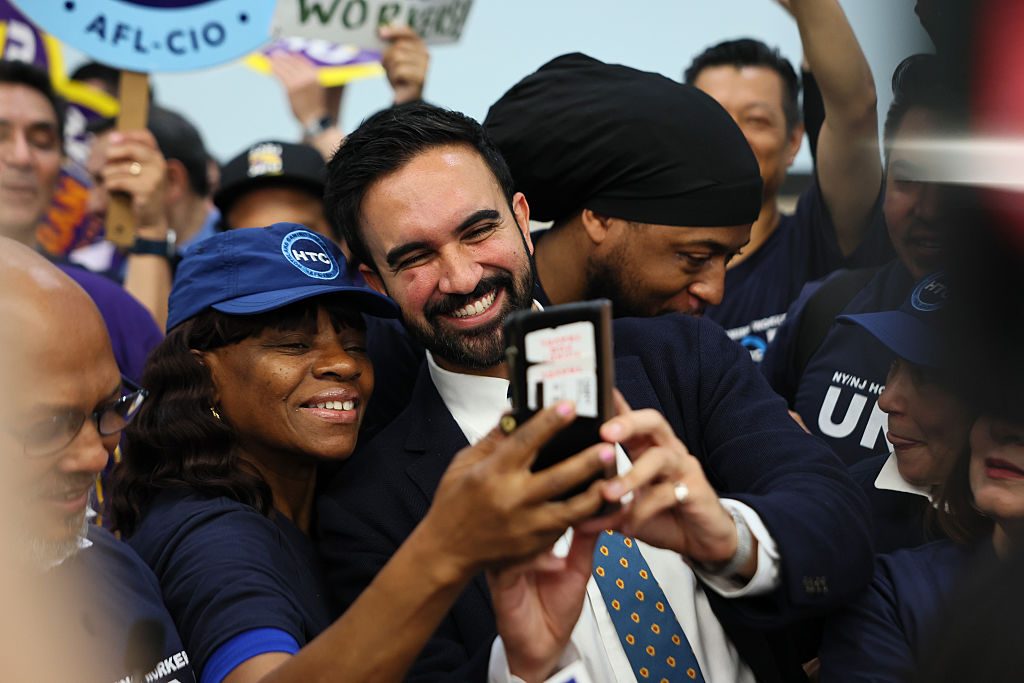
Establishment Democrats are struggling to keep up with Zohran Mamdani. Credit: Getty

Establishment Democrats are struggling to keep up with Zohran Mamdani. Credit: Getty

July 15 2025 - 1:00pm

The Democratic Party’s YouTube channel tells you everything you need to know about why it keeps losing the propaganda wars. With a mere 86,000 subscribers, “The Democrats” trail numerous accounts devoted to sumo wrestling highlights, text-based video game history, and tutorials for styling curly hair. Their recent “Daily Blueprint” videos pull numbers that would embarrass a small-town weatherman, as most hover between a few hundred and a few thousand views.

This digital disasterpiece hasn’t appeared in a vacuum. A new poll from Unite the Country, a Democratic super PAC, shows the party’s credibility with voters has plummeted even further since last November’s losses. Voters now perceive Democrats as “out of touch”, “woke”, and “weak”, with approval ratings below 35% among white men, Hispanic men, and working-class voters. Only 35% of Democrats are optimistic about their party’s future, down from 57% last July. The YouTube ghost town reflects this broader collapse.

Even their attempts at viral content fall flat. The party’s YouTube Shorts, designed specifically to catch fire on social media, rarely crack 10,000 views. Watch Senator Mark Kelly monotonously “debunking” Texas flood conspiracies while his microphone pops and his phone clicks incessantly, and you’ll understand why young voters scroll past without a second thought — just as their eyes glazed over when they watched sexagenarian Minnesota Governor Tim Walz nervously taking notes while debating a much more confident JD Vance in the autumn.

Unable to connect authentically with voters, the Democrats lurch between two doomed strategies. First, they decide they need their own Joe Rogan — some mythical moderate or at least vaguely manly podcaster who can win back men and swing voters with three-hour conversations about psychedelics, conspiracy theories and martial arts. When that predictably goes nowhere (because such a person cannot easily exist within the Democratic coalition), they pivot to whichever progressive just went viral on TikTok.

The latest example of this whiplash is unfolding right now, as party insiders are hurrying to learn from Zohran Mamdani, the Democratic Socialists of America-backed candidate who won New York City’s Democratic mayoral primary over stale and pale former governor Andrew Cuomo. Mamdani, who has collected endorsements from key progressives such as Alexandria Ocasio-Cortez, represents everything the party establishment fears and desires simultaneously: authentic engagement with actual voters, coupled with politics which prompt party stalwarts to host “communication and organizing” breakfasts while also giving the older guard heartburn.

The confounding part is that polling consistently shows Democrats have more popular positions than the Republicans on healthcare, social security, and climate change. Americans actually agree with them on many substantive issues, including a recent shift on immigration. But watch any video on their official channel and you’ll see why that advantage evaporates. Centrist Democrats see a few progressives getting millions of views and conclude they need better social media managers who can teach them to replicate AOC’s Instagram aesthetic or Mamdani’s YouTube energy.

AOC and Mamdani are masters of social media. They produce slick, well-edited videos that hone in on key issues for voters. Whether it’s Mamdani speaking with Trump voters in New York or AOC discussing healthcare while chopping onions, they’re not following a script designed to seem “relatable”.

Meanwhile, the Democratic establishment keeps trying to produce the perfect witch’s brew of messaging: a little bit populist, a little bit progressive, and all center-left for a fictional “median voter” who exists only in the fevered imaginations of political consultants.

The latest polls about Democratic unpopularity underscore what successful gut-instinct politicians across the spectrum already understand: voters will respond to strong natural performers. Whether it’s Donald Trump’s contradictory but always blunt pronouncements, Bernie Sanders’s unwavering Left-wing statism, AOC’s progressivism, or Mamdani’s street-level economic populism, Americans gravitate toward politicians who stake out clear positions. The Democratic establishment’s obsession with focus-grouped messaging creates exactly the kind of mushy, overproduced, and under-watched content that dies on YouTube — and everywhere else.


Oliver Bateman is a historian and journalist based in Pittsburgh. He blogs, vlogs, and podcasts at his Substack, Oliver Bateman Does the Work

MoustacheClubUS

China is threatening America in the AI race

Reports sugget Zhipu AI  has released a new model that can rival leading US systems. Credit: Getty

Reports sugget Zhipu AI has released a new model that can rival leading US systems. Credit: Getty

July 1 2026 - 10:18am

China is trying to catch up with America on artificial intelligence. The Wall Street Journal has reported that Zhipu AI — one of China’s six “AI tiger” LLMs — has released a new model that can rival leading US systems, including Anthropic’s Mythos, in cybersecurity tasks such as pinpointing security bugs. While this marks a milestone in China’s drive to catch up with Western AI capabilities, strong performance on a single benchmark does not mean it has taken the lead. Chinese models still lag behind their Western counterparts in broader capabilities, such as autonomous operation. Skepticism is therefore warranted before resorting to hysterical conclusions, but complacency about the geopolitical implications of China’s AI advances would be an even greater mistake.

On the infrastructure side, Chinese AI is still constrained by access to advanced chips, with American labs way ahead in computing capacity as well as investment. Analysis from earlier this year suggests that Chinese models are likely to be at least a few months behind those in the US. But they are still continuing to make progress, or that the geopolitical importance of AI will be decided only by whose LLM has ventured deeper into the technological frontier. The practical applications of AI, countries’ to capture foreign markets, and the application of AI into the real economy will matter just as much.

Here, China may hold an advantage. As with its dominance across many critical supply chains, Beijing may not need to produce the most advanced AI systems — only those that are affordable and widely deployable. In doing so, it could consolidate global influence by supplying functional, low-cost AI at scale.

Beijing seems to be pursuing exactly that path, developing an AI “open-source” strategy that offers affordable, widely available AI models for companies and individuals to use and modify as they wish. The production of the DeepSeek AI model, which matched the performance of Silicon Valley tools such as ChatGPT at a fraction of the cost for users, created goodwill among Chinese models with developers.

The four most popular models on OpenRouter, an AI hardware platform for developers, are now all Chinese. The goal for China is not only to win the frontier-model race, but to make its systems the default layer of AI adoption across industries and global markets. For most economies, the choice is increasingly between an affordable tool they can deploy now and a more robust one that may be out of reach.

And while the countries adopting Chinese models may be exposed to political pressure and cyber threats from Beijing, safer and more capable alternatives matter little if they are unaffordable. American AI companies are already under pressure to monetize products whose operating costs are rising. If Chinese open-source models become the cheap default for startups, universities, governments and businesses across the developing world, then America’s AI lead will be eroded from below.

Perhaps more concerning for America in the long run is how AI can give Chinese manufacturing even more strength, through the ongoing integration of AI as a general-purpose technology. China’s new Five-Year Plan mentioned AI more than 50 times and includes an “AI+” action plan aimed at spreading AI across the economy.

Beijing has been pioneering automation of its critical infrastructure for years, with promising recent results in increasing warplane production capacity. In that regard, China’s open-model strategy and manufacturing dominance will reinforce each other. Cheap, adaptable models accelerate deployment across the real economy while those deployments generate real-world data and use cases that can feed back into further model improvement.

The United States should not dismiss the importance of its lead in the AI race. That lead worries Beijing, not least because a more automated Chinese economy would also become more vulnerable to AI-generated cyber threats. But nor should Washington assume that China cannot catch up with American capabilities over time.

This AI competition represents part of a broader struggle over tech supply chains and geopolitical influence. Decisions over whether to adopt US or Chinese models could produce a more fragmented global reality, with different regions relying on different cloud providers, chips and security structures. The result will likely be a global economy which is divided into competing spheres, rather than one which produces a single winner.


Miquel Vila is a political and geopolitical risk consultant focusing on industrial strategy, critical infrastructure and global supply chains.

miquelvilam
