




X Close

The EU is finally paying the price for its unfair trade practices

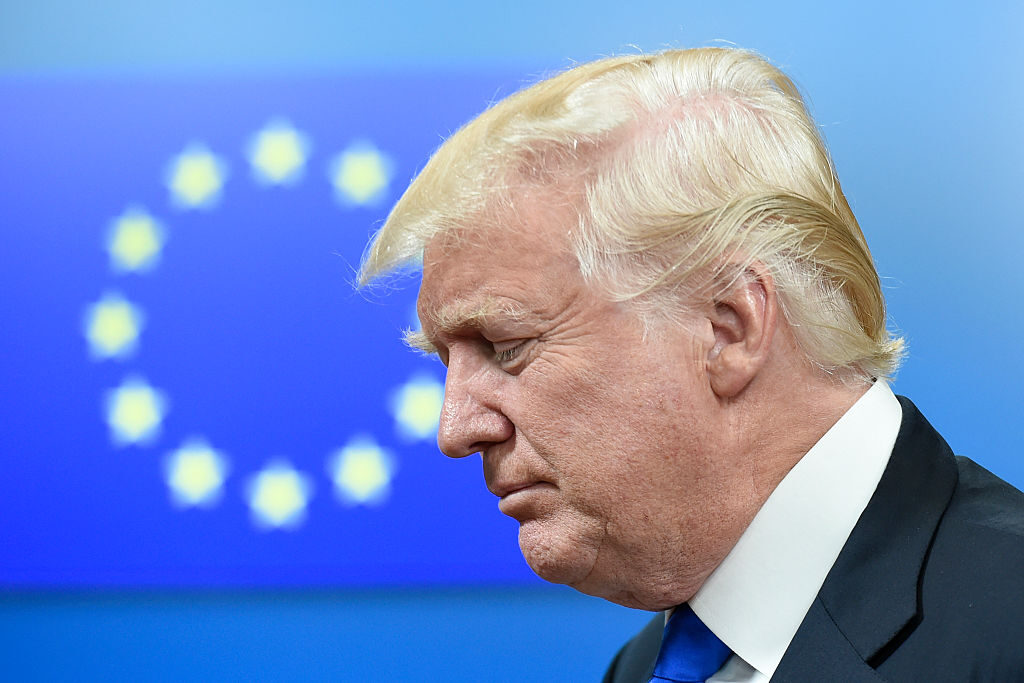
Trump recently announced a 50% tariff on EU goods. Credit: Getty

Trump recently announced a 50% tariff on EU goods. Credit: Getty

May 25 2025 - 8:00am

On Friday, Donald Trump announced a staggering 50% tariff on European Union goods, set to take effect 1 June 2025, unless the EU agrees to significant trade concessions. The escalation — from a previously reduced 10% tariff (set to rise to 20% after 8 July) — has triggered diplomatic backlash and roiled financial markets.

Trump’s tariff proposal targets the EU’s $550 billion in annual exports to the US, compared to $351 billion in US exports to the EU in 2022. Citing “unfair” trade barriers and an imbalanced trade balance, the US President aims to force negotiations. The announcement follows a pattern of aggressive trade rhetoric, reminiscent of his first term, where tariffs were often proposed but sometimes softened after pushback. The EU, a critical US ally and the world’s largest trading bloc, now faces a pivotal moment in navigating this economic ultimatum.

EU leaders responded with measured restraint, signaling a desire to avoid a full-blown trade war while preparing for retaliation. Maros Sefcovic, the EU’s Commissioner for Trade and Economic Security, emphasized a commitment to a “deal based on respect, not threats”. Irish Prime Minister Micheál Martin called the tariff threat “enormously disappointing”, arguing it undermines a vital trading relationship and global economic stability. German Foreign Minister Johann Wadephul echoed this, warning that such tariffs would harm both economies and urging the EU to preserve market access.

The EU has already drafted $108 billion in retaliatory tariffs, targeting US goods like agricultural products and machinery. This preparation reflects lessons from Trump’s first term, when the EU countered US steel and aluminum tariffs with levies on American whiskey and motorcycles. Yet, public statements from Brussels project calm, suggesting a strategy to de-escalate while bracing for impact.

Trump’s earlier retreat on China tariffs suggests he may be open to compromise, but a similar reversal now is unlikely. For starters, making another U-turn would be politically embarrassing for the President. Moreover, the EU holds fewer cards than China. The US would be far less affected by a trade war with Europe than it would have been in a confrontation with China. Even if European imports were targeted by hefty tariffs, it’s unlikely that US store shelves would be left empty.

Moreover, much of what is labeled as “Chinese exports” to the US are, in fact, American products manufactured in China — meaning the lion’s share of the value is captured by US corporations. As a result, it is these very companies that stand to be most harmed by the tariffs — one the main reasons for Trump’s back-pedaling. This is not the case with European exports to the US.

But perhaps most crucially, Trump is right when he says the EU has been engaging in unfair trade practices. Over the past two decades — and especially in the aftermath of the 2010-2011 eurozone crisis — the European Union, despite being one of the wealthiest economic blocs in the world, has systematically suppressed domestic demand through policies of austerity, fiscal restraint and wage compression. This self-imposed deflationary trajectory (which further exacerbated the euro’s inherent deflationary bias) has not been accidental, but rather a deliberate strategy aimed at bolstering price competitiveness on the global stage, while at the same time reducing imports.

In effect, the EU has embraced a hyper-mercantilist, export-driven growth model, prioritizing trade surpluses over internal economic development. This approach has come at the expense of both its own citizens, who face stagnating wages and underfunded public services, and its trading partners — most notably the United States — who have absorbed the EU’s export surpluses as part of an increasingly unbalanced global economic relationship.

Trump’s tariffs should therefore be seen as an opportunity for Europeans to finally confront the deep flaws of the EU’s export-led economic model — a reckoning that is long overdue. Meanwhile, in the short term, the EU could announce an economic and geopolitical rapprochement with China, further weakening the US’s leverage.

Unfortunately, neither scenario is likely. The most probable outcome is that the EU will further align itself with Trump’s confrontational stance on China, hoping to secure trade concessions from the US — all in an effort to sustain an economic model increasingly rendered obsolete by the emerging post-liberal world order.


Thomas Fazi is an UnHerd columnist and translator. His latest book is The Covid Consensus, co-authored with Toby Green.

battleforeurope

China is threatening America in the AI race

Reports sugget Zhipu AI  has released a new model that can rival leading US systems. Credit: Getty

Reports sugget Zhipu AI has released a new model that can rival leading US systems. Credit: Getty

July 1 2026 - 10:18am

China is trying to catch up with America on artificial intelligence. The Wall Street Journal has reported that Zhipu AI — one of China’s six “AI tiger” LLMs — has released a new model that can rival leading US systems, including Anthropic’s Mythos, in cybersecurity tasks such as pinpointing security bugs. While this marks a milestone in China’s drive to catch up with Western AI capabilities, strong performance on a single benchmark does not mean it has taken the lead. Chinese models still lag behind their Western counterparts in broader capabilities, such as autonomous operation. Skepticism is therefore warranted before resorting to hysterical conclusions, but complacency about the geopolitical implications of China’s AI advances would be an even greater mistake.

On the infrastructure side, Chinese AI is still constrained by access to advanced chips, with American labs way ahead in computing capacity as well as investment. Analysis from earlier this year suggests that Chinese models are likely to be at least a few months behind those in the US. But they are still continuing to make progress, or that the geopolitical importance of AI will be decided only by whose LLM has ventured deeper into the technological frontier. The practical applications of AI, countries’ to capture foreign markets, and the application of AI into the real economy will matter just as much.

Here, China may hold an advantage. As with its dominance across many critical supply chains, Beijing may not need to produce the most advanced AI systems — only those that are affordable and widely deployable. In doing so, it could consolidate global influence by supplying functional, low-cost AI at scale.

Beijing seems to be pursuing exactly that path, developing an AI “open-source” strategy that offers affordable, widely available AI models for companies and individuals to use and modify as they wish. The production of the DeepSeek AI model, which matched the performance of Silicon Valley tools such as ChatGPT at a fraction of the cost for users, created goodwill among Chinese models with developers.

The four most popular models on OpenRouter, an AI hardware platform for developers, are now all Chinese. The goal for China is not only to win the frontier-model race, but to make its systems the default layer of AI adoption across industries and global markets. For most economies, the choice is increasingly between an affordable tool they can deploy now and a more robust one that may be out of reach.

And while the countries adopting Chinese models may be exposed to political pressure and cyber threats from Beijing, safer and more capable alternatives matter little if they are unaffordable. American AI companies are already under pressure to monetize products whose operating costs are rising. If Chinese open-source models become the cheap default for startups, universities, governments and businesses across the developing world, then America’s AI lead will be eroded from below.

Perhaps more concerning for America in the long run is how AI can give Chinese manufacturing even more strength, through the ongoing integration of AI as a general-purpose technology. China’s new Five-Year Plan mentioned AI more than 50 times and includes an “AI+” action plan aimed at spreading AI across the economy.

Beijing has been pioneering automation of its critical infrastructure for years, with promising recent results in increasing warplane production capacity. In that regard, China’s open-model strategy and manufacturing dominance will reinforce each other. Cheap, adaptable models accelerate deployment across the real economy while those deployments generate real-world data and use cases that can feed back into further model improvement.

The United States should not dismiss the importance of its lead in the AI race. That lead worries Beijing, not least because a more automated Chinese economy would also become more vulnerable to AI-generated cyber threats. But nor should Washington assume that China cannot catch up with American capabilities over time.

This AI competition represents part of a broader struggle over tech supply chains and geopolitical influence. Decisions over whether to adopt US or Chinese models could produce a more fragmented global reality, with different regions relying on different cloud providers, chips and security structures. The result will likely be a global economy which is divided into competing spheres, rather than one which produces a single winner.


Miquel Vila is a political and geopolitical risk consultant focusing on industrial strategy, critical infrastructure and global supply chains.

miquelvilam