



X Close

The censorship machine is far weaker in 2024 than 2020

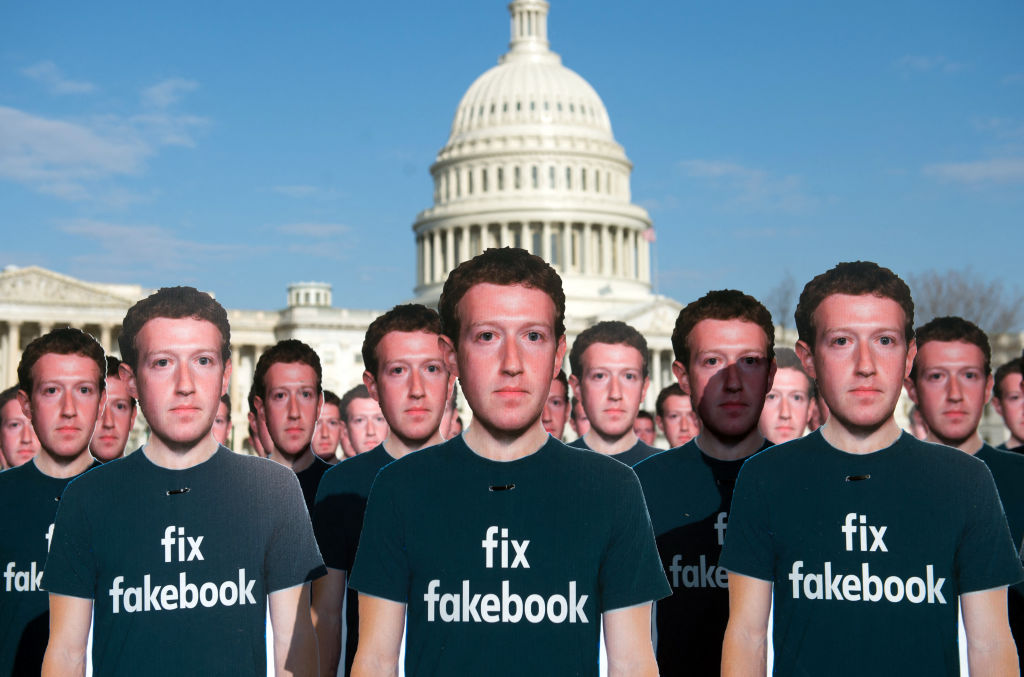
Big Tech companies no longer function as an arm of government. Credit: Getty

Big Tech companies no longer function as an arm of government. Credit: Getty

5 November 2024 - 10:00am

In an October interview, The New York Times’s Lulu García-Navarro asked GOP vice-presidential candidate J.D. Vance whether Donald Trump had lost the 2020 election. Instead of answering, Vance replied with another question: “Is it OK that big technology companies censored the Hunter Biden laptop story?” He has used the same ju-jitsu move on several other occasions when pressed about Trump’s fraud claims, including during his debate with Tim Walz.

Vance is the respectable face of MAGA, so it seems reasonable to surmise the Trump campaign believes social-media censorship — and not rumours about late-night ballot shenanigans — offers the most broadly compelling case for delegitimising the 2020 election results. There are a few reasons for this. For one thing, while there’s no way to prove social media platforms’ handling of the Biden laptop story — which they broadly came to regret — was decisive in tipping the election, there’s also no way to prove it wasn’t. Moreover, even though most Americans disliked Trump’s post-election behaviour four years ago, they also tend to disapprove of the sort of stifling of speech his opponents attempted to undertake under the rubric of fighting “misinformation”.

For their part, Democrats including Walz, Hillary Clinton and John Kerry continue to intone against the dangers of unregulated speech online. But four years after the Biden laptop affair, they have mostly retreated from the battle against misinformation, partly because of Republican pushback, and partly because of its dubious results. Nina Jankowicz, who briefly helmed the Biden administration’s Disinformation Governance Board in 2022, said as much recently, noting that there is less “coordination between the federal government and platforms” than in 2020. The former “disinformation czar” blamed that shift on the fear that any coordination might “get brought up in congressional subpoenas and lawsuits” — such as the hearings on online censorship led by Rep. Jim Jordan and the 2023 Supreme Court case Murthy v. Missouri. Statements from those running the platforms also suggest an increased discomfort with earlier actions in this area, as when Meta CEO Mark Zuckerberg recently expressed regret for acceding to government pressure to censor.

And so we aren’t likely to see a replay of the coordinated effort between government agencies, NGOs such as the Election Integrity Partnership, and private tech companies to flag, suppress, and remove posts determined to be “misinformation”. For those of us who found that entire project troublingly at odds with the First Amendment, its retreat should be a welcome development.

However, it is also unclear whether the effects of these activities ever corresponded either to their architects’ aims — or to the Orwellian nightmares its opponents conjured up in response. Consider the case raised repeatedly by Vance as Exhibit A of the censorship apparatus: the New York Post’s reporting on Hunter Biden’s laptop. The story was blocked on Twitter for two days, after which the company reversed course, with then-CEO Jack Dorsey apologising; Facebook didn’t block it, but algorithmically suppressed it before likewise changing course.

This incident lays bare some unfortunate tendencies, but it doesn’t illustrate the smooth functioning of a well-oiled, top-down “censorship machine”, as has been alleged by some on the Right. Instead, what we see is a clumsy, poorly-thought-out effort that ultimately came to embarrass those behind it. While the online censorship was still in effect, the Biden laptop story was nonetheless being widely discussed, including in the halls of Congress; it is conceivable that it even received more attention than it would have — an instance of the Streisand effect — due to the outrage provoked by the tech companies’ egregious actions.

The ultimate fallout, then, wasn’t a successful stifling of speech, but embarrassment for the establishment, which had attempted and failed to suppress a politically damaging story. So it also went for the ill-fated Disinformation Governance Board, which was disbanded after just three months under fire not just from Republicans but also from progressives and civil libertarians.

Regardless of who prevails, we can hope both parties learn the right lessons from the attempts at online censorship that proliferated around the last election, and are now in abeyance. Such efforts are at odds with most Americans’ deep-seated belief in free speech as well as being fundamentally anti-democratic, since they assume experts can dictate truth and untruth from on high. While we should be encouraged by the failure of these efforts, it is also both ironic and regrettable that their main effect has been to compound public distrust in institutions.


Geoff Shullenberger is managing editor of Compact.

g_shullenberger

China is threatening America in the AI race

Reports sugget Zhipu AI  has released a new model that can rival leading US systems. Credit: Getty

Reports sugget Zhipu AI has released a new model that can rival leading US systems. Credit: Getty

1 July 2026 - 10:18am

China is trying to catch up with America on artificial intelligence. The Wall Street Journal has reported that Zhipu AI — one of China’s six “AI tiger” LLMs — has released a new model that can rival leading US systems, including Anthropic’s Mythos, in cybersecurity tasks such as pinpointing security bugs. While this marks a milestone in China’s drive to catch up with Western AI capabilities, strong performance on a single benchmark does not mean it has taken the lead. Chinese models still lag behind their Western counterparts in broader capabilities, such as autonomous operation. Skepticism is therefore warranted before resorting to hysterical conclusions, but complacency about the geopolitical implications of China’s AI advances would be an even greater mistake.

On the infrastructure side, Chinese AI is still constrained by access to advanced chips, with American labs way ahead in computing capacity as well as investment. Analysis from earlier this year suggests that Chinese models are likely to be at least a few months behind those in the US. But they are still continuing to make progress, or that the geopolitical importance of AI will be decided only by whose LLM has ventured deeper into the technological frontier. The practical applications of AI, countries’ to capture foreign markets, and the application of AI into the real economy will matter just as much.

Here, China may hold an advantage. As with its dominance across many critical supply chains, Beijing may not need to produce the most advanced AI systems — only those that are affordable and widely deployable. In doing so, it could consolidate global influence by supplying functional, low-cost AI at scale.

Beijing seems to be pursuing exactly that path, developing an AI “open-source” strategy that offers affordable, widely available AI models for companies and individuals to use and modify as they wish. The production of the DeepSeek AI model, which matched the performance of Silicon Valley tools such as ChatGPT at a fraction of the cost for users, created goodwill among Chinese models with developers.

The four most popular models on OpenRouter, an AI hardware platform for developers, are now all Chinese. The goal for China is not only to win the frontier-model race, but to make its systems the default layer of AI adoption across industries and global markets. For most economies, the choice is increasingly between an affordable tool they can deploy now and a more robust one that may be out of reach.

And while the countries adopting Chinese models may be exposed to political pressure and cyber threats from Beijing, safer and more capable alternatives matter little if they are unaffordable. American AI companies are already under pressure to monetize products whose operating costs are rising. If Chinese open-source models become the cheap default for startups, universities, governments and businesses across the developing world, then America’s AI lead will be eroded from below.

Perhaps more concerning for America in the long run is how AI can give Chinese manufacturing even more strength, through the ongoing integration of AI as a general-purpose technology. China’s new Five-Year Plan mentioned AI more than 50 times and includes an “AI+” action plan aimed at spreading AI across the economy.

Beijing has been pioneering automation of its critical infrastructure for years, with promising recent results in increasing warplane production capacity. In that regard, China’s open-model strategy and manufacturing dominance will reinforce each other. Cheap, adaptable models accelerate deployment across the real economy while those deployments generate real-world data and use cases that can feed back into further model improvement.

The United States should not dismiss the importance of its lead in the AI race. That lead worries Beijing, not least because a more automated Chinese economy would also become more vulnerable to AI-generated cyber threats. But nor should Washington assume that China cannot catch up with American capabilities over time.

This AI competition represents part of a broader struggle over tech supply chains and geopolitical influence. Decisions over whether to adopt US or Chinese models could produce a more fragmented global reality, with different regions relying on different cloud providers, chips and security structures. The result will likely be a global economy which is divided into competing spheres, rather than one which produces a single winner.


Miquel Vila is a political and geopolitical risk consultant focusing on industrial strategy, critical infrastructure and global supply chains.

miquelvilam
