




X Close

SpaceX IPO confirms Elon Musk as king of space

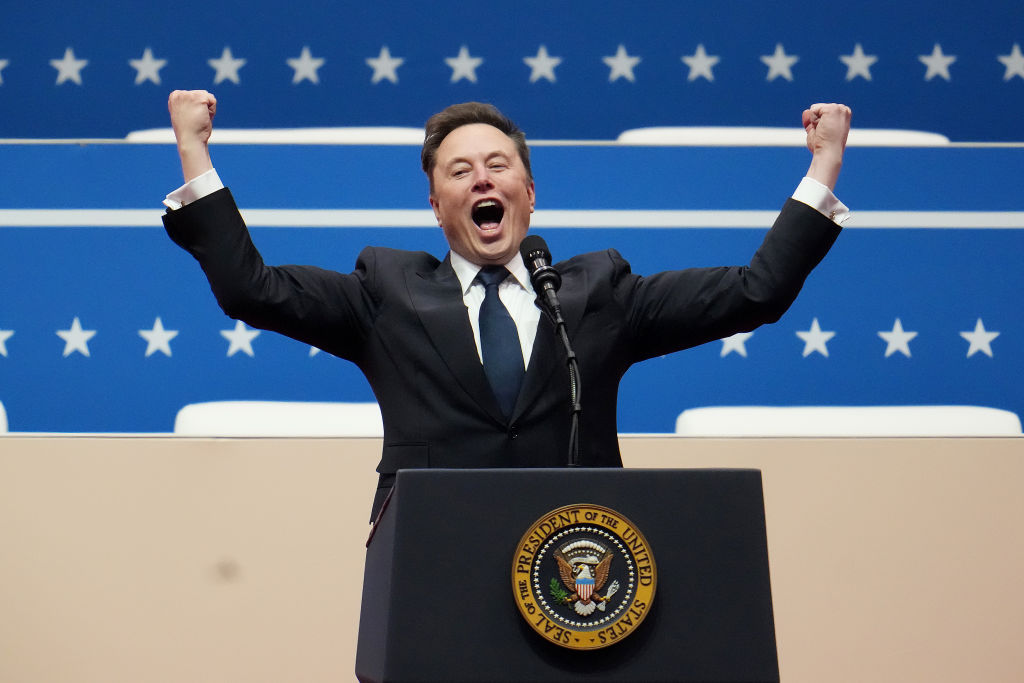
King Musk. Credit: Getty

King Musk. Credit: Getty

June 12 2026 - 8:30pm

SpaceX’s IPO today was a roaring success, making its founder, Elon Musk, the first trillionaire in history.

There’s a lot to be said about this. The idea of a well-heeled entrepreneur taking the reins to bravely open the space frontier did not start with Musk. Rather it has been a recurrent trope in mid-to-late 20th century science fiction, epitomized most famously by D.D. Harriman, the swashbuckling hero of Robert Heinlein’s 1949 classic, The Man Who Sold the Moon. In the years since, a lot of men tried to step into Harriman’s shoes, but they all failed. Through a unique combination of vision, boldness, endurance, and luck, Musk has succeeded.

The SpaceX business plan being offered as the basis for the IPO is nonsense. Musk is certainly not going to launch a million AI data centers into space, powered by solar panels made from lunar materials. Unlike Starlink satellites, which enjoy a decisive positional advantage for their role as communications links by being in orbit, there is no benefit to putting an AI data center in space. It can just as easily do its job on a rooftop, in an office or warehouse, in a tunnel, or on a ship or raft at sea.

On the contrary, any of those locations can be reached for one thousandth the cost of low Earth orbit. Furthermore, the power to drive them is available on Earth in much larger amounts and at vastly lower cost than it is on orbit as well. The idea that the high cost of electricity in space can be remedied by making ultrapure silicon from lunar trash rock, fabricating the resulting material into photovoltaic panels, and then catapulting them to Earth orbit for capture and assembly onto satellites is bat guano nuts. But that does not matter. Musk now has a trillion dollars. With that treasure chest, he can do anything he wants.

Musk does, however, have proprietary AI capabilities that could mount credible competition to the sector’s incumbents, as well as significantly deeper capital reserves than any of them for scaling. Anthropic, OpenAI and the rest will therefore face a serious competitive challenge. If they fail to respond effectively, SpaceX could plausibly evolve into a multi-trillion-dollar company. For now, the verdict remains open.

In the meantime, though, the SpaceX CEO has more than enough cash on hand to establish the first human settlements on the Moon and Mars, without breaking a sweat. Let’s hope that is what he chooses to do.

The difference between Musk and superficially comparable figures such as Jeff Bezos is that Musk has built things that arguably would not exist absent his direct involvement. Bezos got rich by building Amazon, but the idea of making money by retail sales over the internet was obvious. If Bezos had not existed, someone else would have prevailed in that arena, and the human race would have been no poorer for the exchange.

But successful electric car companies and reusable space launch vehicle companies were not guaranteed by the Invisible Hand or any other force of fate. If Musk had not created them, they would not exist. It is for that reason, and not because of his unprecedented wealth, that Musk matters.

Whether Musk or one of his competitors prevails in the onrushing AI race will be of little consequence to the rest of us, or even to Musk himself, who will certainly have the wherewithal to buy groceries either way. But at 55, he still has enough time ahead of him to make epochal history and help transform humanity into a multi-planet, spacefaring species. Several tens of billions — just a small fraction of his ample fortune — would be more than enough to fund such a project. He would be a fool not to. After all, he can’t take it with him.


Dr. Robert Zubrin is an aerospace engineer, president of the Mars Society and author of The Case for Mars and most recently of The New World on Mars: What We Can Create on the Red Planet.

robert_zubrin

China is threatening America in the AI race

Reports sugget Zhipu AI  has released a new model that can rival leading US systems. Credit: Getty

Reports sugget Zhipu AI has released a new model that can rival leading US systems. Credit: Getty

July 1 2026 - 10:18am

China is trying to catch up with America on artificial intelligence. The Wall Street Journal has reported that Zhipu AI — one of China’s six “AI tiger” LLMs — has released a new model that can rival leading US systems, including Anthropic’s Mythos, in cybersecurity tasks such as pinpointing security bugs. While this marks a milestone in China’s drive to catch up with Western AI capabilities, strong performance on a single benchmark does not mean it has taken the lead. Chinese models still lag behind their Western counterparts in broader capabilities, such as autonomous operation. Skepticism is therefore warranted before resorting to hysterical conclusions, but complacency about the geopolitical implications of China’s AI advances would be an even greater mistake.

On the infrastructure side, Chinese AI is still constrained by access to advanced chips, with American labs way ahead in computing capacity as well as investment. Analysis from earlier this year suggests that Chinese models are likely to be at least a few months behind those in the US. But they are still continuing to make progress, or that the geopolitical importance of AI will be decided only by whose LLM has ventured deeper into the technological frontier. The practical applications of AI, countries’ to capture foreign markets, and the application of AI into the real economy will matter just as much.

Here, China may hold an advantage. As with its dominance across many critical supply chains, Beijing may not need to produce the most advanced AI systems — only those that are affordable and widely deployable. In doing so, it could consolidate global influence by supplying functional, low-cost AI at scale.

Beijing seems to be pursuing exactly that path, developing an AI “open-source” strategy that offers affordable, widely available AI models for companies and individuals to use and modify as they wish. The production of the DeepSeek AI model, which matched the performance of Silicon Valley tools such as ChatGPT at a fraction of the cost for users, created goodwill among Chinese models with developers.

The four most popular models on OpenRouter, an AI hardware platform for developers, are now all Chinese. The goal for China is not only to win the frontier-model race, but to make its systems the default layer of AI adoption across industries and global markets. For most economies, the choice is increasingly between an affordable tool they can deploy now and a more robust one that may be out of reach.

And while the countries adopting Chinese models may be exposed to political pressure and cyber threats from Beijing, safer and more capable alternatives matter little if they are unaffordable. American AI companies are already under pressure to monetize products whose operating costs are rising. If Chinese open-source models become the cheap default for startups, universities, governments and businesses across the developing world, then America’s AI lead will be eroded from below.

Perhaps more concerning for America in the long run is how AI can give Chinese manufacturing even more strength, through the ongoing integration of AI as a general-purpose technology. China’s new Five-Year Plan mentioned AI more than 50 times and includes an “AI+” action plan aimed at spreading AI across the economy.

Beijing has been pioneering automation of its critical infrastructure for years, with promising recent results in increasing warplane production capacity. In that regard, China’s open-model strategy and manufacturing dominance will reinforce each other. Cheap, adaptable models accelerate deployment across the real economy while those deployments generate real-world data and use cases that can feed back into further model improvement.

The United States should not dismiss the importance of its lead in the AI race. That lead worries Beijing, not least because a more automated Chinese economy would also become more vulnerable to AI-generated cyber threats. But nor should Washington assume that China cannot catch up with American capabilities over time.

This AI competition represents part of a broader struggle over tech supply chains and geopolitical influence. Decisions over whether to adopt US or Chinese models could produce a more fragmented global reality, with different regions relying on different cloud providers, chips and security structures. The result will likely be a global economy which is divided into competing spheres, rather than one which produces a single winner.


Miquel Vila is a political and geopolitical risk consultant focusing on industrial strategy, critical infrastructure and global supply chains.

miquelvilam