




X Close

Senator Elissa Slotkin’s sudden discovery of ‘normal’

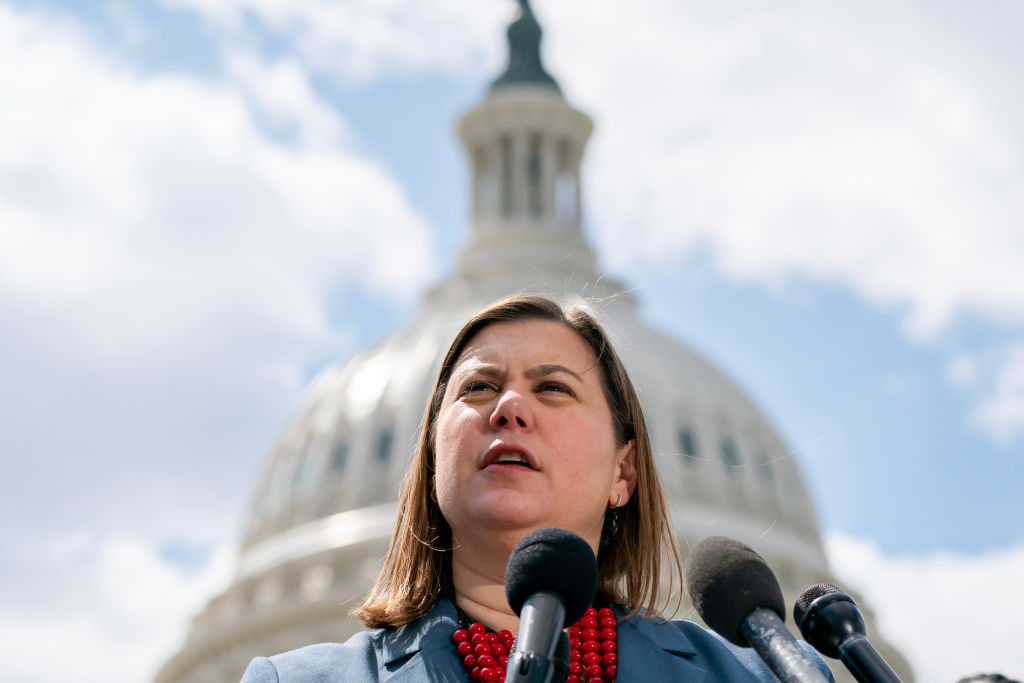
'A clever messaging strategy doesn't make Slotkin a convincing representation of normalcy.' Credit: Getty

‘A clever messaging strategy doesn’t make Slotkin a convincing representation of normalcy.’ Credit: Getty

28 January 2025 - 4:00pm

What does it mean to be a “normal” Democrat in 2025? Earlier this month, Peter Savodnik of The Free Press profiled Sen. Elissa Slotkin, framing the Michigan Democrat as a voice of reason within the party, “reclaiming its soul” as a member of “Team Normal”.

“It was not normal, she said, to alienate voters,” Savodnik wrote. “It was not normal to obsess over race and gender.”

What counts as obsessing over race and gender? Slotkin navigated the Trump-era culture war just as you’d expect an ambitious Michigan Democrat to navigate it, siding with the progressive Left in most major culture war battles while not being the loudest person in the room. Slotkin spent the Trump years supporting legislation and policies which conflated sex and gender identity, opening up single-sex spaces and female teams to biological men and boys. She co-sponsored the radical Equality Act. She participated in a reading of I Am Jazz, an infamous children’s book aimed at normalising childhood transitions.

As a congresswoman, Slotkin opposed Betsy DeVos’s Title IX reform against campus kangaroo courts, which even the Washington Post’s editorial board said brought “needed balance” to schools. In the same year, Slotkin also voted to impeach Trump in 2019. And when the pandemic started, she showed enthusiastically embraced the latest progressive cause célèbre: censorship. As a former CIA analyst, Slotkin took the occasion to urge more content moderation from social media companies, and even hosted a conversation on disinformation that featured Renée DiResta and Nina Jancowicz, the former executive director of the Disinformation Governance Board.

Like most Democrats, she believed the country’s cultural centre had shifted — until the backlash became a potent political force and she began back-pedalling. Better than many Democrats, Slotkin understood that she needed to be perceived as normal and saw identity-based messaging an impediment to that. “We don’t need to obsess about identity politics,” she said in November.

After Kamala Harris’s election loss, Slotkin told Dave Weigel: “I personally think that identity politics needs to go the way of the dodo,” adding that her party should take its messaging “not from the faculty lounge, but the assembly line”. Politico summarised Slotkin’s “theory of the case” as “economic security begets social progress, and in that order.”

The senator argued: “There’s a whole theory of the case that we got the Civil Rights movement in the ‘60s because after World War II, America was so strong economically, we had such a strong middle class, that people understood that someone else having rights doesn’t take away from my rights.”

Her theory may be true, but a clever messaging strategy doesn’t make Slotkin a convincing representation of normalcy. It makes her deceptive, someone who believes voters will ultimately swallow their identity-politics medicine as long as they have good healthcare.

A lawmaker should not be able to take so many divisive stances on, for example, trans ideology and present herself as “normal” without some pushback from journalistsThis will be especially important as Democrats respond to the Trump 2.0 vibe shift by memory-holing their Trump 1.0 stances, hoping enough kitchen-table messaging will make voters forget the past.

People can genuinely change their minds. But Slotkin isn’t even facing questions about her prior record, and is instead being allowed to coast into centrist acclaim by criticising identity politics and cultural progressivism without ever addressing her own contributions to the problem. Journalists shouldn’t let her, or any other Democrats who claim to have been a voice of reason all along, get away with it.


Emily Jashinsky is UnHerd‘s Washington correspondent.

emilyjashinsky

China is threatening America in the AI race

Reports sugget Zhipu AI  has released a new model that can rival leading US systems. Credit: Getty

Reports sugget Zhipu AI has released a new model that can rival leading US systems. Credit: Getty

1 July 2026 - 10:18am

China is trying to catch up with America on artificial intelligence. The Wall Street Journal has reported that Zhipu AI — one of China’s six “AI tiger” LLMs — has released a new model that can rival leading US systems, including Anthropic’s Mythos, in cybersecurity tasks such as pinpointing security bugs. While this marks a milestone in China’s drive to catch up with Western AI capabilities, strong performance on a single benchmark does not mean it has taken the lead. Chinese models still lag behind their Western counterparts in broader capabilities, such as autonomous operation. Skepticism is therefore warranted before resorting to hysterical conclusions, but complacency about the geopolitical implications of China’s AI advances would be an even greater mistake.

On the infrastructure side, Chinese AI is still constrained by access to advanced chips, with American labs way ahead in computing capacity as well as investment. Analysis from earlier this year suggests that Chinese models are likely to be at least a few months behind those in the US. But they are still continuing to make progress, or that the geopolitical importance of AI will be decided only by whose LLM has ventured deeper into the technological frontier. The practical applications of AI, countries’ to capture foreign markets, and the application of AI into the real economy will matter just as much.

Here, China may hold an advantage. As with its dominance across many critical supply chains, Beijing may not need to produce the most advanced AI systems — only those that are affordable and widely deployable. In doing so, it could consolidate global influence by supplying functional, low-cost AI at scale.

Beijing seems to be pursuing exactly that path, developing an AI “open-source” strategy that offers affordable, widely available AI models for companies and individuals to use and modify as they wish. The production of the DeepSeek AI model, which matched the performance of Silicon Valley tools such as ChatGPT at a fraction of the cost for users, created goodwill among Chinese models with developers.

The four most popular models on OpenRouter, an AI hardware platform for developers, are now all Chinese. The goal for China is not only to win the frontier-model race, but to make its systems the default layer of AI adoption across industries and global markets. For most economies, the choice is increasingly between an affordable tool they can deploy now and a more robust one that may be out of reach.

And while the countries adopting Chinese models may be exposed to political pressure and cyber threats from Beijing, safer and more capable alternatives matter little if they are unaffordable. American AI companies are already under pressure to monetize products whose operating costs are rising. If Chinese open-source models become the cheap default for startups, universities, governments and businesses across the developing world, then America’s AI lead will be eroded from below.

Perhaps more concerning for America in the long run is how AI can give Chinese manufacturing even more strength, through the ongoing integration of AI as a general-purpose technology. China’s new Five-Year Plan mentioned AI more than 50 times and includes an “AI+” action plan aimed at spreading AI across the economy.

Beijing has been pioneering automation of its critical infrastructure for years, with promising recent results in increasing warplane production capacity. In that regard, China’s open-model strategy and manufacturing dominance will reinforce each other. Cheap, adaptable models accelerate deployment across the real economy while those deployments generate real-world data and use cases that can feed back into further model improvement.

The United States should not dismiss the importance of its lead in the AI race. That lead worries Beijing, not least because a more automated Chinese economy would also become more vulnerable to AI-generated cyber threats. But nor should Washington assume that China cannot catch up with American capabilities over time.

This AI competition represents part of a broader struggle over tech supply chains and geopolitical influence. Decisions over whether to adopt US or Chinese models could produce a more fragmented global reality, with different regions relying on different cloud providers, chips and security structures. The result will likely be a global economy which is divided into competing spheres, rather than one which produces a single winner.


Miquel Vila is a political and geopolitical risk consultant focusing on industrial strategy, critical infrastructure and global supply chains.

miquelvilam