




X Close

Russian shadow fleet tanker seizure is political theatre

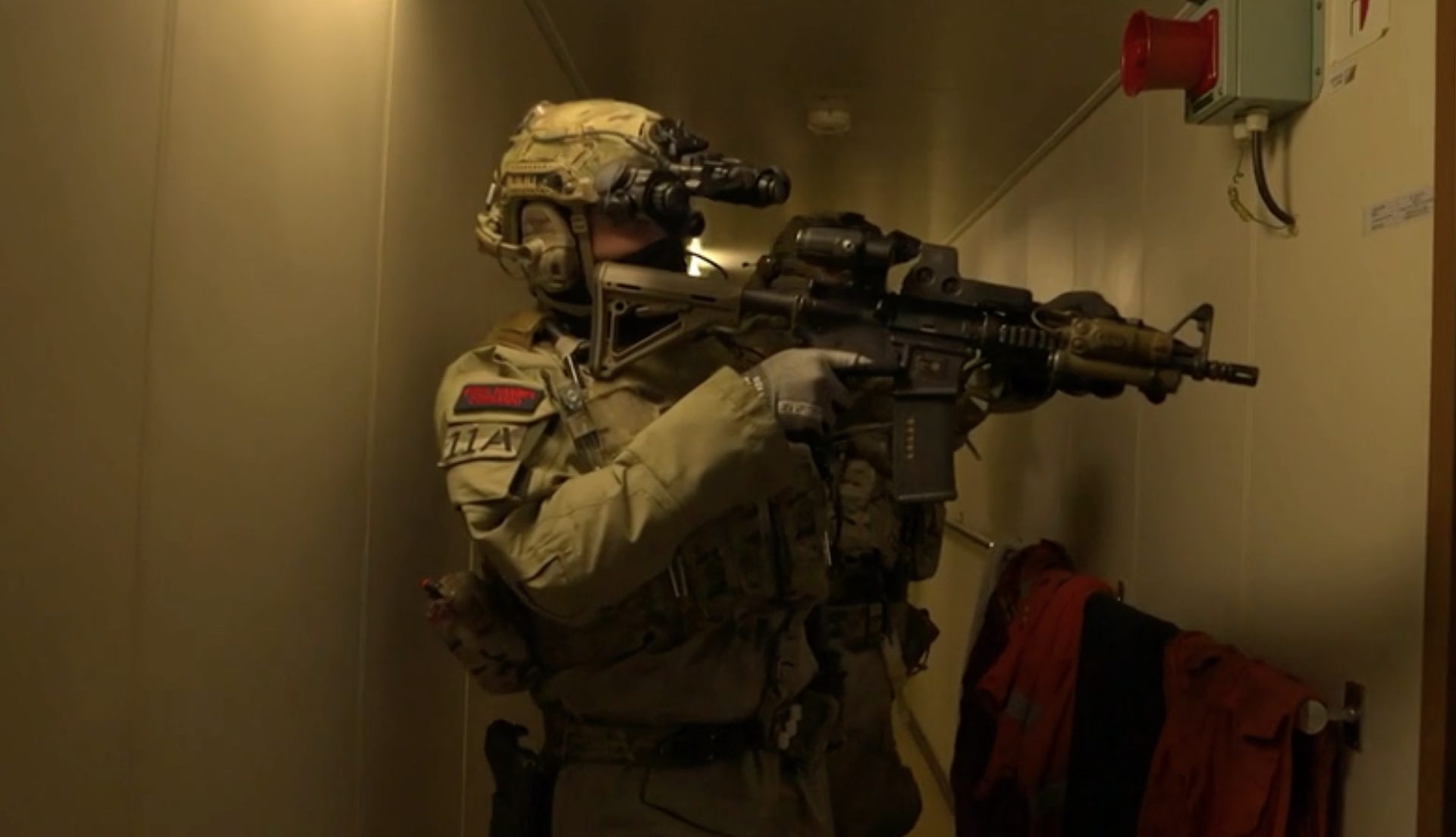
The MOD has released footage of soldiers boarding and searching the Russian vessel. Credit: Ministry of Defence

The MOD has released footage of soldiers boarding and searching the Russian vessel. Credit: Ministry of Defence

15 June 2026 - 7:00am

Yesterday, Royal Marine Commandos seized a Russian shadow fleet tanker sailing in the English Channel, the first time they had done so without American support. Keir Starmer heralded the move as an indication of the country’s military strength and resolve to increase pressure on Russia until it agrees to end its military campaign in Ukraine.

The military operation is already being praised by those who welcome any move that targets Russian assets, but the reality is more sobering. Seizing the Russian tanker imposes limited costs on Moscow and comes at a price to the rest of Europe in the form of uncontrolled escalation risks. Just as importantly, it cannot distract from Britain’s lack of a coherent and resourced defence strategy.

Back in March 2026, Starmer first announced that Britain had the legal authority to seize Russian shadow fleet tankers operating in its waters. Up until now, however, the country’s armed forces have only participated in search and seizure operations alongside the US military. The three-month lag between his statement of legal prerogative and any independent British action raises the question of why Starmer chose to act now.

The timing offers some clues. Coming just days after Defence Secretary John Healey resigned amid a row over military funding, the move appears less a strategic shift than a political gambit aimed at deflecting domestic and international criticism of the state of Britain’s armed forces. It seems hard to believe that there were no sanctioned vessels in and around UK waters at any point since March. After all, Britain has placed at least 600 Russian tankers on its sanctions list. Instead, it seems more probable that political factors were at play.

Unfortunately for Starmer, the seizure of the Russian tanker only serves to underscore the fact that Britain lacks a coherent defence strategy and a plan for financing it. As John Healey’s replacement admitted, the UK is still discussing how much to spend on defence, with fears that the much-vaunted Defence Investment ​Plan does not have enough funds to adequately protect the country.

Taking control of a single Russian vessel imposes minimal costs on the country’s economy. While this may complicate its oil exports, seizing ships happens too infrequently to affect Russia’s strategic calculus or Putin’s willingness to continue the war. In this sense, the British military operation seems largely performative.

That said, Moscow is unlikely to ignore the British move, which it will likely characterise as little more than state-sanctioned piracy. In turn, this will add to already elevated and intensifying escalatory pressures between Russia and Europe, heightening the risk of miscalculation that could spiral into a broader war.

This would not be so concerning if Britain — or the rest of Europe — had a plan to manage these tensions and a clear, coherent strategy for the continent’s defence — especially one that does not depend on the United States. At this point, however, neither exists.

Starmer may have hoped the raid on a Russian tanker would offer a reprieve from these problems, but it is likely to have the opposite effect. Questions over Britain’s defence posture will remain firmly in the spotlight. The Strategic Defence Review marked a step forward in articulating a clearer threat assessment and setting out the capabilities required to meet it. Yet without the funding to resource that strategy, it risks amounting to little more than rhetoric. In that context, the tanker seizure projects less strength than strain, reinforcing a sense of improvisation that may ultimately leave Britain — and Europe — more exposed than before.


Jennifer Kavanagh is a senior fellow and director of military analysis at Defense Priorities.
jekavanagh

China is threatening America in the AI race

Reports sugget Zhipu AI  has released a new model that can rival leading US systems. Credit: Getty

Reports sugget Zhipu AI has released a new model that can rival leading US systems. Credit: Getty

1 July 2026 - 10:18am

China is trying to catch up with America on artificial intelligence. The Wall Street Journal has reported that Zhipu AI — one of China’s six “AI tiger” LLMs — has released a new model that can rival leading US systems, including Anthropic’s Mythos, in cybersecurity tasks such as pinpointing security bugs. While this marks a milestone in China’s drive to catch up with Western AI capabilities, strong performance on a single benchmark does not mean it has taken the lead. Chinese models still lag behind their Western counterparts in broader capabilities, such as autonomous operation. Skepticism is therefore warranted before resorting to hysterical conclusions, but complacency about the geopolitical implications of China’s AI advances would be an even greater mistake.

On the infrastructure side, Chinese AI is still constrained by access to advanced chips, with American labs way ahead in computing capacity as well as investment. Analysis from earlier this year suggests that Chinese models are likely to be at least a few months behind those in the US. But they are still continuing to make progress, or that the geopolitical importance of AI will be decided only by whose LLM has ventured deeper into the technological frontier. The practical applications of AI, countries’ to capture foreign markets, and the application of AI into the real economy will matter just as much.

Here, China may hold an advantage. As with its dominance across many critical supply chains, Beijing may not need to produce the most advanced AI systems — only those that are affordable and widely deployable. In doing so, it could consolidate global influence by supplying functional, low-cost AI at scale.

Beijing seems to be pursuing exactly that path, developing an AI “open-source” strategy that offers affordable, widely available AI models for companies and individuals to use and modify as they wish. The production of the DeepSeek AI model, which matched the performance of Silicon Valley tools such as ChatGPT at a fraction of the cost for users, created goodwill among Chinese models with developers.

The four most popular models on OpenRouter, an AI hardware platform for developers, are now all Chinese. The goal for China is not only to win the frontier-model race, but to make its systems the default layer of AI adoption across industries and global markets. For most economies, the choice is increasingly between an affordable tool they can deploy now and a more robust one that may be out of reach.

And while the countries adopting Chinese models may be exposed to political pressure and cyber threats from Beijing, safer and more capable alternatives matter little if they are unaffordable. American AI companies are already under pressure to monetize products whose operating costs are rising. If Chinese open-source models become the cheap default for startups, universities, governments and businesses across the developing world, then America’s AI lead will be eroded from below.

Perhaps more concerning for America in the long run is how AI can give Chinese manufacturing even more strength, through the ongoing integration of AI as a general-purpose technology. China’s new Five-Year Plan mentioned AI more than 50 times and includes an “AI+” action plan aimed at spreading AI across the economy.

Beijing has been pioneering automation of its critical infrastructure for years, with promising recent results in increasing warplane production capacity. In that regard, China’s open-model strategy and manufacturing dominance will reinforce each other. Cheap, adaptable models accelerate deployment across the real economy while those deployments generate real-world data and use cases that can feed back into further model improvement.

The United States should not dismiss the importance of its lead in the AI race. That lead worries Beijing, not least because a more automated Chinese economy would also become more vulnerable to AI-generated cyber threats. But nor should Washington assume that China cannot catch up with American capabilities over time.

This AI competition represents part of a broader struggle over tech supply chains and geopolitical influence. Decisions over whether to adopt US or Chinese models could produce a more fragmented global reality, with different regions relying on different cloud providers, chips and security structures. The result will likely be a global economy which is divided into competing spheres, rather than one which produces a single winner.


Miquel Vila is a political and geopolitical risk consultant focusing on industrial strategy, critical infrastructure and global supply chains.

miquelvilam