




X Close

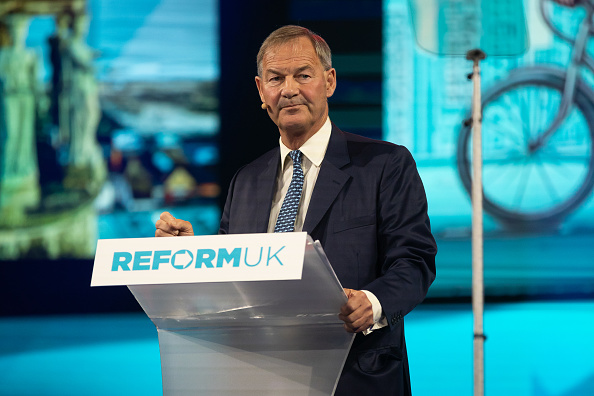
Reform UK’s Rupert Lowe under investigation for bullying

Rupert Lowe has been accused of a 'disturbing pattern of behaviour' against female staff. Credit: Getty

Rupert Lowe has been accused of a ‘disturbing pattern of behaviour’ against female staff. Credit: Getty

7 March 2025 - 5:35pm

Reform UK MP Rupert Lowe has been accused of bullying two female employees, one in his constituency office and one in his parliamentary office. The Great Yarmouth MP has also been accused of making violent threats to party chair Zia Yusuf.

A statement published this afternoon, from Yusuf and the party’s chief whip Lee Anderson, read: “It is with regret that we feel obligated to disclose that the party received complaints from two female employees about serious bullying in the offices of the Member of Parliament for Great Yarmouth, Rupert Lowe.”

“Evidence was provided to us of workplace bullying,” the statement went on, “the targeting of female staff who raised concerns, and evidence of derogatory and discriminatory remarks made about women, including reference to a perceived disability.”

It continued: “We feel we have a duty of care to all our staff […] Accordingly, we appointed an independent King’s Counsel to conduct an investigation into the veracity of these complaints.” The statement added that Lowe is “yet to cooperate” with the investigation.

Responding on social media this afternoon, Lowe claimed that the investigation was “based on zero credible evidence against me”, and referred to the allegations as “a minor staff matter”. He also disputed that he had not cooperated with the KC involved, and said she was “dismayed” that Reform had published its statement today.

The MP has this week been involved in a public dispute with Nigel Farage following an interview in which Lowe referred to the Reform leader’s “messianic” approach to party management and questioned whether he could “deliver the goods” at the next election. Farage responded yesterday by saying Lowe was “completely wrong”.

Lowe has been one of the most active MPs since winning his seat. Analysis from the Telegraph showed that as of 1 February 2025, the Great Yarmouth MP had made 768 spoke contributions in Parliament. In January, the former MEP found favour with Trump-ally Elon Musk, with the tech mogul appearing to endorse him after saying that “Farage doesn’t have what it takes”. Musk said: “I have not met Rupert Lowe but his statements online that I have read so far make a lot of sense.” Lowe thanked Musk for the “kind comments” but came out in support of Farage afterwards.

On the MP’s alleged actions towards Zia Yusuf, the statement said that “Mr Lowe has on at least two occasions made threats of physical violence against our Party Chairman. Accordingly, this matter is with the Police.” Lowe said today in response that “allegations of physical threats are outrageous and entirely untrue.”

“Reform stands for the highest standards of conduct in public life,” the statement concluded, “and we will apply these standards without fear nor favour, including within our own party.” The Great Yarmouth MP, for his part, said that “our voters, our members and our country deserve so much better than this.” He claimed that “infighting serves nobody but our enemies,” adding: “a complete inability to accept even the most mild constructive criticism without such a malicious reaction is not effective leadership.”


China is threatening America in the AI race

Reports sugget Zhipu AI  has released a new model that can rival leading US systems. Credit: Getty

Reports sugget Zhipu AI has released a new model that can rival leading US systems. Credit: Getty

1 July 2026 - 10:18am

China is trying to catch up with America on artificial intelligence. The Wall Street Journal has reported that Zhipu AI — one of China’s six “AI tiger” LLMs — has released a new model that can rival leading US systems, including Anthropic’s Mythos, in cybersecurity tasks such as pinpointing security bugs. While this marks a milestone in China’s drive to catch up with Western AI capabilities, strong performance on a single benchmark does not mean it has taken the lead. Chinese models still lag behind their Western counterparts in broader capabilities, such as autonomous operation. Skepticism is therefore warranted before resorting to hysterical conclusions, but complacency about the geopolitical implications of China’s AI advances would be an even greater mistake.

On the infrastructure side, Chinese AI is still constrained by access to advanced chips, with American labs way ahead in computing capacity as well as investment. Analysis from earlier this year suggests that Chinese models are likely to be at least a few months behind those in the US. But they are still continuing to make progress, or that the geopolitical importance of AI will be decided only by whose LLM has ventured deeper into the technological frontier. The practical applications of AI, countries’ to capture foreign markets, and the application of AI into the real economy will matter just as much.

Here, China may hold an advantage. As with its dominance across many critical supply chains, Beijing may not need to produce the most advanced AI systems — only those that are affordable and widely deployable. In doing so, it could consolidate global influence by supplying functional, low-cost AI at scale.

Beijing seems to be pursuing exactly that path, developing an AI “open-source” strategy that offers affordable, widely available AI models for companies and individuals to use and modify as they wish. The production of the DeepSeek AI model, which matched the performance of Silicon Valley tools such as ChatGPT at a fraction of the cost for users, created goodwill among Chinese models with developers.

The four most popular models on OpenRouter, an AI hardware platform for developers, are now all Chinese. The goal for China is not only to win the frontier-model race, but to make its systems the default layer of AI adoption across industries and global markets. For most economies, the choice is increasingly between an affordable tool they can deploy now and a more robust one that may be out of reach.

And while the countries adopting Chinese models may be exposed to political pressure and cyber threats from Beijing, safer and more capable alternatives matter little if they are unaffordable. American AI companies are already under pressure to monetize products whose operating costs are rising. If Chinese open-source models become the cheap default for startups, universities, governments and businesses across the developing world, then America’s AI lead will be eroded from below.

Perhaps more concerning for America in the long run is how AI can give Chinese manufacturing even more strength, through the ongoing integration of AI as a general-purpose technology. China’s new Five-Year Plan mentioned AI more than 50 times and includes an “AI+” action plan aimed at spreading AI across the economy.

Beijing has been pioneering automation of its critical infrastructure for years, with promising recent results in increasing warplane production capacity. In that regard, China’s open-model strategy and manufacturing dominance will reinforce each other. Cheap, adaptable models accelerate deployment across the real economy while those deployments generate real-world data and use cases that can feed back into further model improvement.

The United States should not dismiss the importance of its lead in the AI race. That lead worries Beijing, not least because a more automated Chinese economy would also become more vulnerable to AI-generated cyber threats. But nor should Washington assume that China cannot catch up with American capabilities over time.

This AI competition represents part of a broader struggle over tech supply chains and geopolitical influence. Decisions over whether to adopt US or Chinese models could produce a more fragmented global reality, with different regions relying on different cloud providers, chips and security structures. The result will likely be a global economy which is divided into competing spheres, rather than one which produces a single winner.


Miquel Vila is a political and geopolitical risk consultant focusing on industrial strategy, critical infrastructure and global supply chains.

miquelvilam