



X Close

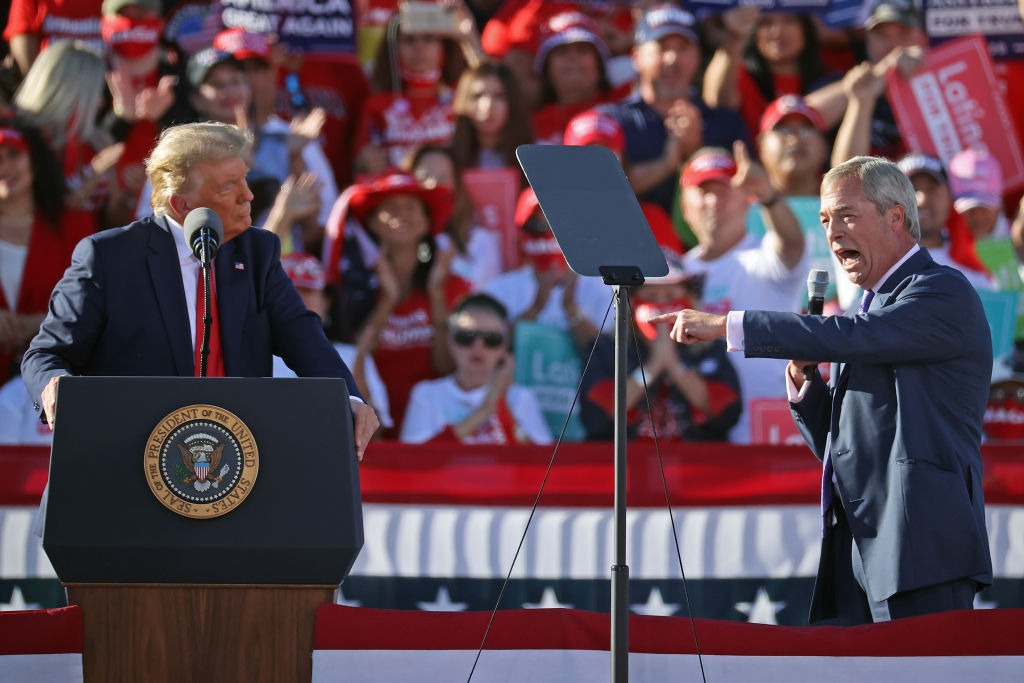
Reform UK voters’ approval of Donald Trump nosedives

An unpopular friendship? Credit: Getty

An unpopular friendship? Credit: Getty

March 6 2025 - 12:45pm

Donald Trump’s popularity among Reform UK voters has plummeted since the US President’s Ukraine interventions, according to new polling.

Figures from YouGov show that over half of Reform supporters (53%) view Trump unfavorably, an increase of 25 percentage points. As a result, his net favorability rating with the voter group has gone from +38 to -8 in just over two weeks. Meanwhile, 80% of all Britons view him negatively, up seven points.

A strong supporter of Trump, Reform leader Nigel Farage has also experienced a dip in favorability ratings. Only a quarter of Britons (26%) now have a positive view of him, down from 30% in mid-February, against two-thirds of the public (65%) who view him negatively.

This comes after Trump and Volodymyr Zelensky’s angry exchange in the Oval Office last week, after which the US cut military aid and intelligence to Kyiv. The Ukrainian President described the incident as “regrettable” and reiterated in a letter to his American counterpart that “nobody wants peace more than Ukrainians.”

Afterwards, Farage criticized Zelensky, saying that he had played the White House meeting “very badly” and was guilty of “showing no respect” for Trump. The Reform leader tempered his friendliness towards the new administration by saying that Vice President JD Vance was “wrong, wrong, wrong” to hint that the UK was a “random country that hasn’t fought a war in 30 or 40 years.”

In contrast, Prime Minister Keir Starmer has seen an uptick in his popularity after swiftly inviting Zelensky to Downing Street in the wake of the White House confrontation. Starmer assured the Ukrainian President that he has “full backing across the United Kingdom”. The proportion of Britons with a favorable view of the PM has increased from 26% in mid-February to 31%, while the proportion with an unfavorable view has fallen from 66% to 59%, leaving his favorability at its highest level in six months.

Farage has made no secret of both his support for Trump and his view that Nato expansion partly provoked Russia’s invasion of Ukraine. Yet public support in Britain for Ukraine has remained significant. At the start of the war in February 2022, 68% of Britons supported UK assistance for Ukraine. In a recent Ipsos poll, this had only fallen to 53%.

Farage’s political opponents have condemned him as a result. Shadow Foreign Secretary Priti Patel this week compared him to former Labour leader Jeremy Corbyn for “equivocating” about Russia’s war of aggression. The Reform UK leader also came under fire for arguing that alleged Nazi salutes made by Elon Musk and Steve Bannon earlier this year were not fascist in nature as they were “out to the side”.

Reform MP Richard Tice, however, rejected the idea that the party is divided over Ukraine, with some MPs being more pro-Trump than others. “As Nigel has said, the only peace that works is an enduring, lasting peace with robust security guarantees,” he said last weekend.

“I think I am the only senior political figure that has donated a five-figure sum, bought a 4×4 pickup, filled it with medical supplies, driven it to Ukraine, given it to frontline soldiers,” he added. “I am not taking any nonsense from anybody. We are completely robust.”


Max Mitchell is UnHerd’s Assistant Editor, Newsroom.

MaxJMitchell1

China is threatening America in the AI race

Reports sugget Zhipu AI  has released a new model that can rival leading US systems. Credit: Getty

Reports sugget Zhipu AI has released a new model that can rival leading US systems. Credit: Getty

July 1 2026 - 10:18am

China is trying to catch up with America on artificial intelligence. The Wall Street Journal has reported that Zhipu AI — one of China’s six “AI tiger” LLMs — has released a new model that can rival leading US systems, including Anthropic’s Mythos, in cybersecurity tasks such as pinpointing security bugs. While this marks a milestone in China’s drive to catch up with Western AI capabilities, strong performance on a single benchmark does not mean it has taken the lead. Chinese models still lag behind their Western counterparts in broader capabilities, such as autonomous operation. Skepticism is therefore warranted before resorting to hysterical conclusions, but complacency about the geopolitical implications of China’s AI advances would be an even greater mistake.

On the infrastructure side, Chinese AI is still constrained by access to advanced chips, with American labs way ahead in computing capacity as well as investment. Analysis from earlier this year suggests that Chinese models are likely to be at least a few months behind those in the US. But they are still continuing to make progress, or that the geopolitical importance of AI will be decided only by whose LLM has ventured deeper into the technological frontier. The practical applications of AI, countries’ to capture foreign markets, and the application of AI into the real economy will matter just as much.

Here, China may hold an advantage. As with its dominance across many critical supply chains, Beijing may not need to produce the most advanced AI systems — only those that are affordable and widely deployable. In doing so, it could consolidate global influence by supplying functional, low-cost AI at scale.

Beijing seems to be pursuing exactly that path, developing an AI “open-source” strategy that offers affordable, widely available AI models for companies and individuals to use and modify as they wish. The production of the DeepSeek AI model, which matched the performance of Silicon Valley tools such as ChatGPT at a fraction of the cost for users, created goodwill among Chinese models with developers.

The four most popular models on OpenRouter, an AI hardware platform for developers, are now all Chinese. The goal for China is not only to win the frontier-model race, but to make its systems the default layer of AI adoption across industries and global markets. For most economies, the choice is increasingly between an affordable tool they can deploy now and a more robust one that may be out of reach.

And while the countries adopting Chinese models may be exposed to political pressure and cyber threats from Beijing, safer and more capable alternatives matter little if they are unaffordable. American AI companies are already under pressure to monetize products whose operating costs are rising. If Chinese open-source models become the cheap default for startups, universities, governments and businesses across the developing world, then America’s AI lead will be eroded from below.

Perhaps more concerning for America in the long run is how AI can give Chinese manufacturing even more strength, through the ongoing integration of AI as a general-purpose technology. China’s new Five-Year Plan mentioned AI more than 50 times and includes an “AI+” action plan aimed at spreading AI across the economy.

Beijing has been pioneering automation of its critical infrastructure for years, with promising recent results in increasing warplane production capacity. In that regard, China’s open-model strategy and manufacturing dominance will reinforce each other. Cheap, adaptable models accelerate deployment across the real economy while those deployments generate real-world data and use cases that can feed back into further model improvement.

The United States should not dismiss the importance of its lead in the AI race. That lead worries Beijing, not least because a more automated Chinese economy would also become more vulnerable to AI-generated cyber threats. But nor should Washington assume that China cannot catch up with American capabilities over time.

This AI competition represents part of a broader struggle over tech supply chains and geopolitical influence. Decisions over whether to adopt US or Chinese models could produce a more fragmented global reality, with different regions relying on different cloud providers, chips and security structures. The result will likely be a global economy which is divided into competing spheres, rather than one which produces a single winner.


Miquel Vila is a political and geopolitical risk consultant focusing on industrial strategy, critical infrastructure and global supply chains.

miquelvilam
