




X Close

Putin may prolong Ukraine war to avoid military rebellion

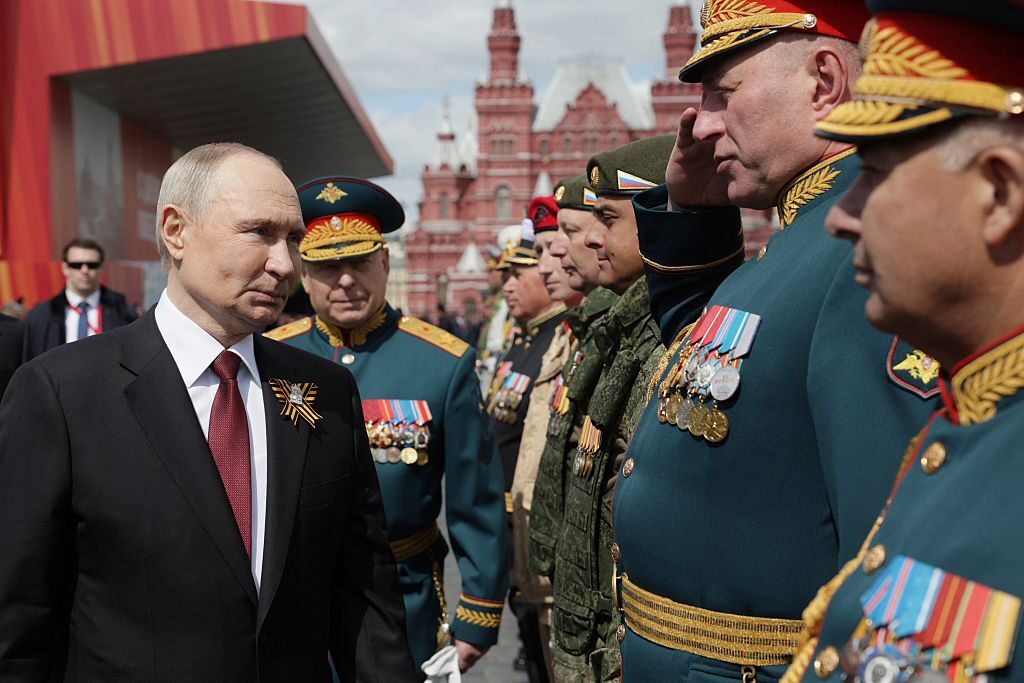
The Russian President's maximalist position will be difficult to renege on. Credit: Getty

The Russian President’s maximalist position will be difficult to renege on. Credit: Getty

1 June 2025 - 8:00am

This week US President Donald Trump appeared to give his Russian counterpart Vladimir Putin a two-week deadline to come to the negotiating table in good faith. When asked about ceasefire negotiations, Trump said: “Within two weeks. We’re gonna find out whether or not (Putin is) tapping us along or not. And if he is, we’ll respond a little bit differently.” But can the US or the West really expect a change of tack from the Kremlin?

Western officials are speculating that Moscow’s high equipment and personnel losses might finally induce Putin to accept a deal. Yet, that is not to say that Russia’s troops would also be persuaded. Soldiers interviewed this month by the New York Times expressed a determination to keep fighting until they control all of Luhansk, Donetsk, Zaporizhzhia and Kherson.

With Russia having only taken an extra 0.6% of Ukrainian land over the past year, those men are unlikely to be reaching those borders any time soon. As another sign of soldiers’ inflated and confused expectations, last month only 18% of Moscow’s career military personnel said they would support peace without Russia having first achieved the goals of the invasion. The only trouble? They shared no consensus on what those goals actually are.

One could argue that, in a society as repressive as Russia, the leadership need not concern itself with the views of its soldiers. However, it is concerned. In July, First Deputy Chief of Staff of the Presidential Administration Sergei Kiriyenko informed regional vice-governors that the Kremlin considers returning veterans to be “the main factor of political and social risks”. He confessed that convicts-turned-soldiers have already committed robbery, rape and murder after returning to civilian life, while officials worry that even those without criminal records may struggle in peacetime and so drift into criminal gangs.

The Kremlin may have to suppress waves of not only crime but domestic unrest. Troops interviewed by the NYT revealed bitterness towards superiors for their corruption, resentment towards civilians for their hedonistic lives, and resolve that their own sacrifices must be compensated by concrete gains for Russia. On the other side, Kiriyenko acknowledged that, since the majority of the population has been protected from the harsh realities of war, “society is not ready to understand and accept” veterans. He added that ex-servicemen’s association with violent crime risks inciting civilians’ “aggression towards all military personnel”.

Moscow is a victim of its own policies. After the government elevated soldiers to hero status to encourage enlistment, veterans expect to be heard in peacetime society. Frontline resentment towards the pampered and protected could not have happened without the Kremlin sheltering elites from the impact of the war to prevent them suffering and, in turn, protesting. Moscow’s maximalist demands have raised soldiers’ hopes.

Most importantly, the public has consistently been told that this is an existential battle against a “Nazi” regime and expansionist West. How does it climb down from a task that is incomplete yet was allegedly so vital to Russia’s survival that it was worth sacrificing hundreds of thousands of lives? Unsurprisingly, Russian President Vladimir Putin is in no hurry to sign an agreement that could bring him a mob, many of whom may be embittered that they lost their compatriots, their youth and, nearly, their lives for the sake of a “botched” settlement.

So how is Putin stopping his “heroes” becoming his villains? Ex-soldiers claiming to speak for their men could become appealing challengers for his throne, with ready-built constituencies of supporters, and it would be controversial to publicly repress them in the way the Kremlin has other oppositionists. Therefore, Russia has quietly quashed grassroots veterans’ organisations for fear they could become sites of activism. It has striven to co-opt ambitious returnees, offering a few carefully selected ex-servicemen high-profile jobs and Duma places. Milbloggers are being brought under control to stop them stirring up criticism. Meanwhile, state media will need to focus on the benefits of any deal, not to mention the joyful human interest stories of families grateful for the agreement — and the president — that reunited them.

The only terms Putin will accept are those he can sell to his people. That means he would rather try to grind his way to the limits of those four regions than concede now, as ending one war risks sparking another on the home front.


Bethany Elliott is a writer specialising in Russia and Eastern Europe.

BethanyAElliott

China is threatening America in the AI race

Reports sugget Zhipu AI  has released a new model that can rival leading US systems. Credit: Getty

Reports sugget Zhipu AI has released a new model that can rival leading US systems. Credit: Getty

1 July 2026 - 10:18am

China is trying to catch up with America on artificial intelligence. The Wall Street Journal has reported that Zhipu AI — one of China’s six “AI tiger” LLMs — has released a new model that can rival leading US systems, including Anthropic’s Mythos, in cybersecurity tasks such as pinpointing security bugs. While this marks a milestone in China’s drive to catch up with Western AI capabilities, strong performance on a single benchmark does not mean it has taken the lead. Chinese models still lag behind their Western counterparts in broader capabilities, such as autonomous operation. Skepticism is therefore warranted before resorting to hysterical conclusions, but complacency about the geopolitical implications of China’s AI advances would be an even greater mistake.

On the infrastructure side, Chinese AI is still constrained by access to advanced chips, with American labs way ahead in computing capacity as well as investment. Analysis from earlier this year suggests that Chinese models are likely to be at least a few months behind those in the US. But they are still continuing to make progress, or that the geopolitical importance of AI will be decided only by whose LLM has ventured deeper into the technological frontier. The practical applications of AI, countries’ to capture foreign markets, and the application of AI into the real economy will matter just as much.

Here, China may hold an advantage. As with its dominance across many critical supply chains, Beijing may not need to produce the most advanced AI systems — only those that are affordable and widely deployable. In doing so, it could consolidate global influence by supplying functional, low-cost AI at scale.

Beijing seems to be pursuing exactly that path, developing an AI “open-source” strategy that offers affordable, widely available AI models for companies and individuals to use and modify as they wish. The production of the DeepSeek AI model, which matched the performance of Silicon Valley tools such as ChatGPT at a fraction of the cost for users, created goodwill among Chinese models with developers.

The four most popular models on OpenRouter, an AI hardware platform for developers, are now all Chinese. The goal for China is not only to win the frontier-model race, but to make its systems the default layer of AI adoption across industries and global markets. For most economies, the choice is increasingly between an affordable tool they can deploy now and a more robust one that may be out of reach.

And while the countries adopting Chinese models may be exposed to political pressure and cyber threats from Beijing, safer and more capable alternatives matter little if they are unaffordable. American AI companies are already under pressure to monetize products whose operating costs are rising. If Chinese open-source models become the cheap default for startups, universities, governments and businesses across the developing world, then America’s AI lead will be eroded from below.

Perhaps more concerning for America in the long run is how AI can give Chinese manufacturing even more strength, through the ongoing integration of AI as a general-purpose technology. China’s new Five-Year Plan mentioned AI more than 50 times and includes an “AI+” action plan aimed at spreading AI across the economy.

Beijing has been pioneering automation of its critical infrastructure for years, with promising recent results in increasing warplane production capacity. In that regard, China’s open-model strategy and manufacturing dominance will reinforce each other. Cheap, adaptable models accelerate deployment across the real economy while those deployments generate real-world data and use cases that can feed back into further model improvement.

The United States should not dismiss the importance of its lead in the AI race. That lead worries Beijing, not least because a more automated Chinese economy would also become more vulnerable to AI-generated cyber threats. But nor should Washington assume that China cannot catch up with American capabilities over time.

This AI competition represents part of a broader struggle over tech supply chains and geopolitical influence. Decisions over whether to adopt US or Chinese models could produce a more fragmented global reality, with different regions relying on different cloud providers, chips and security structures. The result will likely be a global economy which is divided into competing spheres, rather than one which produces a single winner.


Miquel Vila is a political and geopolitical risk consultant focusing on industrial strategy, critical infrastructure and global supply chains.

miquelvilam