




X Close

Pfizergate ruling increases pressure on Ursula von der Leyen

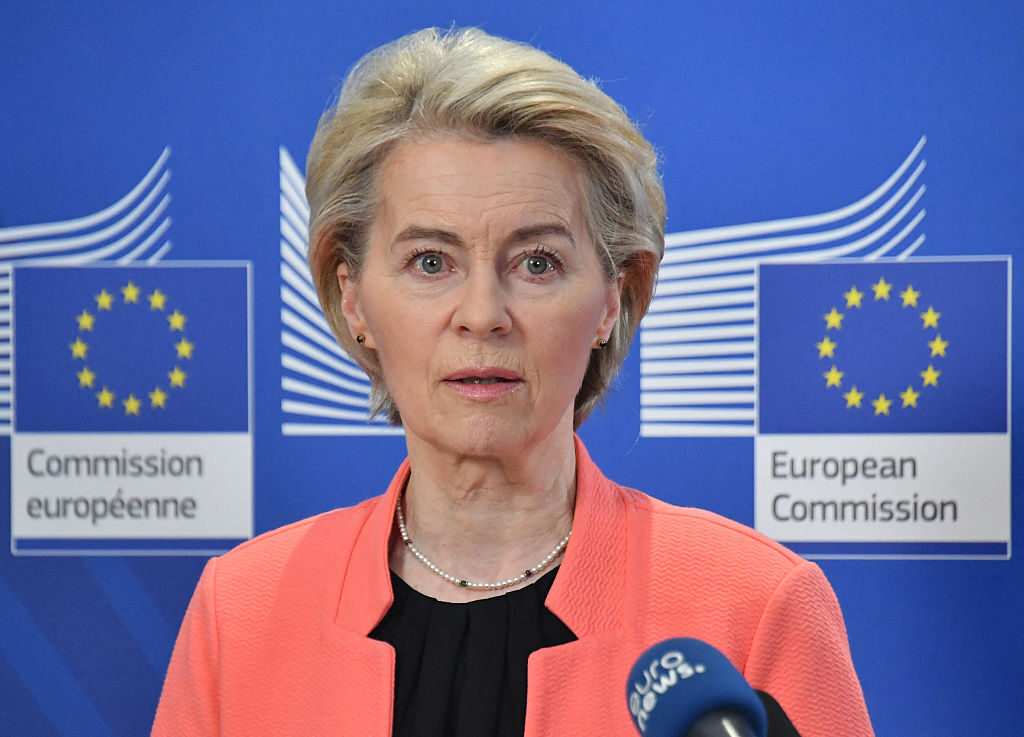
Will the Queen of Brussels be toppled? Credit: Getty

Will the Queen of Brussels be toppled? Credit: Getty

14 May 2025 - 11:15am

European Commission President Ursula von der Leyen has just suffered her first legal setback in the ongoing “Pfizergate” scandal.

Earlier today, the European General Court — part of the EU Court of Justice, the highest court in the bloc — annulled the European Commission’s decision to deny the New York Times access to text messages between von der Leyen and Pfizer CEO Albert Bourla. In these communications, the Commission President single-handedly negotiated the purchase of up to 1.8 billion doses of the Pfizer-BioNTech vaccine at a mind-boggling cost of €35 billion — the largest vaccine contract ever signed by Brussels. According to one analysis, the price per dose she agreed was 15 times higher than the cost of production, meaning that the EU overpaid for the vaccines by tens of billions of euros.

When the NYT, which first broke the story in 2021, requested the messages under EU transparency rules, the Commission refused, claiming it did not keep possession of “short-lived, ephemeral” documents such as texts. The Commission also turned down similar requests by the EU Ombudsman and the European Court of Auditors. In January 2023, the American newspaper sued the Commission, arguing that the refusal violated EU law concerning public access to official documents, regardless of format.

This morning the Court of Justice ruled in favour of the NYT, and deemed that the Commission “has not given a plausible explanation to justify the non-possession of the requested documents”. It emphasised that the Commission could not simply claim it did not hold the messages without providing credible evidence to explain why they were unavailable.

It also judged that the Commission’s argument — that text messages exchanged in the context of a multibillion-euro deal were deemed to “not contain important information” — was patently absurd. The Court further noted that the New York Times had provided “relevant and consistent evidence” confirming the existence of the text messages, including Bourla’s own statements about their role in the vaccine negotiations. Indeed, the Commission’s lack of clarity on whether the messages were deleted was also criticised. Notably, after years of ambiguity even about the existence of the messages, the Commission’s lawyers only acknowledged them last November.

In a significant move, the Court ordered the Commission to pay the NYT’s legal costs, underscoring the gravity of the executive’s failure to comply with transparency obligations. The Commission now must decide whether to appeal the ruling, comply with it by providing the messages, or face further questions about their alleged “deletion”.

Whatever course of action the Commission pursues, and regardless of how the case unfolds in court, this ruling delivers an undeniable blow to von der Leyen’s standing in the court of public opinion — where “Pfizergate” has come to epitomise the EU’s glaring lack of accountability and transparency. The ruling is particularly striking, given that it comes from the European Court of Justice — an institution traditionally seen as staunchly pro-EU and typically reluctant to issue judgments which might undermine the authority of the bloc’s supranational bodies. In this case, however, the Commission’s violations appear to have been simply too blatant to overlook.

The ruling also comes amid growing criticism, even from EU leaders and officials, of von der Leyen’s centralising and authoritarian behaviour. In recent years, the Commission has expanded the scope of its executive action in virtually every field, including many that were previously the exclusive preserve of EU member states and over which the Commission has no formal competence — from fiscal policy to public health to security matters. Under von der Leyen, these powers have expanded to an unprecedented degree, leading to an almost “US-presidential style understanding of executive power”, as Politico wrote in 2022. As a result she has earned the nickname “Queen Ursula” in Brussels.

The pressure on von der Leyen is mounting beyond this ruling. The European Public Prosecutor’s Office, tasked with investigating serious financial crimes against the EU’s financial interests, has confirmed that it has been investigating the Commission over its handling of Covid vaccine procurements. The Queen’s reign might face no immediate threat, but armies are mustering on the horizon.


Thomas Fazi is an UnHerd columnist and translator. His latest book is The Covid Consensus, co-authored with Toby Green.

battleforeurope

China is threatening America in the AI race

Reports sugget Zhipu AI  has released a new model that can rival leading US systems. Credit: Getty

Reports sugget Zhipu AI has released a new model that can rival leading US systems. Credit: Getty

1 July 2026 - 10:18am

China is trying to catch up with America on artificial intelligence. The Wall Street Journal has reported that Zhipu AI — one of China’s six “AI tiger” LLMs — has released a new model that can rival leading US systems, including Anthropic’s Mythos, in cybersecurity tasks such as pinpointing security bugs. While this marks a milestone in China’s drive to catch up with Western AI capabilities, strong performance on a single benchmark does not mean it has taken the lead. Chinese models still lag behind their Western counterparts in broader capabilities, such as autonomous operation. Skepticism is therefore warranted before resorting to hysterical conclusions, but complacency about the geopolitical implications of China’s AI advances would be an even greater mistake.

On the infrastructure side, Chinese AI is still constrained by access to advanced chips, with American labs way ahead in computing capacity as well as investment. Analysis from earlier this year suggests that Chinese models are likely to be at least a few months behind those in the US. But they are still continuing to make progress, or that the geopolitical importance of AI will be decided only by whose LLM has ventured deeper into the technological frontier. The practical applications of AI, countries’ to capture foreign markets, and the application of AI into the real economy will matter just as much.

Here, China may hold an advantage. As with its dominance across many critical supply chains, Beijing may not need to produce the most advanced AI systems — only those that are affordable and widely deployable. In doing so, it could consolidate global influence by supplying functional, low-cost AI at scale.

Beijing seems to be pursuing exactly that path, developing an AI “open-source” strategy that offers affordable, widely available AI models for companies and individuals to use and modify as they wish. The production of the DeepSeek AI model, which matched the performance of Silicon Valley tools such as ChatGPT at a fraction of the cost for users, created goodwill among Chinese models with developers.

The four most popular models on OpenRouter, an AI hardware platform for developers, are now all Chinese. The goal for China is not only to win the frontier-model race, but to make its systems the default layer of AI adoption across industries and global markets. For most economies, the choice is increasingly between an affordable tool they can deploy now and a more robust one that may be out of reach.

And while the countries adopting Chinese models may be exposed to political pressure and cyber threats from Beijing, safer and more capable alternatives matter little if they are unaffordable. American AI companies are already under pressure to monetize products whose operating costs are rising. If Chinese open-source models become the cheap default for startups, universities, governments and businesses across the developing world, then America’s AI lead will be eroded from below.

Perhaps more concerning for America in the long run is how AI can give Chinese manufacturing even more strength, through the ongoing integration of AI as a general-purpose technology. China’s new Five-Year Plan mentioned AI more than 50 times and includes an “AI+” action plan aimed at spreading AI across the economy.

Beijing has been pioneering automation of its critical infrastructure for years, with promising recent results in increasing warplane production capacity. In that regard, China’s open-model strategy and manufacturing dominance will reinforce each other. Cheap, adaptable models accelerate deployment across the real economy while those deployments generate real-world data and use cases that can feed back into further model improvement.

The United States should not dismiss the importance of its lead in the AI race. That lead worries Beijing, not least because a more automated Chinese economy would also become more vulnerable to AI-generated cyber threats. But nor should Washington assume that China cannot catch up with American capabilities over time.

This AI competition represents part of a broader struggle over tech supply chains and geopolitical influence. Decisions over whether to adopt US or Chinese models could produce a more fragmented global reality, with different regions relying on different cloud providers, chips and security structures. The result will likely be a global economy which is divided into competing spheres, rather than one which produces a single winner.


Miquel Vila is a political and geopolitical risk consultant focusing on industrial strategy, critical infrastructure and global supply chains.

miquelvilam