



X Close

Nato’s military advantage over China has evaporated

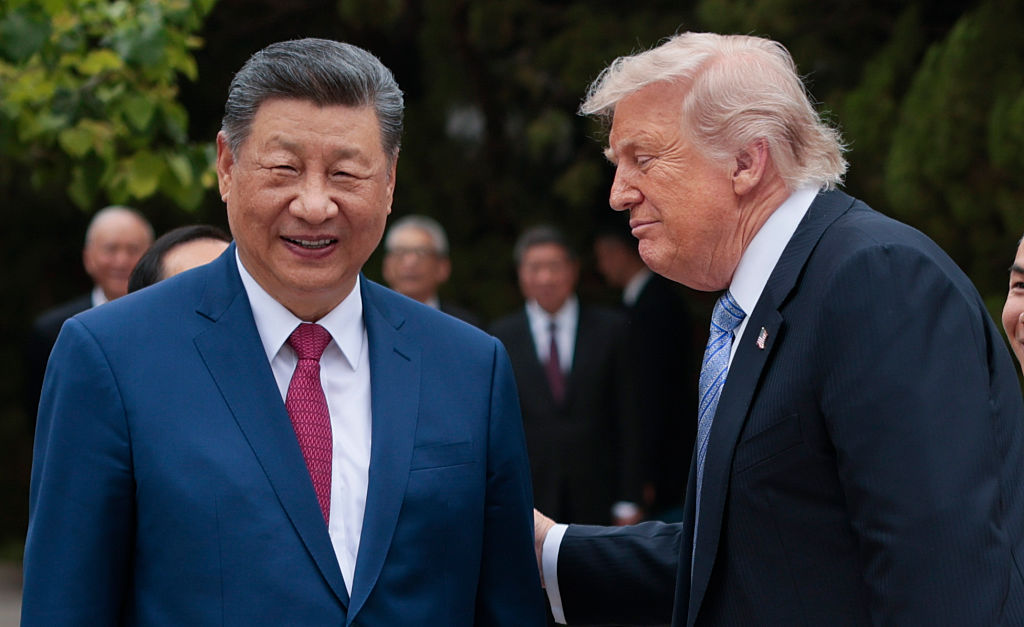
Last week's parade was a display of Beijing's military strength. Credit: Getty

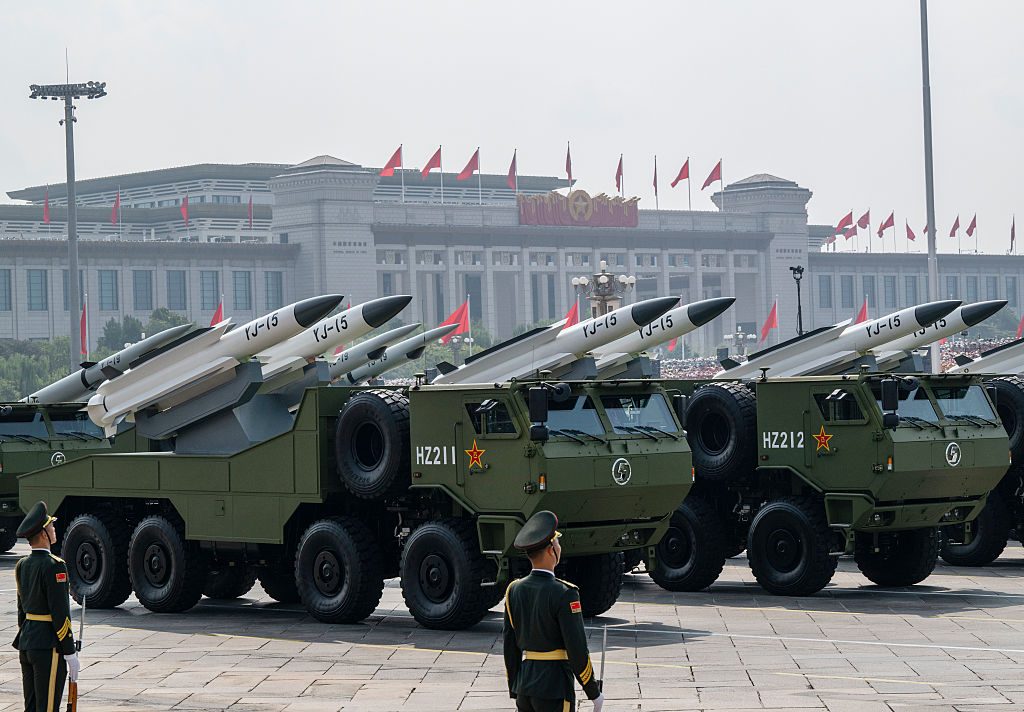
Last week’s parade was a display of Beijing’s military strength. Credit: Getty

8 September 2025 - 7:00pm

The rapid modernisation of China’s armed forces has never been more evident than its parade last week to commemorate 80 years since the end of the Second World War. Similar events in the past have displayed an arsenal formed in much larger part by knock-offs of more advanced Western armaments. But as Vladimir Putin, Kim Jong Un and 18 other foreign leaders looked on, Xi Jinping heralded a bold new era for his country’s defence.

China has increased its military spending by a factor of 13 over the past 30 years, according to Stockholm International Peace Research Institute data, while simultaneously reducing the personnel in its ground forces by 40% over the past 10. As a result, it is now able to field weaponry far more diverse and innovative than ever before. Importantly, much of this is produced using reliable, domestic supply chains where Nato states have over the past decade found themselves vulnerable.

Take as an example China’s progress in cutting-edge hypersonic missile technology, boasted at the parade with the YJ-17, YJ-19, and YJ-20 anti-ship missiles. Travelling at least five times faster than the speed of sound (about 3,800 miles per hour), these missiles present a serious threat to America’s smaller — albeit better equipped — navy. They’re able to dodge and, in salvos, likely overwhelm advanced defence systems. Neither Britain nor any other European nation has developed a hypersonic missile yet, and report leaked in 2023 revealed that the US Department of Defense still lags behind China in this domain.

Then there were the drones, and it’s no surprise that China has invested heavily in this field following developments in Ukraine. In its parade, Beijing displayed a diverse range of different ground, sea, and aerial drones that included a 20 metre-long submersible which may function like an unmanned torpedo capable of performing direct strikes. If it were to come to a naval battle, Ukraine has proven this kind of technology to be capable of serious strategic influence, sending Russia’s Black Sea fleet scurrying for safe harbour by largely using unmanned seaborne drones. And that was without any real navy to speak of, while China possesses the world’s largest by sheer number of ships.

Nato states are expanding their capabilities in this realm, too. For example, German manufacturer Helsing cut a deal with Britain this summer to open a new factory in Plymouth for the production of submersible surveillance drones, and Nato has been performing large-scale joint exercises to prepare for the drone threat. But whether it will be enough to counter China without first being tested in open combat remains in question. Some analysts fear that China may already be ahead. The message is clear: Nato may not be able to rely on its past technological advantage for much longer.

It is, however, important to consider that China hasn’t been to war for almost half a century. Large armies equipped with cutting-edge technology look spectacular at parades, and serve as excellent sales pitches to allied states, but in practice they’re impotent without proper organisation. An incident where a Chinese warship accidentally rammed its own coast guard vessel last month, as well as serious corruption within the People’s Liberation Army, suggest that this could prove a problem for Beijing.

One might also argue, though, that Nato’s recent battlefield experience against insurgencies in Iraq and Afghanistan would carry little value in a conventional war against a superpower like China. When I was reporting in Ukraine, veterans constantly impressed on me that experienced foreign fighters from Europe and the US often struggled with the reality of frontline combat in the trenches. Recent developments in technology, such as China’s drones and hypersonic missiles, also introduce uncertainty about how far the nature of warfare has changed, which remains a constant topic of debate in military circles.

Russia has proven in Ukraine that the combination of production capacity and sheer will are enough to wage a successful war of attrition in the 21st century. China is spending five times as much on defence as Japan and almost seven times as much as South Korea. Although its defence budget is still only about a third the size of America’s, this parade shows that it’s prepared and capable of rapidly closing that gap. Any hope that Nato might have pinned on a technological advantage could disappear if China continues on this trajectory.


Charlie Metcalfe is a freelance journalist specialising in foreign affairs with experience reporting from the Middle East and Europe, including Ukraine.

chrlmtclf

China is threatening America in the AI race

Reports sugget Zhipu AI  has released a new model that can rival leading US systems. Credit: Getty

Reports sugget Zhipu AI has released a new model that can rival leading US systems. Credit: Getty

1 July 2026 - 10:18am

China is trying to catch up with America on artificial intelligence. The Wall Street Journal has reported that Zhipu AI — one of China’s six “AI tiger” LLMs — has released a new model that can rival leading US systems, including Anthropic’s Mythos, in cybersecurity tasks such as pinpointing security bugs. While this marks a milestone in China’s drive to catch up with Western AI capabilities, strong performance on a single benchmark does not mean it has taken the lead. Chinese models still lag behind their Western counterparts in broader capabilities, such as autonomous operation. Skepticism is therefore warranted before resorting to hysterical conclusions, but complacency about the geopolitical implications of China’s AI advances would be an even greater mistake.

On the infrastructure side, Chinese AI is still constrained by access to advanced chips, with American labs way ahead in computing capacity as well as investment. Analysis from earlier this year suggests that Chinese models are likely to be at least a few months behind those in the US. But they are still continuing to make progress, or that the geopolitical importance of AI will be decided only by whose LLM has ventured deeper into the technological frontier. The practical applications of AI, countries’ to capture foreign markets, and the application of AI into the real economy will matter just as much.

Here, China may hold an advantage. As with its dominance across many critical supply chains, Beijing may not need to produce the most advanced AI systems — only those that are affordable and widely deployable. In doing so, it could consolidate global influence by supplying functional, low-cost AI at scale.

Beijing seems to be pursuing exactly that path, developing an AI “open-source” strategy that offers affordable, widely available AI models for companies and individuals to use and modify as they wish. The production of the DeepSeek AI model, which matched the performance of Silicon Valley tools such as ChatGPT at a fraction of the cost for users, created goodwill among Chinese models with developers.

The four most popular models on OpenRouter, an AI hardware platform for developers, are now all Chinese. The goal for China is not only to win the frontier-model race, but to make its systems the default layer of AI adoption across industries and global markets. For most economies, the choice is increasingly between an affordable tool they can deploy now and a more robust one that may be out of reach.

And while the countries adopting Chinese models may be exposed to political pressure and cyber threats from Beijing, safer and more capable alternatives matter little if they are unaffordable. American AI companies are already under pressure to monetize products whose operating costs are rising. If Chinese open-source models become the cheap default for startups, universities, governments and businesses across the developing world, then America’s AI lead will be eroded from below.

Perhaps more concerning for America in the long run is how AI can give Chinese manufacturing even more strength, through the ongoing integration of AI as a general-purpose technology. China’s new Five-Year Plan mentioned AI more than 50 times and includes an “AI+” action plan aimed at spreading AI across the economy.

Beijing has been pioneering automation of its critical infrastructure for years, with promising recent results in increasing warplane production capacity. In that regard, China’s open-model strategy and manufacturing dominance will reinforce each other. Cheap, adaptable models accelerate deployment across the real economy while those deployments generate real-world data and use cases that can feed back into further model improvement.

The United States should not dismiss the importance of its lead in the AI race. That lead worries Beijing, not least because a more automated Chinese economy would also become more vulnerable to AI-generated cyber threats. But nor should Washington assume that China cannot catch up with American capabilities over time.

This AI competition represents part of a broader struggle over tech supply chains and geopolitical influence. Decisions over whether to adopt US or Chinese models could produce a more fragmented global reality, with different regions relying on different cloud providers, chips and security structures. The result will likely be a global economy which is divided into competing spheres, rather than one which produces a single winner.


Miquel Vila is a political and geopolitical risk consultant focusing on industrial strategy, critical infrastructure and global supply chains.

miquelvilam