




X Close

Mark Carney is inheriting a poisoned chalice

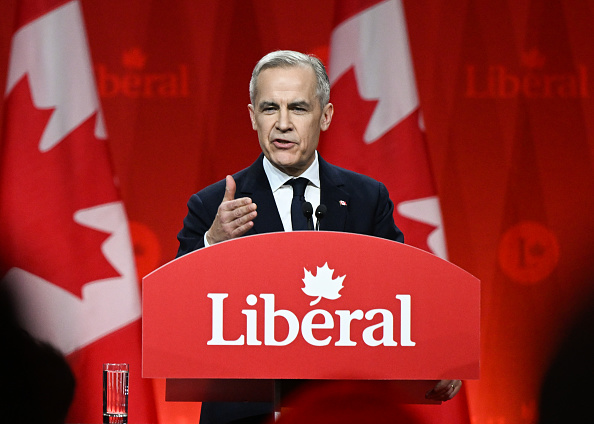
The technocrats are on the march again. Credit: Getty

The technocrats are on the march again. Credit: Getty

March 10 2025 - 10:00am

The contest to succeed Justin Trudeau as leader of the Liberal Party of Canada has produced its expected result: ex-central bank governor Mark Carney won an overwhelming first ballot victory with 85.9% of the party electorate’s vote. The Liberal grassroots have effectively signalled a desire to start afresh, rejecting ex-Trudeau minister Chrystia Freeland in favor of the political novice Carney.

The 59-year-old is set to navigate what is probably the most tense and volatile period of Canadian politics in 30 years. Vowing to scrap the unpopular Trudeau consumer carbon tax and capital gains tax hike, the former Bank of England governor has promised to chart a more pro-business course for the embattled governing party.

Carney will ascend to the post of prime minister in the following days without yet being an elected member of Parliament. However, he may be able to find a seat in the House of Commons soon by calling an early election. The new Liberal chief will want to capitalize on a major Trump-induced polling shift that has revived his party’s fortunes (even Trudeau received a big popularity boost).

Canada is, of course, in the crosshairs of the US administration’s aggressive and unpredictable trade war; and though a temporary partial tariff reprieve was granted, Canadians are expecting high-stakes economic brinkmanship to resume within days. It was against this backdrop of total uncertainty that Carney pitched himself as the experienced policy hand who could steer the country through the latest crisis — as he had during the financial meltdown of 2008. However, it should also be noted that this part of his record has come under attack from then-Conservative prime minister, Stephen Harper, who is disputing the Liberal leader’s claims of success. Another elder statesman, former UK chancellor George Osborne, defended Carney, praising his time at the Bank of England.

Carney’s other great strength, his extensive private sector experience, has also been targeted, with Right-wing sources pinning the blame on him for the relocation of the head office of Canadian asset management giant Brookfield — in which he served as chair — from Toronto to New York. Carney has so far weathered these charges, but questions persist around his corporate decisions and personal wealth. This may come back to bite him in a general election campaign as his chief rival, Conservative leader Pierre Poilievre, could use this line of attack against a man he will surely depict as an out-of-touch elite. Poilievre has seen his commanding lead threatened by Carney’s rise and the two are now neck-and-neck.

In fighting both Trump and Poilievre, Carney will confront a series of challenges not just to his nascent government but also to the endangered brand of managerial technocracy that he so perfectly embodies. As in 2015, at the start of the Trudeau era, when Canada seemed to stand athwart the populist revolution sweeping the Western world, Carney’s could see a dramatic resurgence of center-left liberalism. Or, depending on any number of variables, it could amount to the shortest ministry in Canadian history. Anything could happen and, in keeping with the hockey metaphors he is fond of using, it’s now up to Carney to light the lamp.


Michael Cuenco is Senior Editor at American Affairs.
1TrueCuencoism

China is threatening America in the AI race

Reports sugget Zhipu AI  has released a new model that can rival leading US systems. Credit: Getty

Reports sugget Zhipu AI has released a new model that can rival leading US systems. Credit: Getty

July 1 2026 - 10:18am

China is trying to catch up with America on artificial intelligence. The Wall Street Journal has reported that Zhipu AI — one of China’s six “AI tiger” LLMs — has released a new model that can rival leading US systems, including Anthropic’s Mythos, in cybersecurity tasks such as pinpointing security bugs. While this marks a milestone in China’s drive to catch up with Western AI capabilities, strong performance on a single benchmark does not mean it has taken the lead. Chinese models still lag behind their Western counterparts in broader capabilities, such as autonomous operation. Skepticism is therefore warranted before resorting to hysterical conclusions, but complacency about the geopolitical implications of China’s AI advances would be an even greater mistake.

On the infrastructure side, Chinese AI is still constrained by access to advanced chips, with American labs way ahead in computing capacity as well as investment. Analysis from earlier this year suggests that Chinese models are likely to be at least a few months behind those in the US. But they are still continuing to make progress, or that the geopolitical importance of AI will be decided only by whose LLM has ventured deeper into the technological frontier. The practical applications of AI, countries’ to capture foreign markets, and the application of AI into the real economy will matter just as much.

Here, China may hold an advantage. As with its dominance across many critical supply chains, Beijing may not need to produce the most advanced AI systems — only those that are affordable and widely deployable. In doing so, it could consolidate global influence by supplying functional, low-cost AI at scale.

Beijing seems to be pursuing exactly that path, developing an AI “open-source” strategy that offers affordable, widely available AI models for companies and individuals to use and modify as they wish. The production of the DeepSeek AI model, which matched the performance of Silicon Valley tools such as ChatGPT at a fraction of the cost for users, created goodwill among Chinese models with developers.

The four most popular models on OpenRouter, an AI hardware platform for developers, are now all Chinese. The goal for China is not only to win the frontier-model race, but to make its systems the default layer of AI adoption across industries and global markets. For most economies, the choice is increasingly between an affordable tool they can deploy now and a more robust one that may be out of reach.

And while the countries adopting Chinese models may be exposed to political pressure and cyber threats from Beijing, safer and more capable alternatives matter little if they are unaffordable. American AI companies are already under pressure to monetize products whose operating costs are rising. If Chinese open-source models become the cheap default for startups, universities, governments and businesses across the developing world, then America’s AI lead will be eroded from below.

Perhaps more concerning for America in the long run is how AI can give Chinese manufacturing even more strength, through the ongoing integration of AI as a general-purpose technology. China’s new Five-Year Plan mentioned AI more than 50 times and includes an “AI+” action plan aimed at spreading AI across the economy.

Beijing has been pioneering automation of its critical infrastructure for years, with promising recent results in increasing warplane production capacity. In that regard, China’s open-model strategy and manufacturing dominance will reinforce each other. Cheap, adaptable models accelerate deployment across the real economy while those deployments generate real-world data and use cases that can feed back into further model improvement.

The United States should not dismiss the importance of its lead in the AI race. That lead worries Beijing, not least because a more automated Chinese economy would also become more vulnerable to AI-generated cyber threats. But nor should Washington assume that China cannot catch up with American capabilities over time.

This AI competition represents part of a broader struggle over tech supply chains and geopolitical influence. Decisions over whether to adopt US or Chinese models could produce a more fragmented global reality, with different regions relying on different cloud providers, chips and security structures. The result will likely be a global economy which is divided into competing spheres, rather than one which produces a single winner.


Miquel Vila is a political and geopolitical risk consultant focusing on industrial strategy, critical infrastructure and global supply chains.

miquelvilam