




X Close

MAGA Right teams up with socialist Left on credit card fees

It's okay to be angry about credit card fees. Credit: Getty

It’s okay to be angry about credit card fees. Credit: Getty

15 February 2025 - 2:30pm

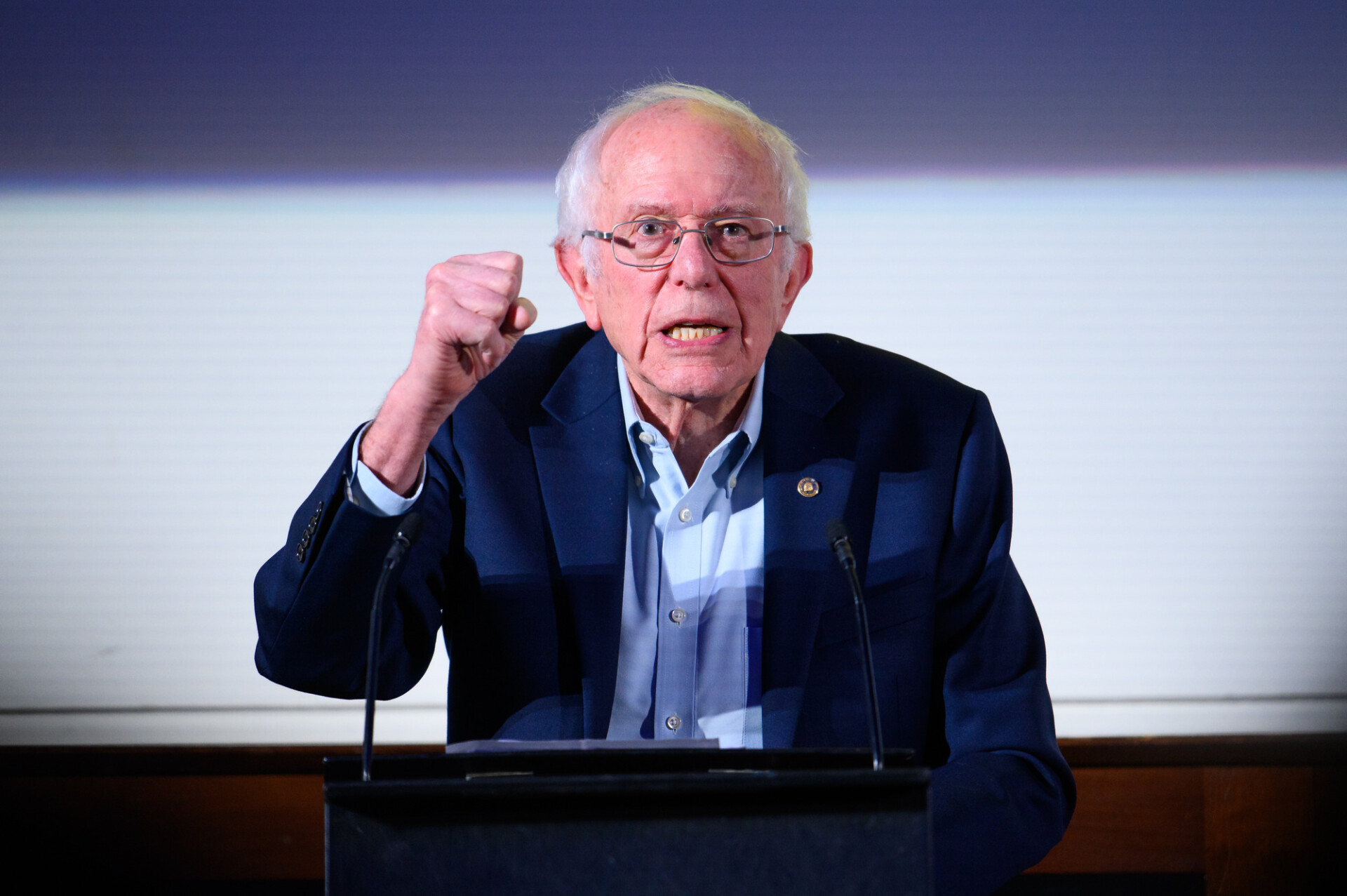
In a rare show of policy unity across the partisan divide, senators Bernie Sanders (D-VT) and Josh Hawley (R-MO) have teamed up to co-sponsor a bill aiming to cap credit card interest rates at 10%. In appealing to the popular campaign pledge made by President Donald Trump, these champions of economic heterodoxy seem to give new life to the “horseshoe theory” of politics, which suggests that the socialist Left and populist Right have much to agree on in opposition to an exhausted political centre.

Their collaboration is, of course, nothing new: they had previously teamed up at the height of the pandemic to offer Americans $1,200 stimulus cheques. But while there is philosophically a lot of common ground to be staked between these factions, the fact of the matter is that neither the Republican nor the Democratic coalitions are likely to make such partnerships tenable.

For instance, the Right-wing side of this so-called realignment has not been well served by the current tack of DOGE, which looks to either cut, weaken or even abolish the Consumer Financial Protection Bureau. The CFPB, which is the brainchild of Senator Elizabeth Warren and is tasked with scrutinising predatory financial practices such as excessive credit card billing, would help to enforce a bill like this. It is not clear how Hawley intends for his proposal to be implemented, since he has not openly rebuked his own party’s designs on the regulatory body.

What’s more, the enthusiasm with which Republicans in both the executive and the legislature are contemplating making cuts to entitlements, along with the GOP’s wider drive toward austerity, has alienated potentially sympathetic allies. This includes Sanders, who had initially been at least partially open to the MAGA agenda, on the grounds that it could reduce the fusion of corporate and government power.

And if personnel is policy, then things look very grim indeed for the realignment as a whole. The one other senator who’s been most receptive to policies in this mould, and who’s been particularly cooperative with the Warren wing of the Democrats on consumer advocacy, is JD Vance. But he has been rendered virtually powerless in day-to-day governance by his elevation to the vice presidency. The same applies for the similarly populist-adjacent Marco Rubio, now at the State Department. This means that a genuine anti-corporate Republican like Hawley is in a much weaker and more isolated position in Congress, compared to any time in the last eight years.

Rather than a harbinger of greater alignment between populist Right and Left, the latest Hawley-Bernie tandem may instead signal the swansong for this kind of ideological formation, which had seemed so promising back in 2016 when it was Bernie and Trump himself who seemed to be converging on everything from trade to immigration. Capping credit card fees is a genuinely helpful pro-middle class idea, but the fact that it is likely to fall by the wayside illustrates just how powerless the horseshoe alliance has become.


Michael Cuenco is Senior Editor at American Affairs.
1TrueCuencoism

China is threatening America in the AI race

Reports sugget Zhipu AI  has released a new model that can rival leading US systems. Credit: Getty

Reports sugget Zhipu AI has released a new model that can rival leading US systems. Credit: Getty

1 July 2026 - 10:18am

China is trying to catch up with America on artificial intelligence. The Wall Street Journal has reported that Zhipu AI — one of China’s six “AI tiger” LLMs — has released a new model that can rival leading US systems, including Anthropic’s Mythos, in cybersecurity tasks such as pinpointing security bugs. While this marks a milestone in China’s drive to catch up with Western AI capabilities, strong performance on a single benchmark does not mean it has taken the lead. Chinese models still lag behind their Western counterparts in broader capabilities, such as autonomous operation. Skepticism is therefore warranted before resorting to hysterical conclusions, but complacency about the geopolitical implications of China’s AI advances would be an even greater mistake.

On the infrastructure side, Chinese AI is still constrained by access to advanced chips, with American labs way ahead in computing capacity as well as investment. Analysis from earlier this year suggests that Chinese models are likely to be at least a few months behind those in the US. But they are still continuing to make progress, or that the geopolitical importance of AI will be decided only by whose LLM has ventured deeper into the technological frontier. The practical applications of AI, countries’ to capture foreign markets, and the application of AI into the real economy will matter just as much.

Here, China may hold an advantage. As with its dominance across many critical supply chains, Beijing may not need to produce the most advanced AI systems — only those that are affordable and widely deployable. In doing so, it could consolidate global influence by supplying functional, low-cost AI at scale.

Beijing seems to be pursuing exactly that path, developing an AI “open-source” strategy that offers affordable, widely available AI models for companies and individuals to use and modify as they wish. The production of the DeepSeek AI model, which matched the performance of Silicon Valley tools such as ChatGPT at a fraction of the cost for users, created goodwill among Chinese models with developers.

The four most popular models on OpenRouter, an AI hardware platform for developers, are now all Chinese. The goal for China is not only to win the frontier-model race, but to make its systems the default layer of AI adoption across industries and global markets. For most economies, the choice is increasingly between an affordable tool they can deploy now and a more robust one that may be out of reach.

And while the countries adopting Chinese models may be exposed to political pressure and cyber threats from Beijing, safer and more capable alternatives matter little if they are unaffordable. American AI companies are already under pressure to monetize products whose operating costs are rising. If Chinese open-source models become the cheap default for startups, universities, governments and businesses across the developing world, then America’s AI lead will be eroded from below.

Perhaps more concerning for America in the long run is how AI can give Chinese manufacturing even more strength, through the ongoing integration of AI as a general-purpose technology. China’s new Five-Year Plan mentioned AI more than 50 times and includes an “AI+” action plan aimed at spreading AI across the economy.

Beijing has been pioneering automation of its critical infrastructure for years, with promising recent results in increasing warplane production capacity. In that regard, China’s open-model strategy and manufacturing dominance will reinforce each other. Cheap, adaptable models accelerate deployment across the real economy while those deployments generate real-world data and use cases that can feed back into further model improvement.

The United States should not dismiss the importance of its lead in the AI race. That lead worries Beijing, not least because a more automated Chinese economy would also become more vulnerable to AI-generated cyber threats. But nor should Washington assume that China cannot catch up with American capabilities over time.

This AI competition represents part of a broader struggle over tech supply chains and geopolitical influence. Decisions over whether to adopt US or Chinese models could produce a more fragmented global reality, with different regions relying on different cloud providers, chips and security structures. The result will likely be a global economy which is divided into competing spheres, rather than one which produces a single winner.


Miquel Vila is a political and geopolitical risk consultant focusing on industrial strategy, critical infrastructure and global supply chains.

miquelvilam