




X Close

Liberals struggle to admit Trump is right on gender ideology

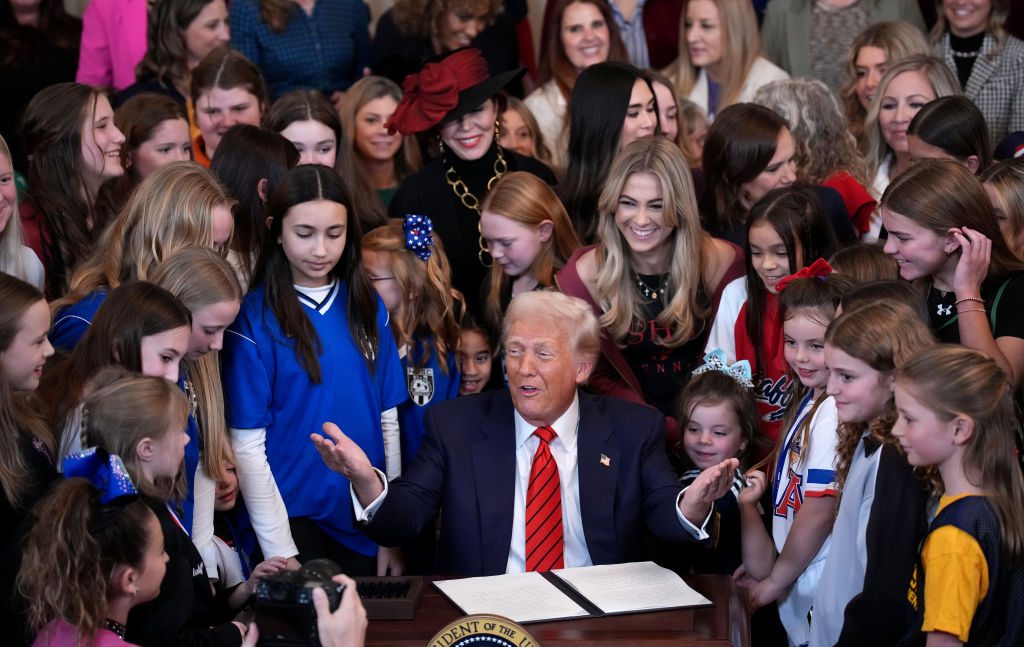
Democrats are struggling to admit that, on this issue, Trump largely has the science right. Credit: Getty

Democrats are struggling to admit that, on this issue, Trump largely has the science right. Credit: Getty

6 July 2025 - 1:00pm

This week, the US Supreme Court agreed to hear two cases about whether it is unconstitutional to ban transgender women from women’s and girls’ sports.

Only last month, in US v. Skrmetti, the conservative majority of the Court declined to name transgender people as a protected class. It also did not view denying “gender-affirming” interventions for minors, such as cross-sex hormones and puberty blockers, as a form of sex discrimination that violated the Constitution’s Equal Protection clause.

This no doubt shocked many of my fellow liberals who are hellbent on insisting that gender-affirming care is evidence-based, medically necessary and life-saving, despite evidence and amicus briefs unearthed in Skrmetti clearly dismantling those arguments. We seem unable to evolve in the face of evidence, likely because doing so requires admitting that, on this issue, Republicans largely have the science right.

In the case of transgender athletes, that science is pretty simple: there are males and females; they are not the same; one cannot actually change sex; and, on average, males have physical advantages over women. Some liberals refused to admit this even after University of Pennsylvania swimmer Lia Thomas, a male who took cross-sex hormones and identified as female, won NCAA titles and towered over women on the podium in 2022.

For others, though, Thomas represented a turning point, when they began to see the fallout from policies that prized gender identity above sex. A number of these policies are now enshrined in some state constitutions. The conservative majority of SCOTUS will no doubt find barring people from sports based on gender identity constitutional, creating more cognitive dissonance for liberals: the same group which dismantled Roe v. Wade will now rule in favour of girls and women.

I admit I was initially sceptical of Trump’s heavy-handed rollback of policies which many liberals have come to see as trans rights. Though I agreed that we needed to re-establish the reality of binary sex (as Trump’s first executive order did), I felt each subsequent trans-related executive order was more aggressive and punitive than the last. I worried that each would meet with ferocious, litigious pushback, endlessly tying up the issues in court.

It seems I was wrong. Packing the Supreme Court with conservatives, rewriting Title IX, and withholding money from hospitals that offer sex-trait modification procedures to minors have had an enormous impact. Major paediatric gender clinics have closed. UPenn has had to apologise to the athletes forced to change with and compete against Thomas. An 82-year-old woman, barred for a lifetime from the YMCA after complaining about a male changing in the women’s locker room, won a $65,000 settlement — not enough to build her own pool, but still a victory for free speech and women’s rights.

What we don’t know is how many of these changes are happening against the will of institutions, and how many represent changes they’d wanted to make but didn’t have the courage to. Presidents Obama and Biden crafted executive orders and changed policies and laws, including Title IX, to make discrimination based on gender identity illegal. They, too, strong-armed institutions into compliance, threatening to withhold funding otherwise. Perhaps UPenn and various hospitals are simply going where the laws and policies take them. Or perhaps they’ve been searching for off-ramps, and it was Trump who finally provided one.


Lisa Selin Davis is the author of Tomboy. She writes at Broadview on Substack.

LisaSelinDavis

China is threatening America in the AI race

Reports sugget Zhipu AI  has released a new model that can rival leading US systems. Credit: Getty

Reports sugget Zhipu AI has released a new model that can rival leading US systems. Credit: Getty

1 July 2026 - 10:18am

China is trying to catch up with America on artificial intelligence. The Wall Street Journal has reported that Zhipu AI — one of China’s six “AI tiger” LLMs — has released a new model that can rival leading US systems, including Anthropic’s Mythos, in cybersecurity tasks such as pinpointing security bugs. While this marks a milestone in China’s drive to catch up with Western AI capabilities, strong performance on a single benchmark does not mean it has taken the lead. Chinese models still lag behind their Western counterparts in broader capabilities, such as autonomous operation. Skepticism is therefore warranted before resorting to hysterical conclusions, but complacency about the geopolitical implications of China’s AI advances would be an even greater mistake.

On the infrastructure side, Chinese AI is still constrained by access to advanced chips, with American labs way ahead in computing capacity as well as investment. Analysis from earlier this year suggests that Chinese models are likely to be at least a few months behind those in the US. But they are still continuing to make progress, or that the geopolitical importance of AI will be decided only by whose LLM has ventured deeper into the technological frontier. The practical applications of AI, countries’ to capture foreign markets, and the application of AI into the real economy will matter just as much.

Here, China may hold an advantage. As with its dominance across many critical supply chains, Beijing may not need to produce the most advanced AI systems — only those that are affordable and widely deployable. In doing so, it could consolidate global influence by supplying functional, low-cost AI at scale.

Beijing seems to be pursuing exactly that path, developing an AI “open-source” strategy that offers affordable, widely available AI models for companies and individuals to use and modify as they wish. The production of the DeepSeek AI model, which matched the performance of Silicon Valley tools such as ChatGPT at a fraction of the cost for users, created goodwill among Chinese models with developers.

The four most popular models on OpenRouter, an AI hardware platform for developers, are now all Chinese. The goal for China is not only to win the frontier-model race, but to make its systems the default layer of AI adoption across industries and global markets. For most economies, the choice is increasingly between an affordable tool they can deploy now and a more robust one that may be out of reach.

And while the countries adopting Chinese models may be exposed to political pressure and cyber threats from Beijing, safer and more capable alternatives matter little if they are unaffordable. American AI companies are already under pressure to monetize products whose operating costs are rising. If Chinese open-source models become the cheap default for startups, universities, governments and businesses across the developing world, then America’s AI lead will be eroded from below.

Perhaps more concerning for America in the long run is how AI can give Chinese manufacturing even more strength, through the ongoing integration of AI as a general-purpose technology. China’s new Five-Year Plan mentioned AI more than 50 times and includes an “AI+” action plan aimed at spreading AI across the economy.

Beijing has been pioneering automation of its critical infrastructure for years, with promising recent results in increasing warplane production capacity. In that regard, China’s open-model strategy and manufacturing dominance will reinforce each other. Cheap, adaptable models accelerate deployment across the real economy while those deployments generate real-world data and use cases that can feed back into further model improvement.

The United States should not dismiss the importance of its lead in the AI race. That lead worries Beijing, not least because a more automated Chinese economy would also become more vulnerable to AI-generated cyber threats. But nor should Washington assume that China cannot catch up with American capabilities over time.

This AI competition represents part of a broader struggle over tech supply chains and geopolitical influence. Decisions over whether to adopt US or Chinese models could produce a more fragmented global reality, with different regions relying on different cloud providers, chips and security structures. The result will likely be a global economy which is divided into competing spheres, rather than one which produces a single winner.


Miquel Vila is a political and geopolitical risk consultant focusing on industrial strategy, critical infrastructure and global supply chains.

miquelvilam