




X Close

Liberal media gives Kamala Harris the soft treatment

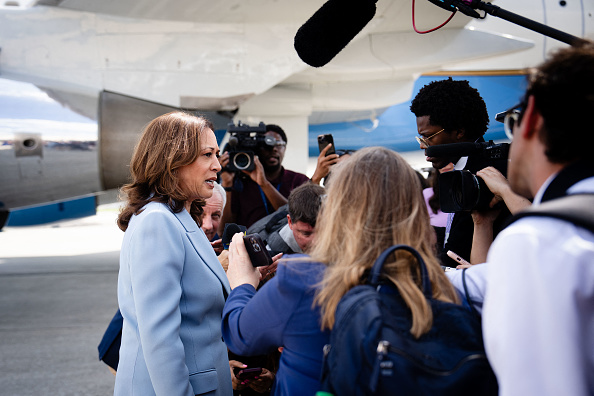
She's giving journalists off-the-record face time. Credit: Getty

She’s giving journalists off-the-record face time. Credit: Getty

12 August 2024 - 1:00pm

The central theme of Kamala Harris’ presidential campaign is “joy”, according to recent headlines from the New York Times, the Washington Post, MSNBC, the Los Angeles Times and others.

It’s the latest instance of the liberal media widely covering soft-hitting human interest stories about the Vice President — including an Atlantic essay on her fondness for food — in sharp contrast to the critical coverage of Joe Biden during the final weeks of his campaign. Other recent Harris news cycles have focused on the online pro-Harris meme culture and running-mate Tim Walz’sdad vibes”. A Monday Time article opened with a description of a Harris rally, reading, “The soundtrack suggested a Beyoncé concert. The light-up bracelets evoked the Eras Tour. And the exuberant crowd… resembled the early days of Barack Obama.”

The 27 June debate, in which Biden’s poor performance ultimately ended his candidacy, opened the floodgates to more hostile reporting from the mainstream press than he’d seen at any point in his presidency. The coverage was so uniformly negative that Biden began publicly picking fights with friendly journalists, asking “what have these people been right about lately? Seriously.”

The lack of critical reporting on Harris likely owes in part to the candidate’s distance from the media. In the three weeks since Biden exited the race, the 59-year-old has not taken an interview or held a press conference, and has answered only two media questions in an impromptu interaction lasting about one minute. It may also be related to Harris’ friendly relationship with certain journalists, who have reportedly been getting off-the-record face time with her despite the lack of interviews.

In the past three weeks, the NYT has published no fewer than five articles on Kamala Harris memes, along with countless other positive articles, and only one story on her media blackout. The same outlet published numerous op-eds calling for Biden to exit the race last month and directed nonstop negative news coverage toward the president, including a report on the White House feeding the media “softball” questions for Biden.

The press has also been slow to zero in on the substance of Harris’ nascent campaign, whose website still doesn’t have a policy section. The New Yorker stands out among the mainstream press for pointing out Harris’ lack of policy plans. “She has not explained what, exactly, happened in Washington after President Joe Biden’s disastrous debate”, the article read, ”or why she has changed her mind on fracking, which she once said should be banned, and has wobbled on Medicare for All, which she once supported.”

Biden’s debate performance — and the media’s reluctance to report on his age prior to that point — sparked a moment of self-reflection among journalists about the industry’s failure to apply harsh scrutiny to the Democratic president. Harris has said she’ll sit down for an interview by the end of August and, until then, the media’s coverage of her will provide some hints as to whether any lessons were learned.


is UnHerd’s US correspondent.

laureldugg

China is threatening America in the AI race

Reports sugget Zhipu AI  has released a new model that can rival leading US systems. Credit: Getty

Reports sugget Zhipu AI has released a new model that can rival leading US systems. Credit: Getty

1 July 2026 - 10:18am

China is trying to catch up with America on artificial intelligence. The Wall Street Journal has reported that Zhipu AI — one of China’s six “AI tiger” LLMs — has released a new model that can rival leading US systems, including Anthropic’s Mythos, in cybersecurity tasks such as pinpointing security bugs. While this marks a milestone in China’s drive to catch up with Western AI capabilities, strong performance on a single benchmark does not mean it has taken the lead. Chinese models still lag behind their Western counterparts in broader capabilities, such as autonomous operation. Skepticism is therefore warranted before resorting to hysterical conclusions, but complacency about the geopolitical implications of China’s AI advances would be an even greater mistake.

On the infrastructure side, Chinese AI is still constrained by access to advanced chips, with American labs way ahead in computing capacity as well as investment. Analysis from earlier this year suggests that Chinese models are likely to be at least a few months behind those in the US. But they are still continuing to make progress, or that the geopolitical importance of AI will be decided only by whose LLM has ventured deeper into the technological frontier. The practical applications of AI, countries’ to capture foreign markets, and the application of AI into the real economy will matter just as much.

Here, China may hold an advantage. As with its dominance across many critical supply chains, Beijing may not need to produce the most advanced AI systems — only those that are affordable and widely deployable. In doing so, it could consolidate global influence by supplying functional, low-cost AI at scale.

Beijing seems to be pursuing exactly that path, developing an AI “open-source” strategy that offers affordable, widely available AI models for companies and individuals to use and modify as they wish. The production of the DeepSeek AI model, which matched the performance of Silicon Valley tools such as ChatGPT at a fraction of the cost for users, created goodwill among Chinese models with developers.

The four most popular models on OpenRouter, an AI hardware platform for developers, are now all Chinese. The goal for China is not only to win the frontier-model race, but to make its systems the default layer of AI adoption across industries and global markets. For most economies, the choice is increasingly between an affordable tool they can deploy now and a more robust one that may be out of reach.

And while the countries adopting Chinese models may be exposed to political pressure and cyber threats from Beijing, safer and more capable alternatives matter little if they are unaffordable. American AI companies are already under pressure to monetize products whose operating costs are rising. If Chinese open-source models become the cheap default for startups, universities, governments and businesses across the developing world, then America’s AI lead will be eroded from below.

Perhaps more concerning for America in the long run is how AI can give Chinese manufacturing even more strength, through the ongoing integration of AI as a general-purpose technology. China’s new Five-Year Plan mentioned AI more than 50 times and includes an “AI+” action plan aimed at spreading AI across the economy.

Beijing has been pioneering automation of its critical infrastructure for years, with promising recent results in increasing warplane production capacity. In that regard, China’s open-model strategy and manufacturing dominance will reinforce each other. Cheap, adaptable models accelerate deployment across the real economy while those deployments generate real-world data and use cases that can feed back into further model improvement.

The United States should not dismiss the importance of its lead in the AI race. That lead worries Beijing, not least because a more automated Chinese economy would also become more vulnerable to AI-generated cyber threats. But nor should Washington assume that China cannot catch up with American capabilities over time.

This AI competition represents part of a broader struggle over tech supply chains and geopolitical influence. Decisions over whether to adopt US or Chinese models could produce a more fragmented global reality, with different regions relying on different cloud providers, chips and security structures. The result will likely be a global economy which is divided into competing spheres, rather than one which produces a single winner.


Miquel Vila is a political and geopolitical risk consultant focusing on industrial strategy, critical infrastructure and global supply chains.

miquelvilam