



X Close

Labour’s Andrew Tate attack ad won’t hurt Farage

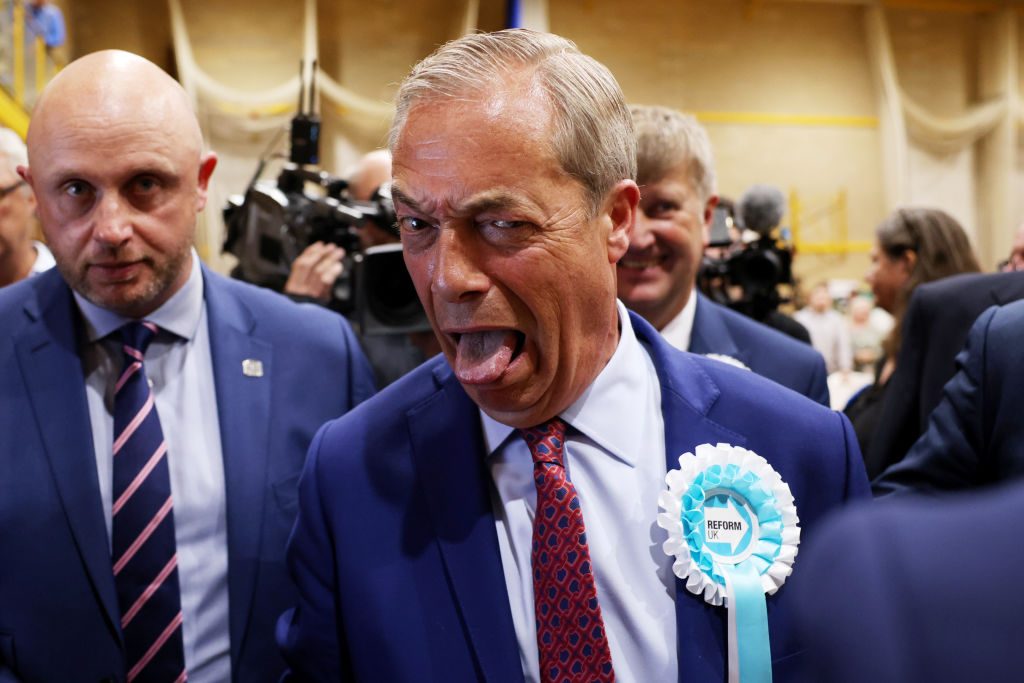
Teflon Nige. Credit: Getty

Teflon Nige. Credit: Getty

17 August 2025 - 5:15pm

In a new attack ad launched today, the Labour Party has attempted to link Nigel Farage with the controversial online influencer Andrew Tate.

The advert highlights comments the Reform UK leader made on the Strike It Big podcast last year, where he described Tate as “an important voice” for young men. Speaking to three male influencers in their twenties, Farage lamented what he saw as a cultural shift against traditional masculinity, saying: “You are all 25, you are all kind of being told you can’t be blokes, you can’t do laddish, fun, bloke things.” He added that masculinity is now viewed as “something we should look down upon, something we should frown upon.”

This is the latest in an emerging pattern of increasingly aggressive — and often bizarre — Labour attacks on the Reform leader. Initially, Keir Starmer’s team brushed Farage off as a mere populist. But as the size of the turquoise wave has grown, Labour has attempted to cast doubt on his patriotic credentials. Earlier this year, the Prime Minister accused Farage of “fawning over Putin”. These supposed Kremlin links were stressed again this week, with Defence Secretary John Healy countering the suggestion that Reform deserves appointments to the House of Lords by stating that the party is full of “Putin apologists”.

Tate and Putin aren’t the only unsavoury figures whom Labour is invoking in a desperate bid to stop the rival party. Just last month, frontbencher Peter Kyle attempted to claim Farage was on the side of sex offenders such as Jimmy Savile, after the Reform leader criticised the Government’s Online Safety Act. Farage has said he won’t respond to the Tate comparison, with a Reform source describing the move as “desperate stuff.”

This is part of Labour’s new “dark arts” strategy. Downing Street has recently formed a dedicated “attack team” targeting Reform UK, under the direction of the Prime Minister’s Chief of Staff Morgan McSweeney. Rather than consistently focusing on Farage himself, the unit is expected to concentrate its efforts on figures within his orbit to undermine the party’s credibility through its supporting cast.

But will this strategy work? In the case of today’s attack ad, Tate is a deeply unpopular figure, with nearly half the British population holding a negative view of him. However, a demographic breakdown reveals some striking patterns. Over a quarter of men aged 18-29 hold a positive view of Tate; 41% of black respondents and 31% of Asian respondents view him favourably, compared to just 15% of white respondents. But overall, less than two-thirds of the population have heard of Tate at all.

In doubling down on ad hominem attacks, Labour risks revealing a startling lack of substantive policy alternatives. By fixating on Farage’s tenuous associations with bad men instead of addressing the real-world challenges facing voters, the Government is ceding open ground to Reform on vital issues such as housing, public services and immigration. Negative campaigning without a positive vision seldom wins hearts or minds, and if Farage has emerged from an attempt at association with Putin — a far more unpopular and better known figure than Tate — he is unlikely to be negatively impacted by this latest ad.

If Labour’s aim is to prevent further Reform gains, it will need more than the “dark arts” of comms and strategy. It requires the thing Starmer so conspicuously lacks, and that is answers to the most serious problems Britain faces today.


China is threatening America in the AI race

Reports sugget Zhipu AI  has released a new model that can rival leading US systems. Credit: Getty

Reports sugget Zhipu AI has released a new model that can rival leading US systems. Credit: Getty

1 July 2026 - 10:18am

China is trying to catch up with America on artificial intelligence. The Wall Street Journal has reported that Zhipu AI — one of China’s six “AI tiger” LLMs — has released a new model that can rival leading US systems, including Anthropic’s Mythos, in cybersecurity tasks such as pinpointing security bugs. While this marks a milestone in China’s drive to catch up with Western AI capabilities, strong performance on a single benchmark does not mean it has taken the lead. Chinese models still lag behind their Western counterparts in broader capabilities, such as autonomous operation. Skepticism is therefore warranted before resorting to hysterical conclusions, but complacency about the geopolitical implications of China’s AI advances would be an even greater mistake.

On the infrastructure side, Chinese AI is still constrained by access to advanced chips, with American labs way ahead in computing capacity as well as investment. Analysis from earlier this year suggests that Chinese models are likely to be at least a few months behind those in the US. But they are still continuing to make progress, or that the geopolitical importance of AI will be decided only by whose LLM has ventured deeper into the technological frontier. The practical applications of AI, countries’ to capture foreign markets, and the application of AI into the real economy will matter just as much.

Here, China may hold an advantage. As with its dominance across many critical supply chains, Beijing may not need to produce the most advanced AI systems — only those that are affordable and widely deployable. In doing so, it could consolidate global influence by supplying functional, low-cost AI at scale.

Beijing seems to be pursuing exactly that path, developing an AI “open-source” strategy that offers affordable, widely available AI models for companies and individuals to use and modify as they wish. The production of the DeepSeek AI model, which matched the performance of Silicon Valley tools such as ChatGPT at a fraction of the cost for users, created goodwill among Chinese models with developers.

The four most popular models on OpenRouter, an AI hardware platform for developers, are now all Chinese. The goal for China is not only to win the frontier-model race, but to make its systems the default layer of AI adoption across industries and global markets. For most economies, the choice is increasingly between an affordable tool they can deploy now and a more robust one that may be out of reach.

And while the countries adopting Chinese models may be exposed to political pressure and cyber threats from Beijing, safer and more capable alternatives matter little if they are unaffordable. American AI companies are already under pressure to monetize products whose operating costs are rising. If Chinese open-source models become the cheap default for startups, universities, governments and businesses across the developing world, then America’s AI lead will be eroded from below.

Perhaps more concerning for America in the long run is how AI can give Chinese manufacturing even more strength, through the ongoing integration of AI as a general-purpose technology. China’s new Five-Year Plan mentioned AI more than 50 times and includes an “AI+” action plan aimed at spreading AI across the economy.

Beijing has been pioneering automation of its critical infrastructure for years, with promising recent results in increasing warplane production capacity. In that regard, China’s open-model strategy and manufacturing dominance will reinforce each other. Cheap, adaptable models accelerate deployment across the real economy while those deployments generate real-world data and use cases that can feed back into further model improvement.

The United States should not dismiss the importance of its lead in the AI race. That lead worries Beijing, not least because a more automated Chinese economy would also become more vulnerable to AI-generated cyber threats. But nor should Washington assume that China cannot catch up with American capabilities over time.

This AI competition represents part of a broader struggle over tech supply chains and geopolitical influence. Decisions over whether to adopt US or Chinese models could produce a more fragmented global reality, with different regions relying on different cloud providers, chips and security structures. The result will likely be a global economy which is divided into competing spheres, rather than one which produces a single winner.


Miquel Vila is a political and geopolitical risk consultant focusing on industrial strategy, critical infrastructure and global supply chains.

miquelvilam
