




X Close

LA riots reflect failure of progressive leadership

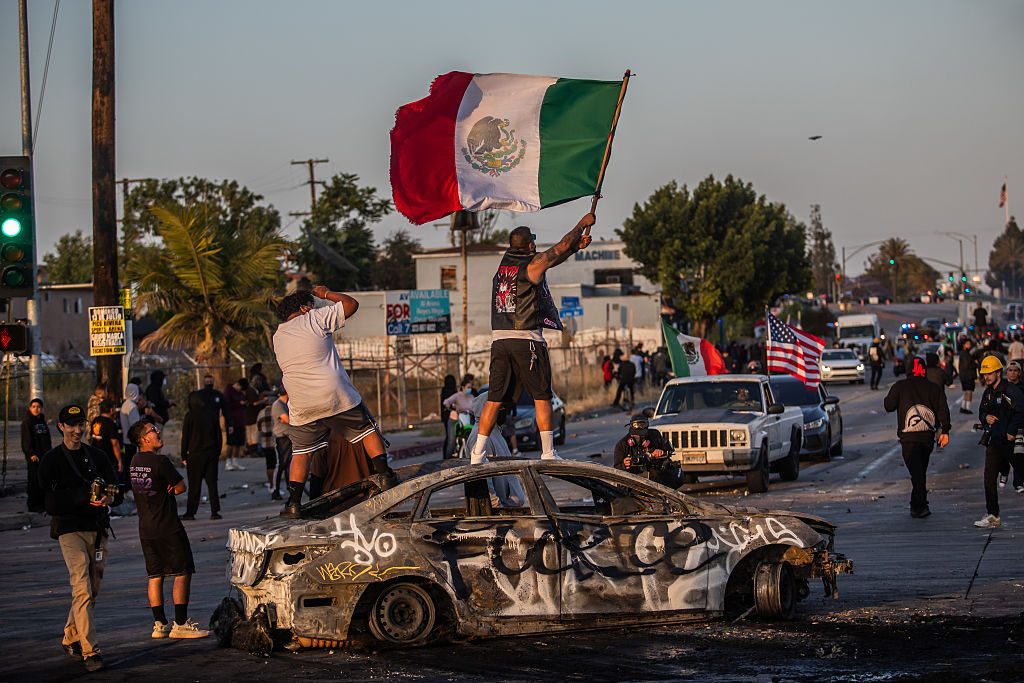
LA's decline is not inevitable. Credit: Getty

LA’s decline is not inevitable. Credit: Getty

8 June 2025 - 9:00pm

Los Angeles has a long, combustible history — and it’s flaring up again. The current unrest, driven in part by political grievances, reflects a deeper dysfunction steadily eroding the city’s foundations. Once a cradle of conservatism and the political home of Ronald Reagan, LA has become a hub of resurgent radicalism, and, to many outside its borders, a symbol of why the country turned to a nativist strongman like Donald Trump.

Now, amid the chaos, there is talk that Trump might go beyond the National Guard and deploy the Marines. It’s a characteristically extreme move, but one that, for anyone familiar with LA’s history of protests spiralling into violence and tragedy (as I witnessed during my 40 years there), may not be entirely out of step with the city’s volatile reality.

Often migrants who come to LA find opportunity but also profound disappointment. African Americans who arrived in large numbers during the Thirties and Forties escaped the overt racism of the South, only to encounter a hostile police force and deeply discriminatory housing practices. Their disillusionment erupted in two of the most explosive racial uprisings in American history: the Watts riots in 1965 and the unrest following the Rodney King verdict in 1992.

For many of today’s immigrants, particularly the undocumented, assimilation into the broader society has been difficult. But unlike African Americans in the Sixties, they are also immigrating to a city that no longer provides a lot of opportunity. Latino incomes, adjusted for cost of living, and homeownership rates are among the lowest in the nation. They also remain largely confined to the low-wage economy, including those who ICE arrested the past two days. The violent conflagration that took place at the Paramount Home Depot, a common gathering spot for undocumented labourers, is something that could be repeated elsewhere in the city.

These people deserve our respect and concern, particularly as they work and do not commit street crimes. But there’s also a large criminal element engaging in impromptu streetside rioting by “smash and grab” gangs that involves crews stripping lights of their copper wire, leaving parts of the city in darkness. In addition, the expansion of the troubled transit system has been slowed by persistent violence and vandalism.

To the delight of people like Trump and his Right-wing supporters, LA reflects the failure of progressive governance. Despite pouring billions into public services, the city is facing a growing budget crisis — all while producing less new housing per capita than nearly every other major US metro. Downtown, once the focus of lavish investment in transit and convention infrastructure, has deteriorated into a cautionary tale: a half-finished skyscraper covered in graffiti, encircled by homeless encampments, and surrounded by hollowed-out buildings, some of which have been set on fire.

Nor is the political situation likely to get better soon. Mayor Karen Bass, the city’s Leftist mayor, seems unwilling to even broach the difference between legal and illegal immigration. Meanwhile, the Democratic Socialists of America’s Isabel Jurado, recently elected from East LA, is even worse. Not satisfied with defunding the police, she wants to abolish it too.

In today’s climate, no major political figure in California dares to publicly support the enforcement of immigration laws. Governor Newsom, for instance, has dismissed the presence of the National Guard — even in the face of attacks on government buildings — as unnecessary. This posture reflects not just ideological leanings, but also the influence of California’s most entrenched political force: public employee unions. Some of their leaders have even been accused of obstructing immigration enforcement efforts. Meanwhile, the media, particularly the Los Angeles Times, reliably echoes whatever narrative the protesters promote, blurring the line between coverage and advocacy.

This leaves America’s second-largest city projecting not glamour and prosperity, but chaos and decline. It’s a troubling image at a time when the future is increasingly being built elsewhere, in places willing to rein in their violent or politically unhinged fringes. Until city leaders find the will to restore order, Los Angeles will remain exactly what Trump needs: a case study in dysfunction that feeds his crude but potentially effective political strategy.


Joel Kotkin is a Presidential Fellow in Urban Futures at Chapman University and a Senior Research Fellow at the Civitas Institute, the University of Texas at Austin.

joelkotkin

China is threatening America in the AI race

Reports sugget Zhipu AI  has released a new model that can rival leading US systems. Credit: Getty

Reports sugget Zhipu AI has released a new model that can rival leading US systems. Credit: Getty

1 July 2026 - 10:18am

China is trying to catch up with America on artificial intelligence. The Wall Street Journal has reported that Zhipu AI — one of China’s six “AI tiger” LLMs — has released a new model that can rival leading US systems, including Anthropic’s Mythos, in cybersecurity tasks such as pinpointing security bugs. While this marks a milestone in China’s drive to catch up with Western AI capabilities, strong performance on a single benchmark does not mean it has taken the lead. Chinese models still lag behind their Western counterparts in broader capabilities, such as autonomous operation. Skepticism is therefore warranted before resorting to hysterical conclusions, but complacency about the geopolitical implications of China’s AI advances would be an even greater mistake.

On the infrastructure side, Chinese AI is still constrained by access to advanced chips, with American labs way ahead in computing capacity as well as investment. Analysis from earlier this year suggests that Chinese models are likely to be at least a few months behind those in the US. But they are still continuing to make progress, or that the geopolitical importance of AI will be decided only by whose LLM has ventured deeper into the technological frontier. The practical applications of AI, countries’ to capture foreign markets, and the application of AI into the real economy will matter just as much.

Here, China may hold an advantage. As with its dominance across many critical supply chains, Beijing may not need to produce the most advanced AI systems — only those that are affordable and widely deployable. In doing so, it could consolidate global influence by supplying functional, low-cost AI at scale.

Beijing seems to be pursuing exactly that path, developing an AI “open-source” strategy that offers affordable, widely available AI models for companies and individuals to use and modify as they wish. The production of the DeepSeek AI model, which matched the performance of Silicon Valley tools such as ChatGPT at a fraction of the cost for users, created goodwill among Chinese models with developers.

The four most popular models on OpenRouter, an AI hardware platform for developers, are now all Chinese. The goal for China is not only to win the frontier-model race, but to make its systems the default layer of AI adoption across industries and global markets. For most economies, the choice is increasingly between an affordable tool they can deploy now and a more robust one that may be out of reach.

And while the countries adopting Chinese models may be exposed to political pressure and cyber threats from Beijing, safer and more capable alternatives matter little if they are unaffordable. American AI companies are already under pressure to monetize products whose operating costs are rising. If Chinese open-source models become the cheap default for startups, universities, governments and businesses across the developing world, then America’s AI lead will be eroded from below.

Perhaps more concerning for America in the long run is how AI can give Chinese manufacturing even more strength, through the ongoing integration of AI as a general-purpose technology. China’s new Five-Year Plan mentioned AI more than 50 times and includes an “AI+” action plan aimed at spreading AI across the economy.

Beijing has been pioneering automation of its critical infrastructure for years, with promising recent results in increasing warplane production capacity. In that regard, China’s open-model strategy and manufacturing dominance will reinforce each other. Cheap, adaptable models accelerate deployment across the real economy while those deployments generate real-world data and use cases that can feed back into further model improvement.

The United States should not dismiss the importance of its lead in the AI race. That lead worries Beijing, not least because a more automated Chinese economy would also become more vulnerable to AI-generated cyber threats. But nor should Washington assume that China cannot catch up with American capabilities over time.

This AI competition represents part of a broader struggle over tech supply chains and geopolitical influence. Decisions over whether to adopt US or Chinese models could produce a more fragmented global reality, with different regions relying on different cloud providers, chips and security structures. The result will likely be a global economy which is divided into competing spheres, rather than one which produces a single winner.


Miquel Vila is a political and geopolitical risk consultant focusing on industrial strategy, critical infrastructure and global supply chains.

miquelvilam