




X Close

Kamala Harris’s tepid Mamdani endorsement won’t sway New Yorkers

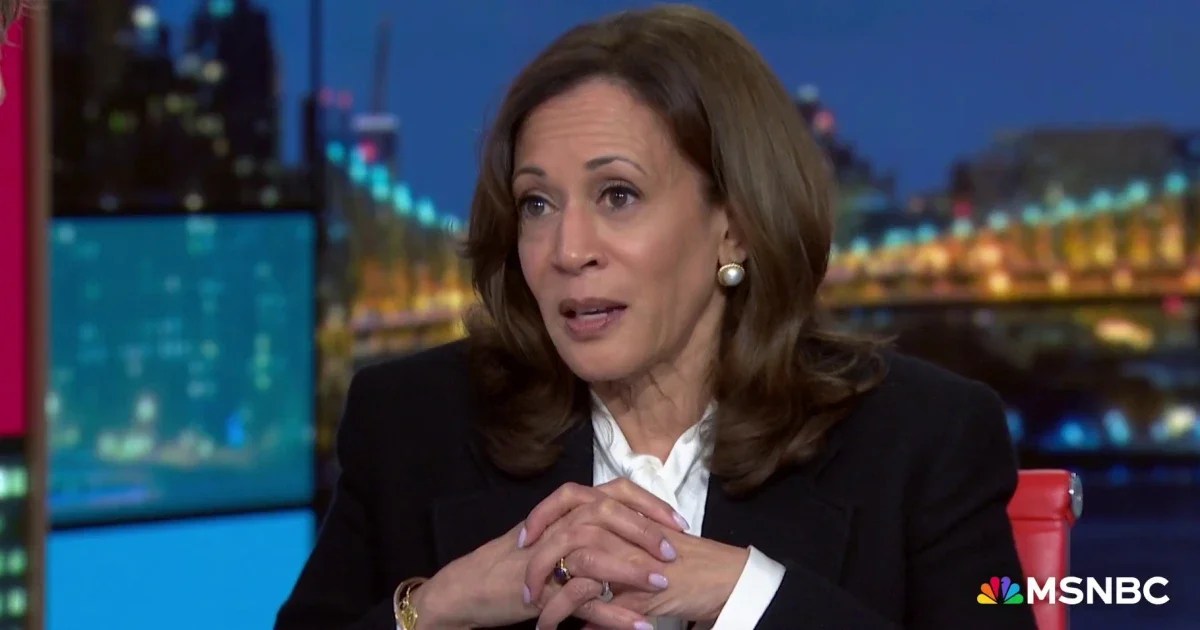
Harris promised to support the Democratic nominee. Credit: MSNBC

Harris promised to support the Democratic nominee. Credit: MSNBC

24 September 2025 - 8:00pm

Former Vice President Kamala Harris chose her words carefully. When asked about New York City’s Democratic mayoral nominee, Zohran Mamdani, she stopped short of offering an endorsement, instead saying that she “supports the nominee”. It was a political half-green light — a party-unity boilerplate message that acknowledged Mamdani within the Democratic fold without embracing his ideology or associating him directly with her brand.

Harris did not volunteer any praise for Mamdani’s policies or vision. Instead, the former V-P explicitly downplayed his singular importance on the national stage, reminding viewers that Mamdani “is not the only star.”

Harris’s half-support comes amid a broader split in how Democrats are responding to Mamdani’s insurgent progressive campaign. On the Left, Alexandria Ocasio-Cortez, Bernie Sanders, Pramila Jayapal and Elizabeth Warren have all expressed support for either the candidate or his policies.

In contrast, many establishment Democrats have been far more hesitant. Governor Kathy Hochul exemplifies the reluctant embrace: she waited three months after the primary before finally offering a public endorsement of Mamdani in mid-September. Even then, Hochul’s support came in the form of a carefully worded op-ed highlighting shared goals like affordability and a common front against Donald Trump.

Still, several key Democrats remain on the sidelines even as the November general election nears. The two most powerful New Yorkers in Congress — House Minority Leader Hakeem Jeffries and Senate Minority Leader Chuck Schumer — have conspicuously not endorsed Mamdani to date.

Harris’s semi-endorsement may be big news in political circles, but on the ground in New York City, it’s unlikely to sway the middle voters who will decide the mayoral race. The voters up for grabs in this scenario — moderate Democrats and swing voters in the outer boroughs — tend to be most concerned with bread-and-butter issues like public safety, the cost of living, and schools.

In the 2024 election, Harris carried New York — but by a narrower margin than her predecessors. On top of that, her national approval ratings are underwater, making any endorsement unlikely to move the needle significantly. This is especially true for the sizable segment of traditional Democratic voters who remain wary of Mamdani, seeing the 33-year-old radical as a potentially risky choice for New York’s safety and economy.

Nor is Harris’s involvement likely to bridge the Democratic Party’s internal rift over Israel that Mamdani’s candidacy has highlighted. His outspoken criticism of Israel’s government and vocal advocacy for Palestinian rights have won him support on the Left, but it has attracted few allies on the moderate wing. Given New York’s sizeable Jewish population, this could present a significant challenge.

Harris’s cautious nod underscores a deeper problem: the Democratic Party is fractured, struggling even to coalesce around the candidate for the nation’s largest city. Her tepid support exposes a party at odds with itself, leaving Mamdani to face a sceptical electorate without the backing of the party establishment.

Santiago Vidal Calvo is a Cities policy analyst at the Manhattan Institute for Policy Research.


China is threatening America in the AI race

Reports sugget Zhipu AI  has released a new model that can rival leading US systems. Credit: Getty

Reports sugget Zhipu AI has released a new model that can rival leading US systems. Credit: Getty

1 July 2026 - 10:18am

China is trying to catch up with America on artificial intelligence. The Wall Street Journal has reported that Zhipu AI — one of China’s six “AI tiger” LLMs — has released a new model that can rival leading US systems, including Anthropic’s Mythos, in cybersecurity tasks such as pinpointing security bugs. While this marks a milestone in China’s drive to catch up with Western AI capabilities, strong performance on a single benchmark does not mean it has taken the lead. Chinese models still lag behind their Western counterparts in broader capabilities, such as autonomous operation. Skepticism is therefore warranted before resorting to hysterical conclusions, but complacency about the geopolitical implications of China’s AI advances would be an even greater mistake.

On the infrastructure side, Chinese AI is still constrained by access to advanced chips, with American labs way ahead in computing capacity as well as investment. Analysis from earlier this year suggests that Chinese models are likely to be at least a few months behind those in the US. But they are still continuing to make progress, or that the geopolitical importance of AI will be decided only by whose LLM has ventured deeper into the technological frontier. The practical applications of AI, countries’ to capture foreign markets, and the application of AI into the real economy will matter just as much.

Here, China may hold an advantage. As with its dominance across many critical supply chains, Beijing may not need to produce the most advanced AI systems — only those that are affordable and widely deployable. In doing so, it could consolidate global influence by supplying functional, low-cost AI at scale.

Beijing seems to be pursuing exactly that path, developing an AI “open-source” strategy that offers affordable, widely available AI models for companies and individuals to use and modify as they wish. The production of the DeepSeek AI model, which matched the performance of Silicon Valley tools such as ChatGPT at a fraction of the cost for users, created goodwill among Chinese models with developers.

The four most popular models on OpenRouter, an AI hardware platform for developers, are now all Chinese. The goal for China is not only to win the frontier-model race, but to make its systems the default layer of AI adoption across industries and global markets. For most economies, the choice is increasingly between an affordable tool they can deploy now and a more robust one that may be out of reach.

And while the countries adopting Chinese models may be exposed to political pressure and cyber threats from Beijing, safer and more capable alternatives matter little if they are unaffordable. American AI companies are already under pressure to monetize products whose operating costs are rising. If Chinese open-source models become the cheap default for startups, universities, governments and businesses across the developing world, then America’s AI lead will be eroded from below.

Perhaps more concerning for America in the long run is how AI can give Chinese manufacturing even more strength, through the ongoing integration of AI as a general-purpose technology. China’s new Five-Year Plan mentioned AI more than 50 times and includes an “AI+” action plan aimed at spreading AI across the economy.

Beijing has been pioneering automation of its critical infrastructure for years, with promising recent results in increasing warplane production capacity. In that regard, China’s open-model strategy and manufacturing dominance will reinforce each other. Cheap, adaptable models accelerate deployment across the real economy while those deployments generate real-world data and use cases that can feed back into further model improvement.

The United States should not dismiss the importance of its lead in the AI race. That lead worries Beijing, not least because a more automated Chinese economy would also become more vulnerable to AI-generated cyber threats. But nor should Washington assume that China cannot catch up with American capabilities over time.

This AI competition represents part of a broader struggle over tech supply chains and geopolitical influence. Decisions over whether to adopt US or Chinese models could produce a more fragmented global reality, with different regions relying on different cloud providers, chips and security structures. The result will likely be a global economy which is divided into competing spheres, rather than one which produces a single winner.


Miquel Vila is a political and geopolitical risk consultant focusing on industrial strategy, critical infrastructure and global supply chains.

miquelvilam