




X Close

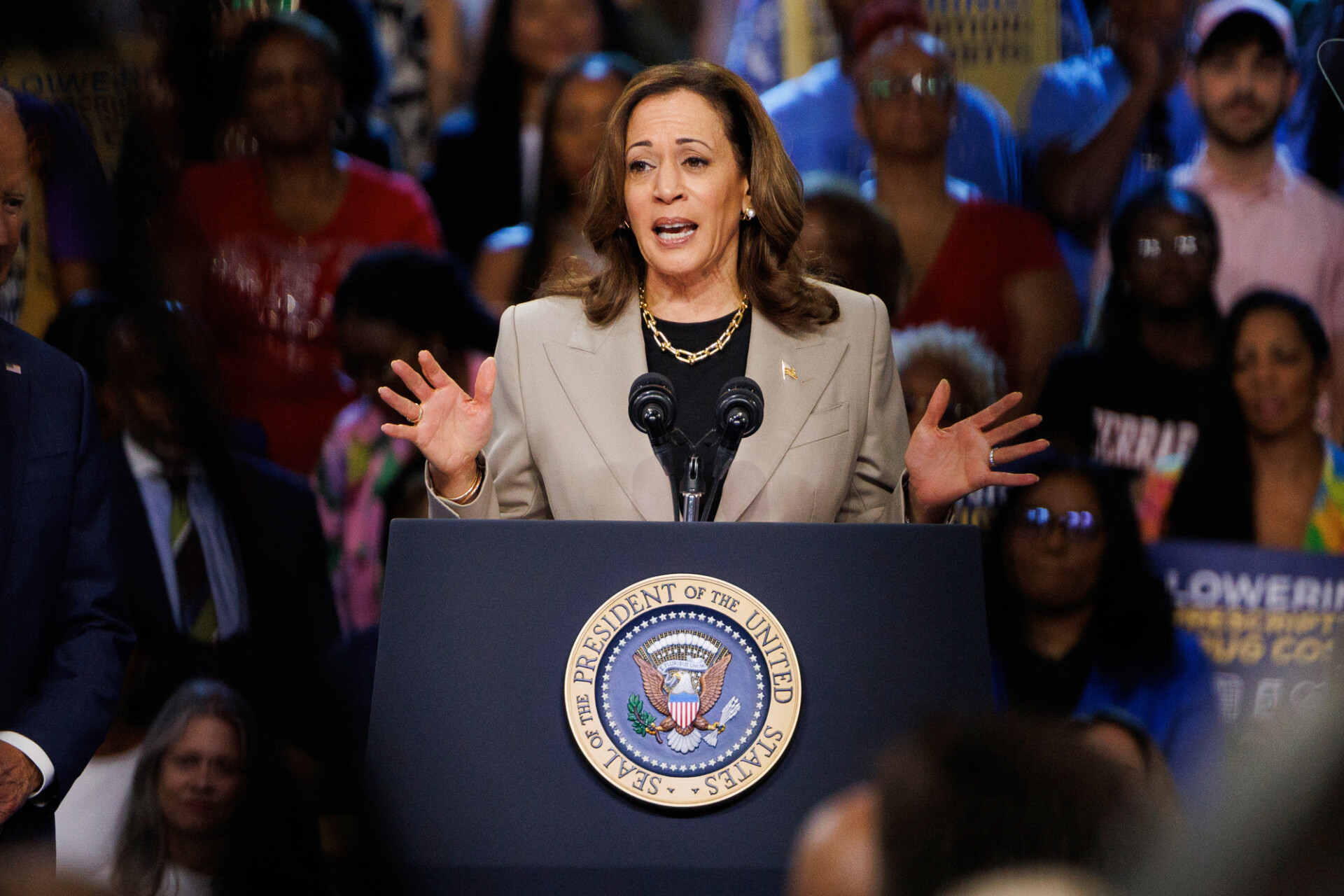
Kamala Harris uses Trump to hide her thin agenda

The Harris campaign is giving no interviews and stirring no controversy. Credit: Getty

The Harris campaign is giving no interviews and stirring no controversy. Credit: Getty

16 August 2024 - 7:30pm

Today Kamala Harris released her plan to, in the words of her campaign, “bring down costs for American families”. The campaign claims that it will alleviate the “sharpest pain points” of an economy that has been running too hot for too long but could now be cooling into a damaging recession.

The plan is strategically inoffensive; it is a signal to the bipartisan establishment, which spans from Mitt Romney to Elizabeth Warren, that there is nothing to fear. And although her Republican rival Donald Trump said that Harris was a “communist”, her proposals — tax incentives for homebuilders, down payment assistance, cheaper medicine — are hardly radical.

Harris has enjoyed a stretch of uncommonly good luck since President Joe Biden announced that he was no longer planning to seek re-election, with a Democratic challenger never materialising. Memes deployed to torment Harris — the coconut tree, the Venn diagrams, “unburdened by what has been” — flipped instantly into fandom. Her husband, Doug Emhoff, emerged as “the internet’s newest boyfriend”. Meanwhile, Tim Walz, the Minnesota Governor whom she picked as her running mate, became an unlikely Gen Z darling.

That is why Harris does not feel the need to take any risks with her policy platform. When she was a candidate in 2019, she proposed a Medicare-for-all policy that was, the pundits declared, too radical for many moderate Americans. She was eventually forced to moderate her position on healthcare, but the political damage had been done. And a lesson had been learned.

Something deeper is at work, too, which signals a shrinkage of our political imagination. Universal healthcare was proposed by Richard Nixon and, later, by the Heritage Foundation, whose plans were put into place by Romney, then the Republican Governor of Massachusetts. But now, Democratic fears of a second Trump term have put all major policy questions to the side. If the future of American democracy is on the line, as this way of thinking goes, who could possibly care what Harris thinks about the estate tax? One could argue that if the US postwar economy had not dispossessed so many Americans, there would have been no rationale for Trump in the first place, but that’s another conversation.

The most meaningful criticism of Harris’s economic plans came from Catherine Rampell, the economics columnist for the Washington Post, who compared the Vice President’s proposal to lower grocery costs by cracking down on price-gouging to the worst excesses of “communist” central planning. “It’s hard to exaggerate how bad Kamala Harris’s price-gouging proposal is,” Rampell wrote.

She isn’t wrong, except that the price-gouging plan stands no chance in Congress, and the Harris team knows as much. The point was to gesture at progressive reforms while making clear to the people with real power that those reforms are about as likely as finding a good brunch spot on Mars.

The even deeper subtext is that whatever proposals Harris may offer, they are still better than the uncertainty of a second Trump term. Yes, some Silicon Valley “contrarians” are boarding the Maga express, but Wall Street has a much lower tolerance for risk than the tech industry. That is why the Harris campaign is giving no interviews and stirring no controversy. For as long as the focus is on Trump and not policy, the Democrats believe they can win. It’s a calculation that says as much about us as it does about our presidential candidates.


China is threatening America in the AI race

Reports sugget Zhipu AI  has released a new model that can rival leading US systems. Credit: Getty

Reports sugget Zhipu AI has released a new model that can rival leading US systems. Credit: Getty

1 July 2026 - 10:18am

China is trying to catch up with America on artificial intelligence. The Wall Street Journal has reported that Zhipu AI — one of China’s six “AI tiger” LLMs — has released a new model that can rival leading US systems, including Anthropic’s Mythos, in cybersecurity tasks such as pinpointing security bugs. While this marks a milestone in China’s drive to catch up with Western AI capabilities, strong performance on a single benchmark does not mean it has taken the lead. Chinese models still lag behind their Western counterparts in broader capabilities, such as autonomous operation. Skepticism is therefore warranted before resorting to hysterical conclusions, but complacency about the geopolitical implications of China’s AI advances would be an even greater mistake.

On the infrastructure side, Chinese AI is still constrained by access to advanced chips, with American labs way ahead in computing capacity as well as investment. Analysis from earlier this year suggests that Chinese models are likely to be at least a few months behind those in the US. But they are still continuing to make progress, or that the geopolitical importance of AI will be decided only by whose LLM has ventured deeper into the technological frontier. The practical applications of AI, countries’ to capture foreign markets, and the application of AI into the real economy will matter just as much.

Here, China may hold an advantage. As with its dominance across many critical supply chains, Beijing may not need to produce the most advanced AI systems — only those that are affordable and widely deployable. In doing so, it could consolidate global influence by supplying functional, low-cost AI at scale.

Beijing seems to be pursuing exactly that path, developing an AI “open-source” strategy that offers affordable, widely available AI models for companies and individuals to use and modify as they wish. The production of the DeepSeek AI model, which matched the performance of Silicon Valley tools such as ChatGPT at a fraction of the cost for users, created goodwill among Chinese models with developers.

The four most popular models on OpenRouter, an AI hardware platform for developers, are now all Chinese. The goal for China is not only to win the frontier-model race, but to make its systems the default layer of AI adoption across industries and global markets. For most economies, the choice is increasingly between an affordable tool they can deploy now and a more robust one that may be out of reach.

And while the countries adopting Chinese models may be exposed to political pressure and cyber threats from Beijing, safer and more capable alternatives matter little if they are unaffordable. American AI companies are already under pressure to monetize products whose operating costs are rising. If Chinese open-source models become the cheap default for startups, universities, governments and businesses across the developing world, then America’s AI lead will be eroded from below.

Perhaps more concerning for America in the long run is how AI can give Chinese manufacturing even more strength, through the ongoing integration of AI as a general-purpose technology. China’s new Five-Year Plan mentioned AI more than 50 times and includes an “AI+” action plan aimed at spreading AI across the economy.

Beijing has been pioneering automation of its critical infrastructure for years, with promising recent results in increasing warplane production capacity. In that regard, China’s open-model strategy and manufacturing dominance will reinforce each other. Cheap, adaptable models accelerate deployment across the real economy while those deployments generate real-world data and use cases that can feed back into further model improvement.

The United States should not dismiss the importance of its lead in the AI race. That lead worries Beijing, not least because a more automated Chinese economy would also become more vulnerable to AI-generated cyber threats. But nor should Washington assume that China cannot catch up with American capabilities over time.

This AI competition represents part of a broader struggle over tech supply chains and geopolitical influence. Decisions over whether to adopt US or Chinese models could produce a more fragmented global reality, with different regions relying on different cloud providers, chips and security structures. The result will likely be a global economy which is divided into competing spheres, rather than one which produces a single winner.


Miquel Vila is a political and geopolitical risk consultant focusing on industrial strategy, critical infrastructure and global supply chains.

miquelvilam