



X Close

Justin Trudeau’s immigration U-turn is too little, too late

The Canadian Prime Minister still maintains that mass migration is his country's 'super power'. Credit: Getty

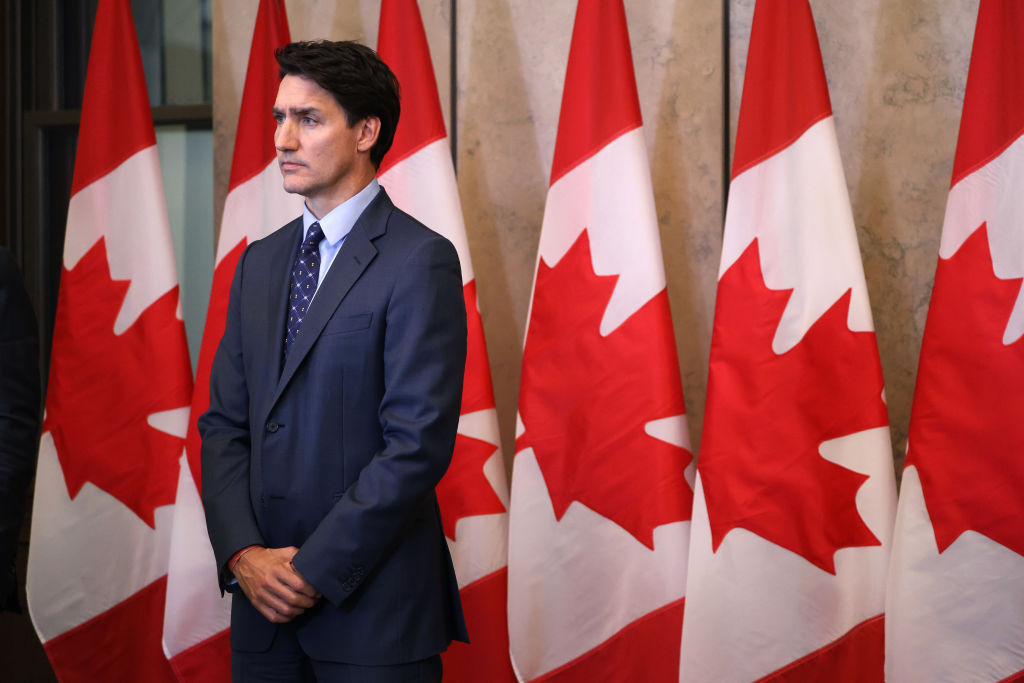
The Canadian Prime Minister still maintains that mass migration is his country’s ‘super power’. Credit: Getty

27 October 2024 - 12:00pm

After surviving an abortive party revolt this week and with his personal popularity ratings in free fall, Canada’s Prime Minister Justin Trudeau is looking for ways to regain control of the narrative. And he may have just found one in the form of a major policy U-turn pledging to cut the country’s immigration targets. Flanked by immigration minister Marc Miller, Trudeau announced a 21% cut to next year’s permanent resident arrivals, from 500,000 to 395,000. This is to be followed by further cuts to 380,000 in 2026 and 365,000 in 2027.

The estimated effect of these changes is a 2% decline in the population after roughly three years of exorbitant demographic expansion, during which the country reached a total population of over 40 million, up from 37 million in 2021. These were the largest annual increases since the Baby Boom of the Fifties — the difference being that the vast bulk (97% in 2023) of this growth came from immigration rather than births.

Long touted by Canada’s political and business leaders as a catch-all solution to an ageing population, immigration had been a point of consensus for years. However, the effects of an increasingly permissive approach became too much to ignore, particularly in the areas of housing and labour markets. Trudeau’s announcement was coated with liberal rhetoric affirming Canada’s commitment to ensuring a pro-immigration society. The Prime Minister said “Immigration is our superpower — and always will be.” Nonetheless, he went on to emphasise the pragmatic case for immediate cuts in what seemed like a rare admission of error, conceding: “We didn’t get the balance quite right.” It is an overdue course correction for a botched policy undertaken, in large part, to juice growth numbers and prevent a recession.

The Prime Minister was also quick to castigate the business sector which had “exploit[ed] foreign workers while refusing to hire Canadians for a fair wage”. What’s more, “colleges and universities are bringing in more international students than communities can accommodate, treating them as an expendable means to line their own pockets”. Trudeau is entirely correct in identifying the major interest groups who advocated for these unsustainable numbers. But the question is why his federal government, which is responsible for approving visas — along with the various provincial governments (notably, Doug Ford’s Ontario Tory government), which are responsible for higher education and housing — listened to these lobbies and acquiesced for so long.

Indeed, the same lobbies are now up in arms. The Canadian Chamber of Commerce has warned that “decreasing our labour pool will impact employers across Canada struggling to find the workforce they need […]”. An op-ed in the Globe and Mail claims that “Canada is potentially heading for a labour supply decline”. Only now, these same pro-business voices have lost their credibility with the Canadian public: ditto for the Prime Minister, who will likely lose the next election, despite the U-turn.

As to whether cuts themselves will be enough to restore balance to the system — a problem for the next prime minister — everything will depend on whether the estimated 2.36 million temporary visa holders will actually leave the country once their visas expire in the next two years. The polite, conflict-averse Canadian public may not have the stomach to demand that migrants leave the country. Just like his father, holding onto power is Trudeau’s priority — but he won’t want to stick around for the tough decisions and potential acrimony.


Michael Cuenco is Senior Editor at American Affairs.
1TrueCuencoism

China is threatening America in the AI race

Reports sugget Zhipu AI  has released a new model that can rival leading US systems. Credit: Getty

Reports sugget Zhipu AI has released a new model that can rival leading US systems. Credit: Getty

1 July 2026 - 10:18am

China is trying to catch up with America on artificial intelligence. The Wall Street Journal has reported that Zhipu AI — one of China’s six “AI tiger” LLMs — has released a new model that can rival leading US systems, including Anthropic’s Mythos, in cybersecurity tasks such as pinpointing security bugs. While this marks a milestone in China’s drive to catch up with Western AI capabilities, strong performance on a single benchmark does not mean it has taken the lead. Chinese models still lag behind their Western counterparts in broader capabilities, such as autonomous operation. Skepticism is therefore warranted before resorting to hysterical conclusions, but complacency about the geopolitical implications of China’s AI advances would be an even greater mistake.

On the infrastructure side, Chinese AI is still constrained by access to advanced chips, with American labs way ahead in computing capacity as well as investment. Analysis from earlier this year suggests that Chinese models are likely to be at least a few months behind those in the US. But they are still continuing to make progress, or that the geopolitical importance of AI will be decided only by whose LLM has ventured deeper into the technological frontier. The practical applications of AI, countries’ to capture foreign markets, and the application of AI into the real economy will matter just as much.

Here, China may hold an advantage. As with its dominance across many critical supply chains, Beijing may not need to produce the most advanced AI systems — only those that are affordable and widely deployable. In doing so, it could consolidate global influence by supplying functional, low-cost AI at scale.

Beijing seems to be pursuing exactly that path, developing an AI “open-source” strategy that offers affordable, widely available AI models for companies and individuals to use and modify as they wish. The production of the DeepSeek AI model, which matched the performance of Silicon Valley tools such as ChatGPT at a fraction of the cost for users, created goodwill among Chinese models with developers.

The four most popular models on OpenRouter, an AI hardware platform for developers, are now all Chinese. The goal for China is not only to win the frontier-model race, but to make its systems the default layer of AI adoption across industries and global markets. For most economies, the choice is increasingly between an affordable tool they can deploy now and a more robust one that may be out of reach.

And while the countries adopting Chinese models may be exposed to political pressure and cyber threats from Beijing, safer and more capable alternatives matter little if they are unaffordable. American AI companies are already under pressure to monetize products whose operating costs are rising. If Chinese open-source models become the cheap default for startups, universities, governments and businesses across the developing world, then America’s AI lead will be eroded from below.

Perhaps more concerning for America in the long run is how AI can give Chinese manufacturing even more strength, through the ongoing integration of AI as a general-purpose technology. China’s new Five-Year Plan mentioned AI more than 50 times and includes an “AI+” action plan aimed at spreading AI across the economy.

Beijing has been pioneering automation of its critical infrastructure for years, with promising recent results in increasing warplane production capacity. In that regard, China’s open-model strategy and manufacturing dominance will reinforce each other. Cheap, adaptable models accelerate deployment across the real economy while those deployments generate real-world data and use cases that can feed back into further model improvement.

The United States should not dismiss the importance of its lead in the AI race. That lead worries Beijing, not least because a more automated Chinese economy would also become more vulnerable to AI-generated cyber threats. But nor should Washington assume that China cannot catch up with American capabilities over time.

This AI competition represents part of a broader struggle over tech supply chains and geopolitical influence. Decisions over whether to adopt US or Chinese models could produce a more fragmented global reality, with different regions relying on different cloud providers, chips and security structures. The result will likely be a global economy which is divided into competing spheres, rather than one which produces a single winner.


Miquel Vila is a political and geopolitical risk consultant focusing on industrial strategy, critical infrastructure and global supply chains.

miquelvilam
