



X Close

Just Stop Oil’s activism is turning into blackmail

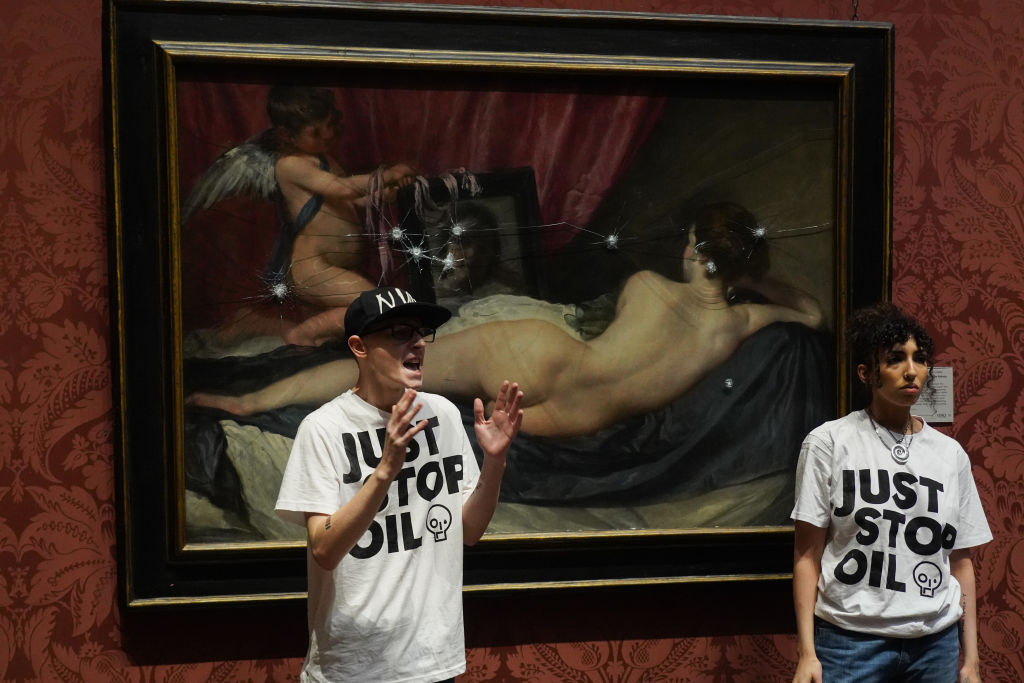
Are climate activists holding society hostage? Credit: Getty

Are climate activists holding society hostage? Credit: Getty

18 October 2024 - 6:00pm

Is Just Stop Oil a protest group, or a protection racket? On Thursday the group published an “open letter” to the directors of the National Gallery, asking for a meeting. The letter came in response to one written by the National Museum Directors’ Council, begging the group to stop vandalising paintings in major galleries.

Just Stop Oil, founded in 2022, demands an end to new fossil fuel licences issued by the British Government. The group is notorious for a high-visibility and confrontational protest style with stunts including blocking roads and football games, occupying refineries, and vandalising beloved paintings in major art galleries. Recent such attacks have included Vincent van Gogh’s Sunflowers, John Constable’s The Hay Wain and Diego Velázquez’s Rokeby Venus.

The NMDC letter highlights the physical damage, staff and visitor distress, and — the point they are no doubt keenest to emphasise — harm to the overall mission of providing open access to great art that results from such vandalism. While the letter says “the world is in a very dark place”, suggesting its writers are sympathetic to the climate cause, it also warns that a result of such attacks is “greater barriers” between visitors and the artworks themselves.

JSO’s response describes the art vandals in heroic terms as “action takers” and “members of the public” that, implicitly, represent Britain’s silent majority. We are perhaps to assume that the kind of Middle Englanders who bring their kids up to town for a rare trip to a big museum have taken to vandalising the paintings when they do so. These heroes are, we learn, “unafraid to use the cultural power of their national institutions when those institutions fail to do so”. Or, in other words, they desire to commandeer institutions whose founding ideal was — however partially and problematically — universal good, in service to their specific ideological project.

The note itself promises “We’ll leave the soup at home” but conspicuously does not undertake to stop committing acts of vandalism. JSO declares only that the group has “some ideas” on how the National Gallery can “mitigate” its failure to behave, and think, in precisely the manner the group dictates. The overall tone is unmistakably that of a pirate or protection racketeer: nice art collection you have there, shame if something happened to it.

But this is obviously incompatible with an ideal of universal access which relies on high levels of civic trust. Never mind the supposed “woke capture” of cultural institutions; ideological piracy such as Just Stop Oil is now attempting can only result in the collapse of that ideal.

Should it succeed, it would inevitably result in other fringe groups attempting the same manoeuvre. Modern Britain is awash with ideological fringe groups, many of which have mutually contradictory aims. Very obviously, then, public art galleries cannot accede to every one of the ideological programmes that might threaten to vandalise public exhibitions if not obeyed. So the gallery has no option but to try and maintain at least a formal neutrality, in the interests of its founding mission. And this in turn means the would-be ideological pirates have no option but either to give up or keep attacking.

Given their zealotry, as the NMDC points out, the principal effect is less likely to be the National Gallery adopting climate alarmism à la JSO, than the demise of the gallery’s enabling social norm of trust in visitors’ orderly behaviour and respect for the exhibits. And since JSO’s response, this race to the bottom has already escalated. Shortly after JSO’s letter, the National Gallery announced new security measures banning visitors from bringing in liquids — a significant decline in the level of implicit trust placed in those who come to view the art.

Will one side or the other back down? This seems implausible, given their competing missions and ideological commitments. And if this is so, the endpoint of declining trust in the norms of public art appreciation is no more public art, and a narrowing of access to the world’s treasures to a pre-vetted elite. It is difficult to see how this would help prevent the extraction of fossil fuels.


Mary Harrington is a contributing editor at UnHerd.

moveincircles

China is threatening America in the AI race

Reports sugget Zhipu AI  has released a new model that can rival leading US systems. Credit: Getty

Reports sugget Zhipu AI has released a new model that can rival leading US systems. Credit: Getty

1 July 2026 - 10:18am

China is trying to catch up with America on artificial intelligence. The Wall Street Journal has reported that Zhipu AI — one of China’s six “AI tiger” LLMs — has released a new model that can rival leading US systems, including Anthropic’s Mythos, in cybersecurity tasks such as pinpointing security bugs. While this marks a milestone in China’s drive to catch up with Western AI capabilities, strong performance on a single benchmark does not mean it has taken the lead. Chinese models still lag behind their Western counterparts in broader capabilities, such as autonomous operation. Skepticism is therefore warranted before resorting to hysterical conclusions, but complacency about the geopolitical implications of China’s AI advances would be an even greater mistake.

On the infrastructure side, Chinese AI is still constrained by access to advanced chips, with American labs way ahead in computing capacity as well as investment. Analysis from earlier this year suggests that Chinese models are likely to be at least a few months behind those in the US. But they are still continuing to make progress, or that the geopolitical importance of AI will be decided only by whose LLM has ventured deeper into the technological frontier. The practical applications of AI, countries’ to capture foreign markets, and the application of AI into the real economy will matter just as much.

Here, China may hold an advantage. As with its dominance across many critical supply chains, Beijing may not need to produce the most advanced AI systems — only those that are affordable and widely deployable. In doing so, it could consolidate global influence by supplying functional, low-cost AI at scale.

Beijing seems to be pursuing exactly that path, developing an AI “open-source” strategy that offers affordable, widely available AI models for companies and individuals to use and modify as they wish. The production of the DeepSeek AI model, which matched the performance of Silicon Valley tools such as ChatGPT at a fraction of the cost for users, created goodwill among Chinese models with developers.

The four most popular models on OpenRouter, an AI hardware platform for developers, are now all Chinese. The goal for China is not only to win the frontier-model race, but to make its systems the default layer of AI adoption across industries and global markets. For most economies, the choice is increasingly between an affordable tool they can deploy now and a more robust one that may be out of reach.

And while the countries adopting Chinese models may be exposed to political pressure and cyber threats from Beijing, safer and more capable alternatives matter little if they are unaffordable. American AI companies are already under pressure to monetize products whose operating costs are rising. If Chinese open-source models become the cheap default for startups, universities, governments and businesses across the developing world, then America’s AI lead will be eroded from below.

Perhaps more concerning for America in the long run is how AI can give Chinese manufacturing even more strength, through the ongoing integration of AI as a general-purpose technology. China’s new Five-Year Plan mentioned AI more than 50 times and includes an “AI+” action plan aimed at spreading AI across the economy.

Beijing has been pioneering automation of its critical infrastructure for years, with promising recent results in increasing warplane production capacity. In that regard, China’s open-model strategy and manufacturing dominance will reinforce each other. Cheap, adaptable models accelerate deployment across the real economy while those deployments generate real-world data and use cases that can feed back into further model improvement.

The United States should not dismiss the importance of its lead in the AI race. That lead worries Beijing, not least because a more automated Chinese economy would also become more vulnerable to AI-generated cyber threats. But nor should Washington assume that China cannot catch up with American capabilities over time.

This AI competition represents part of a broader struggle over tech supply chains and geopolitical influence. Decisions over whether to adopt US or Chinese models could produce a more fragmented global reality, with different regions relying on different cloud providers, chips and security structures. The result will likely be a global economy which is divided into competing spheres, rather than one which produces a single winner.


Miquel Vila is a political and geopolitical risk consultant focusing on industrial strategy, critical infrastructure and global supply chains.

miquelvilam
