




X Close

John Healey exit confirms British defence is in crisis

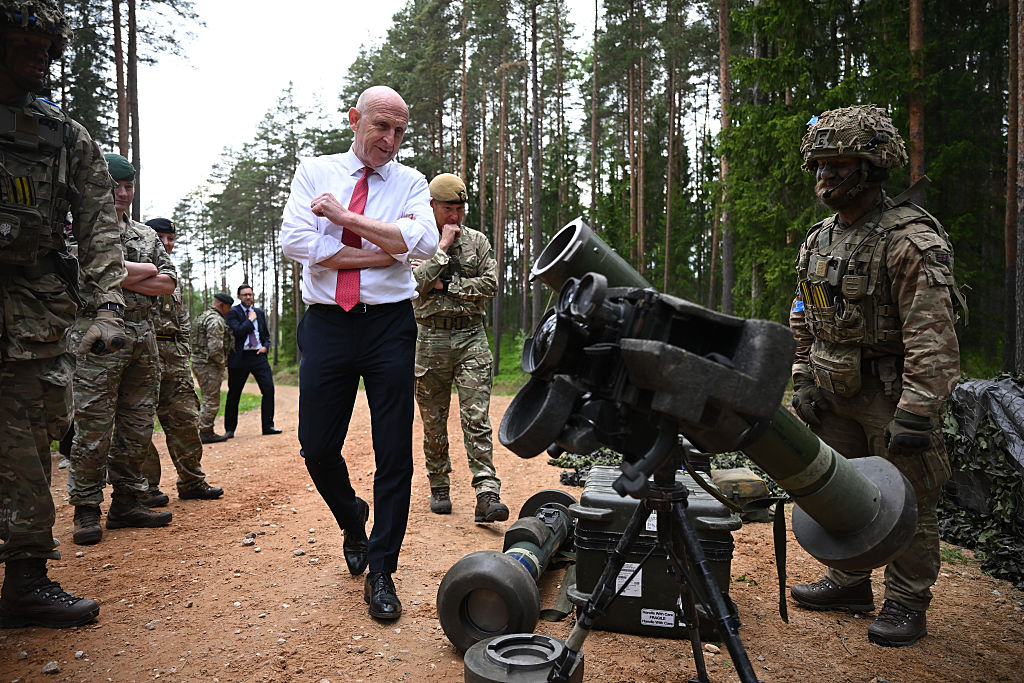
Healey has suggested that the Defence Investment Plan 'falls short of what is required'. Credit: Getty

Healey has suggested that the Defence Investment Plan ‘falls short of what is required’. Credit: Getty

11 June 2026 - 4:15pm

The departure of John Healey as Defence Secretary came as a surprise. Long famed for his loyalty, Healey had, only hours earlier, been characterised by an ex-RAF officer in the Financial Times as “a completely aligned and inside-the-tent Cabinet minister”. Healey was, in other words, a man who was committed to this Government.

Healey’s resignation is yet another sign of Prime Minister Keir Starmer losing his grip. Besides the loss of an ally, this will only add momentum to leadership challenges at a time when No. 10’s strategy hinges on slowing the manoeuvring. Moreover, the episode exposes intense behind-the-scenes wrangling over military spending and the delayed Defence Investment Plan, with departments forced to cut capital budgets to meet defence demands.

For all the rancour behind closed doors, the final plan — as Healey himself put it — “falls well short of what is required”, lacking both ambition and urgency. The truth is that, while the Government may have been forcing departments to raid their coffers, defence spending has never been a deeply felt priority for Labour. As a former senior military official stated, they spent “14 years in opposition dreaming great dreams of what they would accomplish once in power again. And it was not to raise defence spending”. One need only look to Work and Pensions Secretary Pat McFadden’s private remark that Labour MPs were constantly asking who to tax “in order to pay benefits” to show where the party’s true interests lie. See also the immediate drop-off in support for Ukraine once Labour got into power, including delays to supplies of long-range missiles.

Even Starmer’s much-vaunted commitment to raise defence spending to 2.5% of GDP from April 2027, with an ambition to reach 3% in the next parliament, was driven more by a desire to avoid battles with Washington than with Moscow. It was simply a diplomatic, rather than strategic, calculation designed to secure a favourable meeting with Donald Trump. Subsequent geopolitical turbulence, much of it emanating from Washington itself, has already rendered those targets outdated. Healey promised after that commitment that he would not empty the Treasury’s piggy bank for additional defence spending this parliament. In practice, however, the UK’s efforts to placate the White House by offering to lead on peacetime actions in Ukraine and the Strait of Hormuz have only upped the financial pressures.

The UK is poorly placed to respond to a febrile and increasingly dangerous military landscape. It is currently ranked second to last on a list assessing Nato members’ progress on capability, an embarrassing position made starker only by the fact that it sits just above Iceland, which has no standing army. It has also emerged that the Royal Navy’s entire available fleet of nuclear attack submarines has been stuck in port — a gift for the Kremlin as Russia ramps up hostile activity in British waters.

Meanwhile, as Nato allies agree that Moscow could be ready to attack one of them by 2029, the British army is so depleted that it could “seize a small market town on a good day”, according to General Sir Richard Barrons. The stalled Defence Investment Plan has already caused further strife, with the Commons Public Accounts Committee warning that the associated delays have weakened the country’s credibility with allies and made procurement of equipment costlier, “hindering the government’s attempt to modernise the armed forces”.

Starmer wanted this plan to be his legacy. Indeed, it stands as a neat encapsulation of his premiership: late, hesitant, unambitious and corrosive to ministerial unity. Healey spoke in his letter of having outlined alternatives to meet mid-term funding challenges, but Starmer was clearly willing to lose a loyal ally rather than embrace those. It was, in the Prime Minister’s mind, better to chip away at other budgets than turn to taxation or borrowing. Now the UK will head to the Nato summit next month with a new, untested Defence Secretary and the spotlight — not to mention Donald Trump’s focus — solely on its substandard defence posture. In politics and war alike, that is the problem with being weak; it only invites more bullies and battles.


Bethany Elliott is a writer specialising in Russia and Eastern Europe.

BethanyAElliott

China is threatening America in the AI race

Reports sugget Zhipu AI  has released a new model that can rival leading US systems. Credit: Getty

Reports sugget Zhipu AI has released a new model that can rival leading US systems. Credit: Getty

1 July 2026 - 10:18am

China is trying to catch up with America on artificial intelligence. The Wall Street Journal has reported that Zhipu AI — one of China’s six “AI tiger” LLMs — has released a new model that can rival leading US systems, including Anthropic’s Mythos, in cybersecurity tasks such as pinpointing security bugs. While this marks a milestone in China’s drive to catch up with Western AI capabilities, strong performance on a single benchmark does not mean it has taken the lead. Chinese models still lag behind their Western counterparts in broader capabilities, such as autonomous operation. Skepticism is therefore warranted before resorting to hysterical conclusions, but complacency about the geopolitical implications of China’s AI advances would be an even greater mistake.

On the infrastructure side, Chinese AI is still constrained by access to advanced chips, with American labs way ahead in computing capacity as well as investment. Analysis from earlier this year suggests that Chinese models are likely to be at least a few months behind those in the US. But they are still continuing to make progress, or that the geopolitical importance of AI will be decided only by whose LLM has ventured deeper into the technological frontier. The practical applications of AI, countries’ to capture foreign markets, and the application of AI into the real economy will matter just as much.

Here, China may hold an advantage. As with its dominance across many critical supply chains, Beijing may not need to produce the most advanced AI systems — only those that are affordable and widely deployable. In doing so, it could consolidate global influence by supplying functional, low-cost AI at scale.

Beijing seems to be pursuing exactly that path, developing an AI “open-source” strategy that offers affordable, widely available AI models for companies and individuals to use and modify as they wish. The production of the DeepSeek AI model, which matched the performance of Silicon Valley tools such as ChatGPT at a fraction of the cost for users, created goodwill among Chinese models with developers.

The four most popular models on OpenRouter, an AI hardware platform for developers, are now all Chinese. The goal for China is not only to win the frontier-model race, but to make its systems the default layer of AI adoption across industries and global markets. For most economies, the choice is increasingly between an affordable tool they can deploy now and a more robust one that may be out of reach.

And while the countries adopting Chinese models may be exposed to political pressure and cyber threats from Beijing, safer and more capable alternatives matter little if they are unaffordable. American AI companies are already under pressure to monetize products whose operating costs are rising. If Chinese open-source models become the cheap default for startups, universities, governments and businesses across the developing world, then America’s AI lead will be eroded from below.

Perhaps more concerning for America in the long run is how AI can give Chinese manufacturing even more strength, through the ongoing integration of AI as a general-purpose technology. China’s new Five-Year Plan mentioned AI more than 50 times and includes an “AI+” action plan aimed at spreading AI across the economy.

Beijing has been pioneering automation of its critical infrastructure for years, with promising recent results in increasing warplane production capacity. In that regard, China’s open-model strategy and manufacturing dominance will reinforce each other. Cheap, adaptable models accelerate deployment across the real economy while those deployments generate real-world data and use cases that can feed back into further model improvement.

The United States should not dismiss the importance of its lead in the AI race. That lead worries Beijing, not least because a more automated Chinese economy would also become more vulnerable to AI-generated cyber threats. But nor should Washington assume that China cannot catch up with American capabilities over time.

This AI competition represents part of a broader struggle over tech supply chains and geopolitical influence. Decisions over whether to adopt US or Chinese models could produce a more fragmented global reality, with different regions relying on different cloud providers, chips and security structures. The result will likely be a global economy which is divided into competing spheres, rather than one which produces a single winner.


Miquel Vila is a political and geopolitical risk consultant focusing on industrial strategy, critical infrastructure and global supply chains.

miquelvilam