




X Close

John Bolton’s guilty plea is the endpoint of DC’s leaking culture

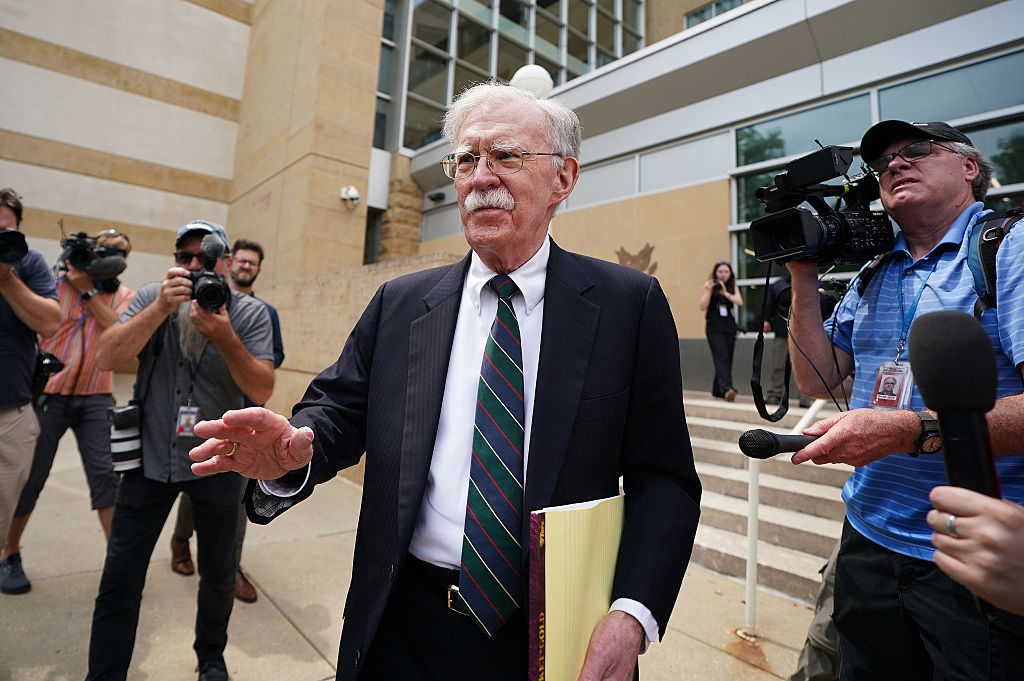
Bolton yesterday pleaded guilty to mishandling classified documents. Credit: Getty

Bolton yesterday pleaded guilty to mishandling classified documents. Credit: Getty

27 June 2026 - 1:00pm

If you want to avoid being prosecuted for mishandling classified information, you need to do one of two things. You should either win election to the presidency, or retain the president’s approval to mishandle classified information without leaving a paper trail.

John Bolton isn’t the president, and he failed manifestly on that second concern. That is why Donald Trump’s former national security advisor yesterday reached a plea agreement with the Department of Justice (DOJ). The deal will see Bolton avoid the decades of possible prison time he would have faced had he gone to trial and been convicted. Instead, the ardent Trump critic and former US ambassador to the United Nations will pay a $2.25 million fine, surrender his federal pension, and complete 100 hours of community service and three years of supervised release. Bolton also faces a prison sentence of up to five years.

Bolton and his supporters presented this case as a political witch hunt. The reality is different. The investigation into his mishandling of classified information began during the Biden administration and generated momentum following an Iranian hack of Bolton’s emails. The Trump administration essentially pushed an objectively motivated prosecution over the finish line, albeit to the obvious delight of then-Attorney General Pam Bondi. After all, Bondi was under heavy pressure from Trump to weaponise her department against the President’s perceived enemies. She lost her job for failing to sate his appetite in this regard.

Still, Bolton’s case underlines the new reality when it comes to prosecutions involving classified information: you had better be too powerful to touch (the president), or too close to the president to touch. Consider the blockbuster New York Times report earlier this month on what was said and by whom in the White House Situation Room in response to the Epstein files. There have been repeated leaks to the press on the status of US negotiations with Iran and the content of just-concluded calls between Trump and Israeli Prime Minister Benjamin Netanyahu. These leaks clearly came from senior administration sources and pertain to highly classified information. And yet there have been neither prosecutions nor reports of FBI investigations into the leaks.

Had a career military or intelligence officer been suspected of leaking this kind of information to the media, they would have faced immediate and severe sanctions. It is difficult for such individuals even to have friendships with journalists because of the reporting requirements and counterintelligence attention entailed. That those responsible for the Iran war leaks have faced no consequences underlines how FBI Director Kash Patel and acting Attorney General Todd Blanche have zero interest in uncovering evidence of Trump allies in illegal acts. It’s not a question of investigative difficulty. Because of how tightly held some of the reported classified information would have been, any FBI investigation would immediately focus on a narrow list of possible suspects.

This rot goes to the top. Biden’s DOJ aggressively prosecuted Trump for his retention of numerous highly classified documents after his presidency. But when it came to Biden’s own wilful retention of classified documents in his garage, among other places, the DOJ took a very different approach than it did towards his predecessor. Because of Biden’s apparent cognitive decline during DOJ interviews, the Department declined to bring charges. Yes, Trump refused to return the classified documents in his possession after months of demands from the government. But Biden’s conduct was also inexcusable: he had read many of his documents aloud to a ghostwriter, even saying he had “just found all the classified stuff downstairs”.

The basic problem is that far too many politicians and political operatives now believe they have a get-out-of-jail-free card for leaking whatever classified information they wish. They must simply retain the perception of the president’s favour and avoid a paper trail. Yet these same individuals are the ones least knowledgeable about the risks of leaking classified information, or the masterful efforts that foreign intelligence services will go to get said information out of them, including adversaries such as China and allies such as Israel. The result is a situation which is both unethical and dangerous.


Tom Rogan is a national security writer at the Washington Examiner

TomRtweets

China is threatening America in the AI race

Reports sugget Zhipu AI  has released a new model that can rival leading US systems. Credit: Getty

Reports sugget Zhipu AI has released a new model that can rival leading US systems. Credit: Getty

1 July 2026 - 10:18am

China is trying to catch up with America on artificial intelligence. The Wall Street Journal has reported that Zhipu AI — one of China’s six “AI tiger” LLMs — has released a new model that can rival leading US systems, including Anthropic’s Mythos, in cybersecurity tasks such as pinpointing security bugs. While this marks a milestone in China’s drive to catch up with Western AI capabilities, strong performance on a single benchmark does not mean it has taken the lead. Chinese models still lag behind their Western counterparts in broader capabilities, such as autonomous operation. Skepticism is therefore warranted before resorting to hysterical conclusions, but complacency about the geopolitical implications of China’s AI advances would be an even greater mistake.

On the infrastructure side, Chinese AI is still constrained by access to advanced chips, with American labs way ahead in computing capacity as well as investment. Analysis from earlier this year suggests that Chinese models are likely to be at least a few months behind those in the US. But they are still continuing to make progress, or that the geopolitical importance of AI will be decided only by whose LLM has ventured deeper into the technological frontier. The practical applications of AI, countries’ to capture foreign markets, and the application of AI into the real economy will matter just as much.

Here, China may hold an advantage. As with its dominance across many critical supply chains, Beijing may not need to produce the most advanced AI systems — only those that are affordable and widely deployable. In doing so, it could consolidate global influence by supplying functional, low-cost AI at scale.

Beijing seems to be pursuing exactly that path, developing an AI “open-source” strategy that offers affordable, widely available AI models for companies and individuals to use and modify as they wish. The production of the DeepSeek AI model, which matched the performance of Silicon Valley tools such as ChatGPT at a fraction of the cost for users, created goodwill among Chinese models with developers.

The four most popular models on OpenRouter, an AI hardware platform for developers, are now all Chinese. The goal for China is not only to win the frontier-model race, but to make its systems the default layer of AI adoption across industries and global markets. For most economies, the choice is increasingly between an affordable tool they can deploy now and a more robust one that may be out of reach.

And while the countries adopting Chinese models may be exposed to political pressure and cyber threats from Beijing, safer and more capable alternatives matter little if they are unaffordable. American AI companies are already under pressure to monetize products whose operating costs are rising. If Chinese open-source models become the cheap default for startups, universities, governments and businesses across the developing world, then America’s AI lead will be eroded from below.

Perhaps more concerning for America in the long run is how AI can give Chinese manufacturing even more strength, through the ongoing integration of AI as a general-purpose technology. China’s new Five-Year Plan mentioned AI more than 50 times and includes an “AI+” action plan aimed at spreading AI across the economy.

Beijing has been pioneering automation of its critical infrastructure for years, with promising recent results in increasing warplane production capacity. In that regard, China’s open-model strategy and manufacturing dominance will reinforce each other. Cheap, adaptable models accelerate deployment across the real economy while those deployments generate real-world data and use cases that can feed back into further model improvement.

The United States should not dismiss the importance of its lead in the AI race. That lead worries Beijing, not least because a more automated Chinese economy would also become more vulnerable to AI-generated cyber threats. But nor should Washington assume that China cannot catch up with American capabilities over time.

This AI competition represents part of a broader struggle over tech supply chains and geopolitical influence. Decisions over whether to adopt US or Chinese models could produce a more fragmented global reality, with different regions relying on different cloud providers, chips and security structures. The result will likely be a global economy which is divided into competing spheres, rather than one which produces a single winner.


Miquel Vila is a political and geopolitical risk consultant focusing on industrial strategy, critical infrastructure and global supply chains.

miquelvilam