




X Close

John Bolton: Ukraine should have joined Nato in 2008

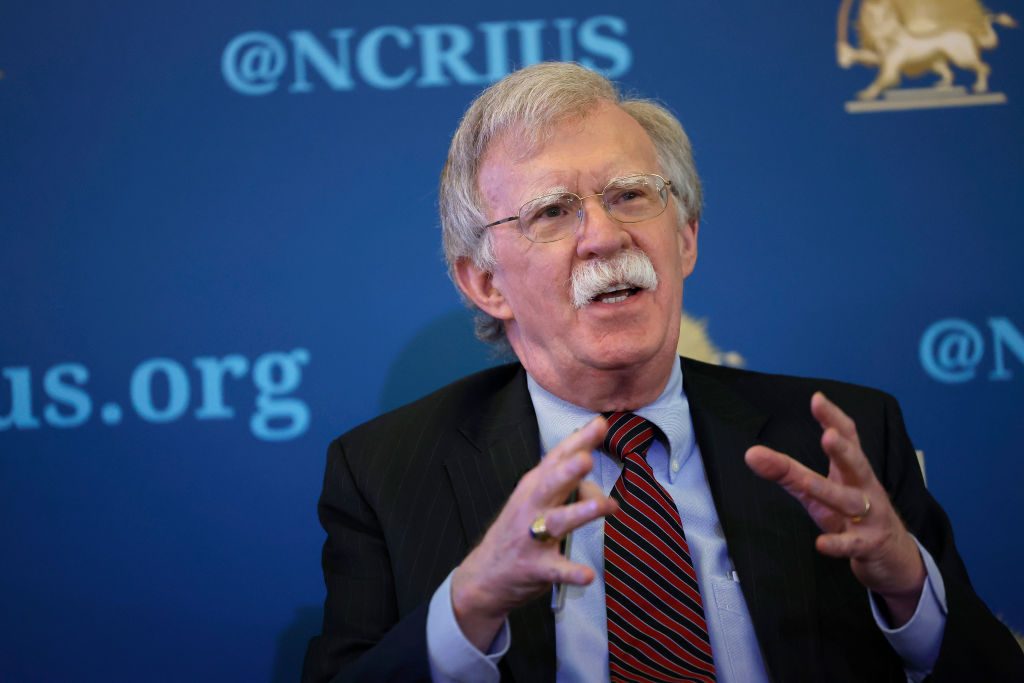
Trump's former advisor critiqued the President's diplomacy. Credit: Getty

Trump’s former advisor critiqued the President’s diplomacy. Credit: Getty

2 September 2025 - 10:45am

The Lansdowne Club, London

Nato members should have allowed the expedited accession of Ukraine to the alliance in 2008, according to former US national security advisor John Bolton.

Speaking at The Lansdowne Club in London for an event by the Eurosceptic think tank Bruges Group, the former Trump aide suggested that if France and Germany had accepted then-President George W. Bush’s attempt to speed up Ukraine and Georgia’s accession to Nato, Russia’s consequent invasions of both countries could have been avoided.

“Ukraine is critical for the security of Europe,” he said, “and I just regret that the French and the Germans in April 2008 at the Bucharest Summit blocked George W. Bush’s effort to get Ukraine and Georgia into Nato on an expedited basis.” He continued: “But you don’t get any laboratory experiments in international affairs and it only took until August of 2008 for Russia to invade Georgia.”

In 2008, France and Germany refused to let Ukraine and Georgia join Nato as they thought it would not bolster the alliance’s military strength and would simultaneously cross one of Moscow’s explicit red lines. In 2007, Vladimir Putin told the Munich Security Conference that the West had broken its promise made at the end of the Cold War not to expand Nato and had damaged trust in international law. While some member states refused Ukrainian and Georgian accession in 2008, Croatia and Albania joined in 2009.

Bolton said yesterday that “the only safe place in Europe is being a Nato member.” He added that “Finland and Sweden have proven this point by abandoning 75 years of neutrality” and joining the alliance in recognition of Russia’s threat. Finland joined in 2023 before Sweden the year after. “Nato is critical for all of us,” Bolton said.

The former US ambassador to the UN also spoke at length about the “danger” of the Sino-Russian axis of power. The Shanghai Cooperation Summit took place this week, with Xi Jinping, Vladimir Putin and India’s Narendra Modi holding trilateral talks and promising closer alignment. Bolton said this was a direct threat to the West. “Today, in China, you can see that Putin and Xi Jinping and, unfortunately, the Prime Minister Modi of India, whom President Trump has all but thrown back into the arms of the Russians and the Chinese, are talking closely, [in a meeting that] we’re excluded from.” At the summit, Putin reiterated Moscow’s official position that Western attempts to bring Ukraine into Nato were prolonging the war.

The former Trump advisor, who has since become one of the President’s strongest critics, said America’s tariff policy and “trade war with the rest of the world” is “probably the worst self-inflicted problem” in US history. He said this was not only provoking enemies of the US, but also isolating allies. Just last week, Bolton’s home was raided by the FBI as part of an investigation into classified documents. On his second day in office, Trump removed his former aide’s security detail.

Bolton seemed most exercised by what he views as Trump’s diplomatic ineptitude. “I don’t know what the administration in Washington is going to do next,” he said. “I think we’ve been through a series of delegations where we’ve watched Vladimir Putin essentially work his KGB magic [on Trump].”

“When the [US] President began in Alaska, he went to Anchorage, saying there would be severe sanctions against Russia,” Bolton continued. “There was no ceasefire, and he came out of the meeting saying, ‘You don’t need a ceasefire, and we’re not going to have any sanctions,’ which is where we are.”


Max Mitchell is UnHerd’s Assistant Editor, Newsroom.

MaxJMitchell1

China is threatening America in the AI race

Reports sugget Zhipu AI  has released a new model that can rival leading US systems. Credit: Getty

Reports sugget Zhipu AI has released a new model that can rival leading US systems. Credit: Getty

1 July 2026 - 10:18am

China is trying to catch up with America on artificial intelligence. The Wall Street Journal has reported that Zhipu AI — one of China’s six “AI tiger” LLMs — has released a new model that can rival leading US systems, including Anthropic’s Mythos, in cybersecurity tasks such as pinpointing security bugs. While this marks a milestone in China’s drive to catch up with Western AI capabilities, strong performance on a single benchmark does not mean it has taken the lead. Chinese models still lag behind their Western counterparts in broader capabilities, such as autonomous operation. Skepticism is therefore warranted before resorting to hysterical conclusions, but complacency about the geopolitical implications of China’s AI advances would be an even greater mistake.

On the infrastructure side, Chinese AI is still constrained by access to advanced chips, with American labs way ahead in computing capacity as well as investment. Analysis from earlier this year suggests that Chinese models are likely to be at least a few months behind those in the US. But they are still continuing to make progress, or that the geopolitical importance of AI will be decided only by whose LLM has ventured deeper into the technological frontier. The practical applications of AI, countries’ to capture foreign markets, and the application of AI into the real economy will matter just as much.

Here, China may hold an advantage. As with its dominance across many critical supply chains, Beijing may not need to produce the most advanced AI systems — only those that are affordable and widely deployable. In doing so, it could consolidate global influence by supplying functional, low-cost AI at scale.

Beijing seems to be pursuing exactly that path, developing an AI “open-source” strategy that offers affordable, widely available AI models for companies and individuals to use and modify as they wish. The production of the DeepSeek AI model, which matched the performance of Silicon Valley tools such as ChatGPT at a fraction of the cost for users, created goodwill among Chinese models with developers.

The four most popular models on OpenRouter, an AI hardware platform for developers, are now all Chinese. The goal for China is not only to win the frontier-model race, but to make its systems the default layer of AI adoption across industries and global markets. For most economies, the choice is increasingly between an affordable tool they can deploy now and a more robust one that may be out of reach.

And while the countries adopting Chinese models may be exposed to political pressure and cyber threats from Beijing, safer and more capable alternatives matter little if they are unaffordable. American AI companies are already under pressure to monetize products whose operating costs are rising. If Chinese open-source models become the cheap default for startups, universities, governments and businesses across the developing world, then America’s AI lead will be eroded from below.

Perhaps more concerning for America in the long run is how AI can give Chinese manufacturing even more strength, through the ongoing integration of AI as a general-purpose technology. China’s new Five-Year Plan mentioned AI more than 50 times and includes an “AI+” action plan aimed at spreading AI across the economy.

Beijing has been pioneering automation of its critical infrastructure for years, with promising recent results in increasing warplane production capacity. In that regard, China’s open-model strategy and manufacturing dominance will reinforce each other. Cheap, adaptable models accelerate deployment across the real economy while those deployments generate real-world data and use cases that can feed back into further model improvement.

The United States should not dismiss the importance of its lead in the AI race. That lead worries Beijing, not least because a more automated Chinese economy would also become more vulnerable to AI-generated cyber threats. But nor should Washington assume that China cannot catch up with American capabilities over time.

This AI competition represents part of a broader struggle over tech supply chains and geopolitical influence. Decisions over whether to adopt US or Chinese models could produce a more fragmented global reality, with different regions relying on different cloud providers, chips and security structures. The result will likely be a global economy which is divided into competing spheres, rather than one which produces a single winner.


Miquel Vila is a political and geopolitical risk consultant focusing on industrial strategy, critical infrastructure and global supply chains.

miquelvilam